
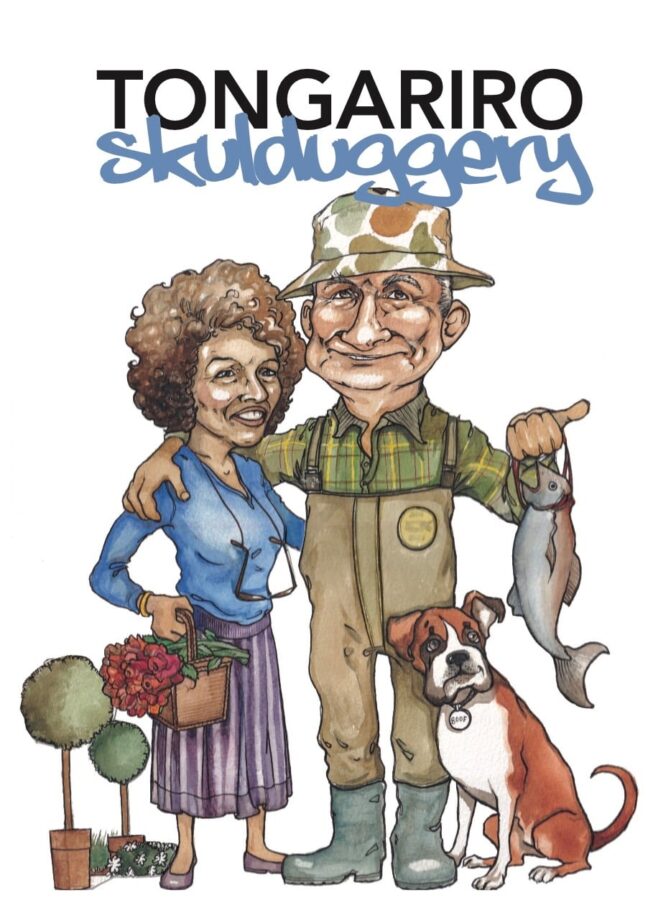
 For the best Father’s Day gift on Sunday, September 6:
Go to TRM’s blog: https://www.tongarirorivermotel.co.nz/fishing-for-the…/
SWMBO (She Who Must Be Obeyed is the Manager for all complaints at TRM) is still defending this issue, five years after the original publication. Who would have imagined it is still being argued? Will there be a sequel? Or a prequel? What was the real underlying message behind the plot?
The BIG question discussed in “Fishing for the Truth” confirms Māori are not indigenous to NZ?
Now about five years since the first publication, TRM still receives guests with probing questions about the “mockumentary” – TONGARIRO Skulduggery. TRM sold out five times and had to reorder to satisfy orders. The final print run is now available.
The following is repeated for the fisho who asked, how much is true and what is not? And how did Sir Bob Jones feature in the background story? etc.
For Father’s Day holiday reading to help explain where the inscrutable evidence came from… Yet that has not provided sufficient evidence for some so-called experts who still doubt and argue about it. Perhaps they are afraid it might affect some of their similarly questionable Treaty Claims?
So the “mockumentary” story must have pinched a few nerves to still be questioned five years later. As it is the biggest-selling book that has ever been written about Turangi, it should be on your Father’s Day list. It is now a collector’s item, only available at Tongariro River Motel reception.

Consider the evidence from the archaeologist employed by the Ministry of Works who investigated all excavations for the power project…
“In the 1960’s excavations deep in the tailrace, two bodies were found protected by upturned dugout canoes, cut in two halves, protecting the corpses… Fifty years ago Trevor Hosking believed the graves must have been for high-ranking priests.”
He also wrote about other archaeological digs in the Taupo region, where they discovered artefacts from earlier pre-Māori settlements, particularly in the caves under Whakamoenga Point and at Orakei Korako. Wherever there was a supply of hot artesian water, he reported they could excavate signs of earlier pre-Māori settlements. He called these original settlers the “Korako” people.
To determine the truth, two prominent Maori leaders considered the issue and are quoted in Tongariro Skulduggery, one current and one historical.

1
‘Maori Are Not Indigenous To Aotearoa” claims Ngapuhi Chief David Rankin
Interviewer: “You recently voiced support for historians who claim that New Zealand was settled much earlier than commonly accepted. Are you merely supporting free speech and political incorrectness, or do you genuinely believe that there were other civilisations here in NZ before the arrival of Kupe circa 1250AD?”
David Rankin: “Let me just start off and say this: Māori are not the indigenous people of Aotearoa New Zealand. There were many other races already living here long before Kupe arrived. I am his direct descendant, and I know from our oral history passed down 44 generations. I believe this needs to be investigated further because every Māori community talks about Waitaha, Turehu and Patupaiarehe. This goes hand in hand with the other research.
As Māori, we have come to a time of maturity where we need to debate these issues. I want to reach a genuine consensus on this issue, although I think academics want it to disappear. If we start talking about it and investigating it, it’s an exciting opportunity to explore.
My ancestors like Kupe came to the Hokianga in search of other people. In the Waima ranges, there was a pipi shelter on the mountains, and the kuia used to talk about the fair skinned people up there. Many people identify as Paniora (translated as Spaniard), suggesting that Portuguese and Spanish sailors washed up on ancient ships in Northland.
In 2002, I went to the Austronesian Leaders Conference in Taiwan and we discussed similarities with Taiwanese Aborigines. We traced our origins and the Maori and Polynesian connection to China. All the leaders, such as myself and Matiu Rei, Aborigines, Solomon islanders, Rapa Nui and Hawaiians, were all interested in early settlement theories.
There is a lot of writing about the whole ancestral link. Really, Māori didn’t navigate here; we came on a tidal drift. Te Tai Tokerau is actually the tidal drift from the Tokelau Islands. When my ancestors arrived at the shores of Aotearoa, there were people here to greet them. The question is: who are those people? It goes hand-in- hand with our oral history.”
There are questions written by Ian Wishart, Noel Hilliam and others that need to be answered.”
In TRM’s “mockumentary”, David Rankin was also quoted as follows: “The Waitangi Tribunal has not really worked for Māori as it has made a handful very, very wealthy and not benefited the iwi overall. The gravy train has to stop… Let’s be clear. The Tribunal exists to make lawyers and a few elite Maori very rich. It has divided and destroyed many of our communities. The sooner it is shut down, the better.”
Wow!
2

In chapter 3 on DNA, page 27, the Mockumentary book quotes an excerpt written by Sir John Te Herekiekie Grace in his 1959 History of Tuwharetoa – the tribe that occupied the Taupo region.

Sir John Te Herekiekie Grace (Ngāti Tuwharetoa, 1905-1985) was one of many Māori leaders who emerged in the post-second world war 1950s era; he was an interpreter, community leader and high commissioner. Grace’s prominence increased in the 1960s in his many appointments including to the New Zealand Geographic Board, the National Historical Places Trust, the Māori Education Foundation and the Māori Purposes Fund Board. He worked for 15 years on researching the book Tuwharetoa: A History of the Māori People of the Taupo District, which explores the origins of the Ngāti Tuwharetoa iwi and covers the origins of the tribe from Hawai’i through to the mid-twentieth century. Grace’s extensive research and publication was, and still is, recognised as a tribal classic.

He wrote:
“Tuwharetoa was a tribe that originally settled on the Bay of Plenty coast and during the 16th century found its way into Taupo. It found these tribes in occupation of the district, but by gradual absorption, diplomatic alliances and aggressive warfare, finally took complete possession of the land. The original occupants of the land were a tribe of fair-skinned flaxen-haired people called Ngati Hotu. They lived by the lake in company with another fair-skinned tribe, Ngati Ruakopiri. (The third tribe was Ngati Kurapoto.)”.
3

As the “Mockumentary” was aimed at anglers, they might be more persuaded by another quote from a famous 1972 fishing book – KAKAHI by Peter McIntyre, in Chapter 15 on page 108. He writes:
“The original people living in Kakahi were the Ngati-Hotu, a tribe of the Tangata Whenua, who had been discovered by the Arawas living around Taupo and Roto-Aira… It has been claimed that the Ngati-Hotu were pre-historic or pre-Maori people. Maori tradition says they were fair-skinned with reddish-golden hair. In describing them the great Maori chief Te Heu Heu Tukino used the words Kiriwhero, meaning reddish skin, and Urukehu, meaning reddish golden hair.”
4

Next, probably the most publicised claim to recover pre-Maori tribal land, was by Monica Matumua from Taumaranui, who argued her family history, her “whakapapa”, with the Treaty of Waitangi land claims department. She believes her tribe, Ngati Hotu, descended from the Patupaiarehe people who were referred to as fair-skinned fairy people of the King Country. She claimed there were only two people in her tribe that could still speak their language. It was nothing like Maori. Her tribe was originally discovered by a party of Wanganui Maori exploring upriver. They called for reinforcements to attack the settlement. There were many battles around 1450. These battles are also confirmed in other sources such as Peter McIntyre’s book Kakahi. Mangakeke Pa, 10 km from Taumaranui, had long been occupied by Ngati Hotu chief, Kakahi, before his people were driven away. Monica and her family also provide live evidence on youtube videos about the pre-Maori era – Skeletons in the Cupboard – Episode 1 – The Redheads.
We accept that fishermen are renowned for tall stories about the one that got away. But considering all that information from different sources confirming the Ngati Hotu’s existence, it could not be ignored. TRM’s Mockumentary is an entertaining, interwoven tapestry of historical fact and fiction. It deliberately includes other similar contentious factual material as well to support the controversial fictitious plot. The more controversial story provides the base for a more interesting plot. We hope the above references should be sufficient evidence to convince any doubtful readers…
Tongariro Skulduggery?
While TRM inmates anxiously await the launch of the new book, Tongariro Skulduggery, SWMBO (She Who Must Be Obeyed, who manages everything at TRM, must have an extraordinary imagination) has been questioned about a character in the book referred to as the “White Mouse” of Turangi.
SWMBO describes the intriguing plot as a “mockumentary”. She claims that was Her deliberate ploy to satirize a story based on the republic of Turangi, mocking everything in a documentary style. She promises you will love it! The plot develops twists and turns following the discovery of an ancient skull on the Tongariro River. This eventually results in a spy being appointed, known as the white mouse of Turangi, for sneaking confidential information back and forth to add more drama.
Another famous spy also features – one of international notoriety was exposed but indemnified from prosecution because of his close connections with the Royals. Quite extraordinary stuff!
SWMBO must have mentioned TONGARIRO Skulduggery, as somehow it leaked out in the Turangi Tavern where they have all been guessing who the “white mouse” might be? TRM staff have already been questioned and may need protection. It could be any of those in the images, but the “white mouse” in this tale is a fictitious hero who some already imagine they recognise. But there are other famous people involved too.
Another hero, who negotiates the biggest financial deal in Turangi’s history, is a well-known prominent person. The nature and extent of her preposterous deal with Government is quite mind-boggling. You might recognise her, or one of the other fishy inmates hiding in the images featured in the epic story.
So where did the tag – “White Mouse” – arise from?
Nancy Grace Augusta Wake (30 August 1912 – 7 August 2011) known as the “White Mouse”, worked as a spy for the British in World War II. At one time she was on the top of the Gestapo‘s most-wanted list.
Wake was born in Wellington, New Zealand in 1911. She ran away from home at the age of 16, and in 1935 went to London. She learned to be a journalist and worked in Paris. She married a rich factory owner, Henry Fioca in 1939. When the war started she became an ambulance driver. She soon became a part of a group led by Pat O’Leary (real name Albert Guérisse) which helped British soldiers escape from France. The Gestapo soon noticed her activities and she fled to Spain.
In England she joined the Special Operation Executive (SOE). In April 1944, Wake was parachuted into France to work with the French Resistance before the D-Day landings. She was involved in several major battles with the German army. She is known to have killed an SS soldier with her bare hands.
Turangi’s “white mouse” shows similar exceptional bravery in such strange circumstances. But we cannot tell too much – if you want to know more, you to buy the book. All profits from sales of “Tongariro Skulduggery” are to be directed for protection and conservation of some of the local neglected trout rivers.


