
New water battle looming in Hawke’s Bay in wake of the failed Ruataniwha Dam plan

Hawke’s Bay orchardists Jerf Van Beek and Brian McClay put up signs ahead of rally opposing an application for a Water Conservation Order on the Ngaruroro River.
Opponents to an application for a Water Conservation Order on the catchment are organising a protest rally featuring tractors and heavy machinery on September 19 – just days after a government-appointed Special Tribunal is in Napier for a pre-hearing conference.
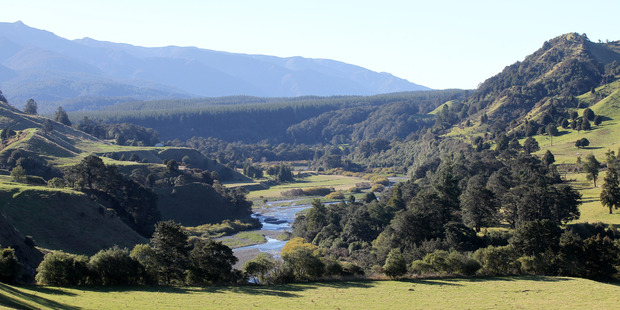
The Ngaruroro is the region’s second largest river, with a catchment covering about 2000square kilometres. It has sources in the Kaimanawa, Kaweka and northern Ruahine Ranges and flows in south-easterly direction before entering the Pacific Ocean between Napier and Hastings.

In December 2015 five parties applied for a water conservation order for the Ngaruroro and the smaller Clive rivers; Fish and Game, Forest and Bird, Ngāti Hori ki Kohupatiki, Whitewater New Zealand and Jet Boating New Zealand.

The lower Ngaruroro River, between Napier and Hastings.
They say the rivers have outstanding values and they want protection of the entire length of both rivers and their tributaries and the groundwater that is hydraulically connected to the Lower Ngaruroro River.
The 7km long Clive River is included because it is the old mouth of the Ngaruroro.
There are about 85 water take consents in the lower Ngaruroro catchment, with a report in 2010 finding it was over-allocated. Most of the water is used on pastoral and orchard land.

Federated Farmers president Katie Milne and other farming leaders met on the Ngaruroro River last month and pledged to make all New Zealand rivers swimmable.
The applicants said the Upper and Lower Ngaruroro and the Clive River had outstanding amenity values and should be protected.
“The Ngaruroro catchment provides outstanding native fish habitat on the basis of its physical characteristics, high water quality, and the fact it supports a significant diversity of species, many of which are classified as threatened,” their application stated.
They said the order seeks to preserve the Upper Ngaruroro Waters in their near natural state and “existing land uses and levels of land use can continue, but this application (if successful) would place restrictions on any additional water takes or discharges (point or non-point), and dams”.
On the Lower Ngaruroro the order, if successful, would introduce water quality limits, a restriction on physical modification of the braided reach, prevent damming, retain the current flow allocation regime for existing users, but place restrictions on new activities.
The applicants say the lower river has good water quality despite a relatively high level of land use and intensification. They say the water quality limits they propose would allow existing discharges and land use to continue, unless the water quality continues to degrade, as it is presently.
But the orchardists aren’t buying that and are gearing up to fight the application.
Orchardist Jerf Van Beek, who is also Horticulture NZ’s seasonal labour coordinator, said the order would have a huge impact on urban and rural communities and the region was able to look after the river through the TANK process, which was a group of 35 individuals from various sectors including environmental and tangata whenua that works with the Hawke’s Bay Regional Council to review land and water management in the napier and Hastings areas.
“The WCO will be detrimental to our economy and hundreds of jobs will be lost. We think we can achieve the environmental balance with the processes we have in place,” Van Beek said.
Regional council chairman Rex Graham, also an orchardist, said he was “disappointed that outsiders have interfered” with the TANK process, which had been underway for four years.
“We have been working to achieve a balance between farming and the environment. But the WCO will decimate horticulture on the Heretaunga Plains. If the WCO goes ahead it will be the death of business in the region. Let’s not under estimate this – we will be fighting it to the end,” Graham said.
He said under the order there would be an average of 27 irrigation ban days and in a dry year there could be up to 90 irrigation ban days.
“That lack of confidence in water being available when needed will see growers deciding not to plant crops, and processors being unable to secure supply to keep factories running,” he said.
The orchardists say the rally on the 19th would involve tractors and heavy machinery and would travel from Hastings to Clive.
Submissions on the application closed on the 24th of August.
A pre-hearing conference is being held in Napier next Friday. It will be held by the Special Tribunal formed to hear the application. Its members are Richard Fowler, QC (Chair), Alec Neill, Dr Ngaire Phillips, Dr Roger Maaka and John McCliskie.
Council moves on from the Ruataniwha Water Storage Scheme
Hawke’s Bay Regional Council voted at its full meeting last month to “move on” from the Ruataniwha Water Storage Scheme after five years of controversy.
The $330 million irrigation project would have been the largest in the country, building a 7km long dam to provide a secure water supply, particularly for landowners on the drought-prone Ruataniwha Plains.
The regional council had pledged to invest $80 million of ratepayers money, subject to certain conditions being met. But after years of debate about the environmental impact of the dam and its financial viability – and a Supreme Court decision in July which ruled a land swap deal needed for the project to go ahead was unlawful – the council officially withdrew its financial support for the project at the meeting.
Supporters have suggested the dam could be revisited down the track, though perhaps not by the council, but environmentalists have vowed to fight any future attempt to revive the large-scale water storage project.
During the meeting, council chief executive James Palmer said there were “significant impediments” to the scheme going forward.
The council agreed to follow advice to write off the $14 million spent to date by council’s investment company, HBRIC Ltd. It also decided not to invest any more capital in the scheme and said the remaining $66m earmarked for the project would no longer be ring-fenced
Mr Palmer told councillors the move signalled the end of the road, in terms of the council’s financial support for the scheme.
Central Hawke’s Bay councillor Debbie Hewitt said it was a sad day, noting without the RWSS there would be many losses from its promised environmental benefits, to a loss of production in Hawke’s Bay’s primary and horticulture sectors.
“We’ve lost employment opportunities that the region is desperately screaming out for. We’ve lost the opportunity to have containers going through the port in increasing volumes.”
She was optimistic the project would still go ahead in some form, “and it’s going to be probably far better off without council being a cornerstone investor, in terms of getting on and the project being a success”.
The scheme could proceed if a private investor aligned with HBRIC. Council authorised the company to sell any intellectual property developed to date in connection with the scheme.
The decision did not come as a surprise. The tide had been turning against the scheme for some time, with the majority of those now around the council table seemingly elected with an anti-dam mandate.
After the meeting council chairman Rex Graham said it was a “hollow victory”.
“I thought it was a really poor use of ratepayers’ money,” he said. “[But] I very much sympathise with the farmers.”
For farmers, the council’s “gut-wrenching” move raised questions about water security.
“In one sense it’s a positive to have a definite decision so farmers know where they stand,” Federated Farmers’ Hawke’s Bay provincial president Will Foley said. “I’d like to think it’s over in terms of the council’s running of it, but hopefully not over for the dam itself.”
Farmers would be looking for other water supply options.
Mr Graham said council would need to re-examine, or revisit the plan. He was not sure what support the council could offer those required to meet Plan Change 6 requirements.
Greenpeace said yesterday’s move was a “real victory for our rivers”.
Agriculture campaigner Genevieve Toop said if there was any move to revive the dam in future, “we would be right back in there trying to stop it”.
“There is no way that dam can ever be good for the environment. It will always mean more dairying and that will always mean more polluted rivers. We will always be opposed to it.”
– CHB Mail
Disappointment at Hawke’s Bay Regional Council opposition to Ngaruroro River Water Conservation Order

Fish & Game is disappointed the Hawke’s Bay Regional Council is opposing a Water Conservation Order to protect the Ngaruroro and Clive Rivers.
A group, including Fish & Game, Ngati Hori ki Kohupatiki, Forest & Bird, Whitewater NZ and Jet Boating NZ, has jointly applied for the Water Conservation Order.
A Special Tribunal is now considering the application and public submissions close this afternoon. (eds – 4pm Thursday 24.8.17)
The Hawke’s Bay Regional Council voted on Tuesday to oppose the Water Conservation Order and says it will be making a submission against it.
Fish & Game Communications Manager Don Rood says the council decision is disappointing.
“It is incredibly disappointing an elected body like the Hawke’s Bay Regional Council would fail to see the merit in protecting a great river like the Ngaruroro, especially when the Water Conservation Order is backed by local iwi, recreation and environmental organisations.
“It needs to heed the mood of New Zealanders who are increasingly upset at how their waterways are being drained, polluted and abused.
“Hawke’s Bay residents are no different in their desire for swimmable rivers and the council should note that,” Don Rood says.
“Fish & Game is pleased the Independent Special Tribunal appointed by the Minister for the Environment is now underway so the evidence and arguments can be properly tested.”
If approved as the applicants are asking, the WCO would cover the entire Ngaruroro River, including its tributaries and connected groundwater, and seven kilometres of the Clive River and its connected groundwater.
Don Rood says the council’s decision to fight the WCO is all the more baffling because only last week, it put a freeze on new water consents for the Heretaunga Plains saying current takes are at the limit of what is environmentally acceptable.
“Only a few days ago, the council’s own chair was quoted as saying it’s clear that at the height of summer, more water is being taken from the Heretaunga aquifer than its streams and rivers can cope with.
“The Council can’t have it both ways. If it says the present situation is environmentally unacceptable, then it needs to bite the bullet and provide the strong leadership necessary to ensure the environment and community are protected,” he says.
A Water Conservation Order protects rivers or other water bodies that are nationally outstanding – similar to National Parks. If the Ngaruroro application is approved, it will be only the 16th for the whole of New Zealand.
The deadline for public submissions is 4pm tomorrow, Thursday 24 August.
Once the submissions are considered, the Special Tribunal will hold a hearing and write a report, including a recommendation on whether to grant the Water Conservation Order, and if so, on what terms.
The final decision will be made by the Minister for the Environment.
Anyone wanting to make a submission can do so on the Environmental Protection Authority website www.epa.govt.nz/ngaruroro
Meanwhile…
Government’s new irrigation focus ‘a cynical smokescreen’
Fish & Game is dismissing as “cynical” and “a smokescreen” the government’s claim it is giving the crown’s irrigation company a new environmental focus.
The Primary Industries Minister Nathan Guy has just announced Cabinet has approved changing Crown Irrigation’s constitution – so it can fund water storage projects with direct environmental and economic benefits rather than just economic benefits alone.
Crown Irrigation was established in 2013 to invest and advise on irrigation schemes and Mr Guy claims the move to expand its focus is good news for the environment.
But Fish & Game says the move is cynical and will provide no environmental benefit.
“This is just a smokescreen for the government to continue its policy of intensifying agriculture at the expense of the environment while appearing to be listening to the growing public anger over the state of our waterways,” Fish & Game’s Chief Executive Bryce Johnson says.
“Despite what the minister is claiming, irrigation and dams aren’t good for our rivers, lakes and streams.
“Creating more and more water storage projects will only exacerbate our water quality problems by encouraging more and more intensive agriculture,” Mr Johnson says.
“This is a path to further environmental degradation and we need to stop trying to put intensive farming operations like dairying in inappropriate regions with naturally leaky soils and vulnerable waterways.
“The government has plenty of reports, including from its own advisors like the Parliamentary Commissioner For The Environment and the Prime Minister’s Chief Science Advisor, that this sort of development is not good for the environment.
“To claim otherwise is just plain wrong and it is time the government heeded its own advisors,” says Bryce Johnson.
Fish & Game says the government’s apparent change in direction is just semantics and indicates it realises it is exposed by its claims that irrigation schemes and dams provide significant economic benefits.
“The reality is that dams provide very expensive water and farmers are reluctant to commit to buying water from schemes like the one proposed for Wairarapa,” Bryce Johnson says.
“That understandable reluctance by farmers is why the government is using taxpayers’ money to subsidise these otherwise economically unfeasible schemes.
“The government’s latest announcement is desperate stuff and shows it is scrambling to prove its damming and irrigation policies are economically sound when in reality they are being debunked economically and environmentally,” Mr Johnson says.
Mr Johnson says with an election only weeks away, the present government would be better to listen more carefully to the public anger over water quality.
“The public have had enough. They are tired of having their waterways damned, diverted and dirtied and the present government’s failure to listen is frustrating voters even further.
“Surely the government needs to listen to the obvious public mood and come up with a coherent and acceptable water quality policy which heals the damage already done,” Bryce Johnson says.