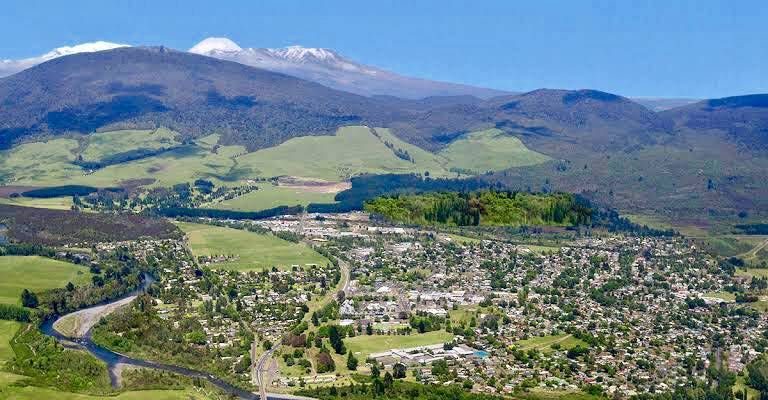
This article was published today in Tourism Ticker. It is also on Tongariro Junction Face Book page.
Perspectives: Small towns must be part of NZs tourism narrative
21st April 2026
Small tourism towns drive year-round visitor spend and economic activity, yet remain under-recognised and underinvested in national planning, writes Tongariro Junction Accommodation director Lewis Dawson.
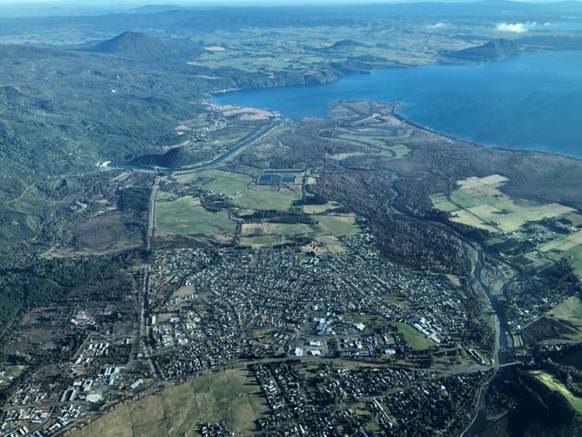
Sitting beside Tongariro National Park, the Tongariro River, and Lake Taupō, Tūrangi continues to welcome visitors from around New Zealand and the world.
New Zealand’s tourism story is often told through major centres, headline attractions, and a small number of flagship destinations. Many tourism-led smaller towns are already delivering strong year-round visitor returns, even though town centre investment has not matched the tourism value already being created.
Tūrangi is one of those places. Sitting beside Tongariro National Park, the Tongariro River, and Lake Taupō, it continues to welcome visitors from around New Zealand and the world.
For central and local government, the point is clear: these towns are already highly successful despite receiving comparatively little reinvestment into the everyday streets, buildings, and public spaces that both visitors and locals rely on.
That popularity is visible in the accommodation data itself. At our own property recently, guests from 17 different countries stayed in a single day. They were all free, independent travellers who had booked from their own homes, independently of one another, either directly or through online platforms.
This is a central part of New Zealand’s tourism story. It shows that places with strong visitor economies are already carrying a meaningful share of the visitor economy and, in places like Tūrangi, punching well above their weight.
What makes this especially important is that in towns built around hosting, the visitor economy is inseparable from everyday life. It supports local jobs and businesses year-round and helps put food on the table well beyond peak seasons. The same assets that serve visitors are also the everyday assets locals rely on, such as the town centre, local retail, public spaces, libraries, cafés, bookshops, and the everyday life of living in a small town.
This is why small towns must be part of the national tourism narrative. They are still often framed as the communities between headline destinations. In reality, they are the places that hold visitors, extend stays, turn passing visitors into local spend, and turn travel into memory.
In Tūrangi, this continuity is strengthened by local stories and books, but the same pattern is visible in many smaller visitor towns. A bookshop is not separate from tourism. It is part of the town’s soft infrastructure, where maps, local writing, gifts, and ideas help travellers understand where they are. In that sense, authors and booksellers help carry small towns into the world in ways that traditional promotion often cannot.
Government investment into major events rightly recognises the economic value of attracting visitors through concerts, conferences, and one-off experiences. But in many visitor-economy towns, commercial accommodation is already delivering the bed-night equivalent of several major events, spread right across the year rather than concentrated in isolated event spikes.
This creates a more widely distributed local economic benefit, with occupancy, retail spend, and town centre activity experienced continuously rather than concentrated into short event-driven surges.
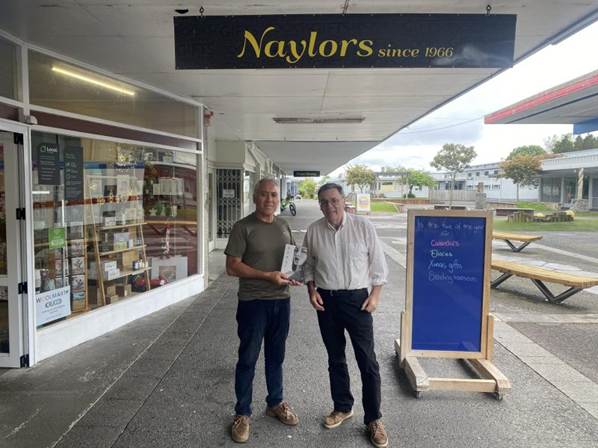
Award-winning author Dr Monty Soutar and Lewis Dawson at Naylors store in Tūrangi, where a bookshop is not separate from tourism it is part of the towns soft infrastructure.
In these economies, new money enters the town daily through visitor activity already embedded in everyday life. Rather than a closed circular flow of the same local spending recirculating, this creates a daily external injection of income into the town as a whole. This is the kind of net new inflow that strengthens the wider town economy over time. In many places, this is further strengthened by holiday homeowners and regular weekend residents who bring income from outside the city into the town week after week, well beyond traditional holiday peaks.
To identify future demand, forward accommodation bookings provide real-time commercial intelligence. Much tourism research is retrospective, whereas event models often rely on projected bed nights to account for one-off spikes. By contrast, shared accommodation booking visibility allows cafés, retailers, and other local service businesses to plan staffing, stock, and services against known future demand.
In this way, commercial accommodation often serves as a coordinating hub for the wider service economy. If a local takeaway knows well in advance that a school group or large visitor booking is arriving, it has time to bring in stock, roster casual staff, and prepare properly. That allows the wider town economy to meet visitor demand with confidence rather than scrambling after it.
At its best, this means independent local businesses begin to function like multiple departments within a larger tourism enterprise, operating efficiently and gearing up in advance to help maintain a strong visitor experience. They are coordinated through local communication and shared demand awareness rather than a single corporate structure.
In towns with strong tourism foundations built over decades of hosting, the synergy between local businesses is already well understood. This is not a survival economy. It is a well-oiled local system, where accommodation, cafés, retail, and services work together in ways that industry leaders would benefit from studying as a model.
A strong, beautiful town centre creates the opportunity to capture even more of this new money locally. The more enjoyable, walkable, and visually appealing these places become, the more likely both visitors and regular weekend residents are to spend in town rather than bringing discretionary purchases with them from larger centres or passing through without stopping.
Investment in these everyday town assets delivers immediate returns to workers, businesses, and families. It also creates long-term tourism value through stronger streetscapes, local pride, and places people want to photograph, share, and return to. When streets, buildings, and public spaces are treated as part of the visitor experience, they help build safer, more confident communities and reduce the neglect that can allow decline and crime to take hold.
There can also be a perception gap. A run-down civic presentation can create a negative perception among tourists, even when actual visitor demand remains strong. In practice, domestic and international visitors often judge these places by the experiences they offer rather than by others’ assumptions about them.
There is also a statistical blind spot. The success of these economies can be obscured within broader regional destination data, making it difficult for decision-makers working from desktop statistics alone to see the true scale of local visitor activity. This can be reinforced by census timing itself. Because census counts are taken on a weekday night, they can understate the practical size and demographic mix of towns with large holiday-homeowner and regular-weekend-resident populations.
This helps explain why underinvestment can persist: central government, local councils, and prospective private investors may rely on macroeconomic data that understates the true scale and demographic profile of these towns. Where ground-level demand is not separately measured, small towns with significant tourism economies can remain under-recognised despite carrying substantial evening, weekend, and holiday visitor loads.
The opportunity is to build on proven success, improve returns on existing tourism assets, and deepen the everyday life and economic confidence already present in these communities. Smaller communities already delivering these returns deserve their place in the national tourism narrative. They are already among its quiet leaders, and even modest reinvestment in these communities can compound those returns further.