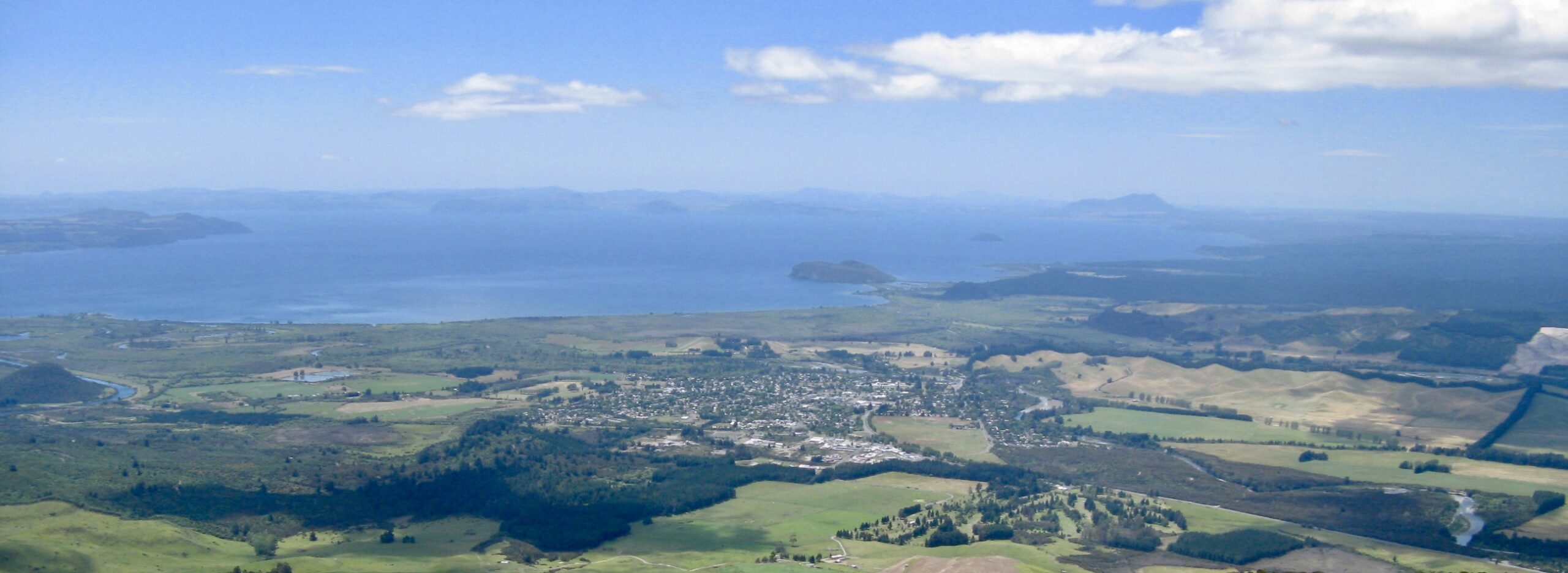
ANZAC weekend reading – casting for daisies.
This is in reply to a recent TRM blog which mentioned the sad loss of “de Lautour’s” Pool. After being asked who/where/what etc. some of his background is described in the following article. But there were also far more interesting historic Tongariro River memories which deserve to be included, so you will enjoy the Daisies story too.
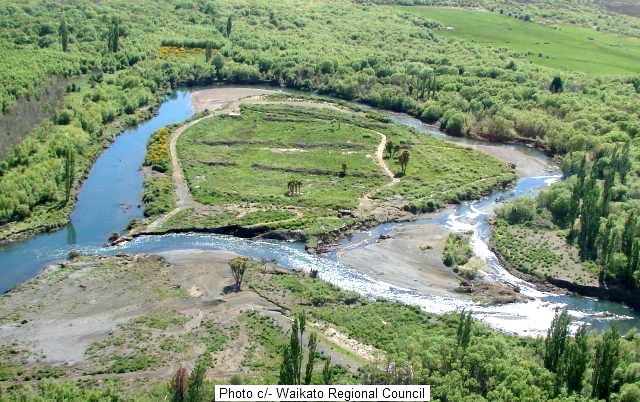
In 2013 the Tongariro River broke through below The Bends, isolating de Latours Pool, and changed the lower river fishing pools for ever.
In “Pools of the Tongariro” by Allan & Barbara Cooper,1975 publication, they described there was some divergence of opinion on the identity of de Latour.
It seems most likely that he was an overseas visitor who, according to Joe Frost, stayed at the Delta Camp and made his way upstream to fish this pool.
He is mentioned in a letter from J. C. Buckingham of NZ Fishing and Shooting Gazette, January 1928, “My other friends there in the early days were de Latour, an observant naturalist.”
Other opinions suggest that de Latour was a member of a family in Hawke’s Bay who lived in Taupo for a number of years.
But the most recent information we found was taken from the following NZ Geographic magazine article dated April 2000, by Derek Grzelewski.
“Ever since the American writer Zane Grey fished these waters in the 1920s and declared New Zealand to be the “angler’s Eldorado,” fly-fishing enthusiasts have beaten a path to our river-banks and lake shores to test their skills against the trout’s cunning. In central North Island rivers such as the renowned Tongariro River rainbow trout predominate: hard-fighting, fine-tasting fish whose speckled flanks and blush of pink make them an alluring as well as a challenging quarry.
…. If anywhere can claim to be trophy territory, it is Taupo. The lake that gives its name to the region and town is the largest lake in Australasia. It is the size of Singapore and contains 60 cubic kilometres of water—enough to cover the land area of the North Island to a depth of half a metre. The lake is the caldera of an ancient volcano which last erupted in 186 A.D. This blow-out is considered to be the most violent in Earth’s recent history, but it was only a fraction of the magnitude of many previous Taupo eruptions. One in 20,000 B.C. covered the Chatham Islands, more than 800 km away, with a layer of ash 12 cm thick. Another produced enough pumice to fill the present lake twice.
Over the millennia, as the volcano has intermittently blown, gargled, hawked and spat, its caldera has slowly filled with water, eventually becoming one of the world’s most famous fishbowls.
Although both brown and rainbow trout are to be found in Lake Taupo, it is the feisty rainbows that have given the lake its international reputation. Their progenitors were first released into a tributary of the Tongariro River in 1898. Within four years, rainbow trout weighing 3.5-4 kg were being caught in the Waikato River, which flows out of Lake Taupo, and in the lake itself a 10 kg fish was caught five years after the first releases. In one season, 56,000 fish, totalling 112 tonnes, were taken from the lake and its associated rivers. Trout were so plentiful that they were given to local farmers as pig food.
Then, in 1912, the size and the quality of the fish rapidly deteriorated. It was a textbook case of an introduced predator—trout—upsetting the balance of an existing ecosystem, in this case, decimating the resident population of koaro, a native galaxiid fish. To remedy the situation, gamekeepers embarked on a massive netting operation to reduce the trout population. The solution worked for a while, but by the early 1930s, there were again too many trout and not enough food. This time the wardens employed a different strategy: rather than culling the predator they bolstered the prey. Common smelt, a small silvery fish, were introduced. They spread like locusts and have thrived in Lake Taupo ever since. The trout population bounced back with vigour.
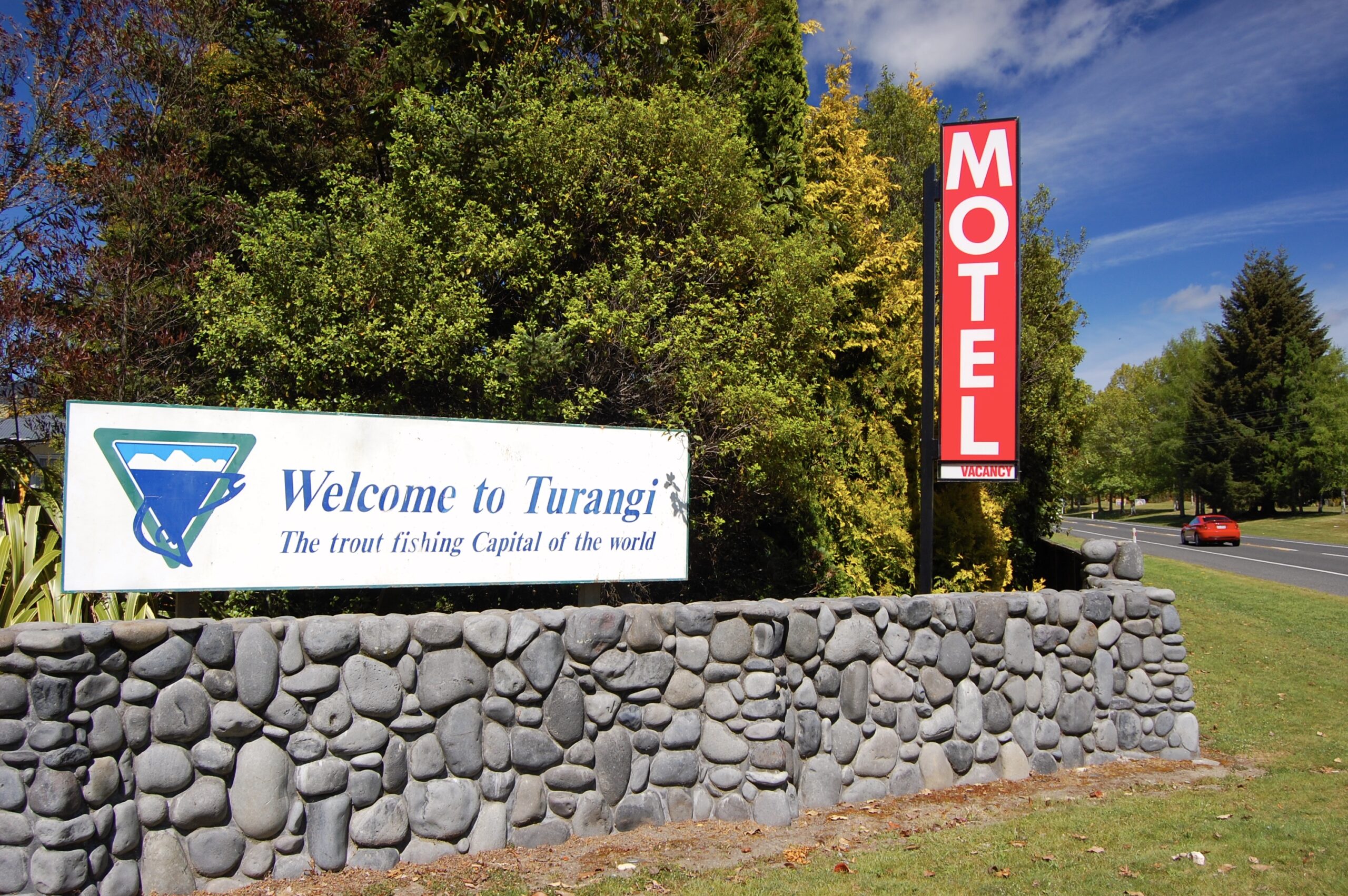
Those early years of the Taupo fishery were a time of great secrecy among anglers. One Taupo saga tells of an Irishman named de Lautour, who was the first to fish the Waitahanui River—today one of the country’s premier trout venues. The reclusive de Lautour lived in a reed but on a Maori burial ground, for which he paid rent of two bags of flour a year. He tied his flies on the riverbank, never keeping spares in case someone should find them. For seven years he lived there on trout and the vegetables he grew, until the idyll came to an abrupt end when he poisoned a litter of his landlord’s pigs, which kept rooting in his garden, and was banished from the area. But by then the secret was already out, and someone else was about to trumpet it to the world.
That person was Zane Grey, writer of Westerns and catcher of fish. In 1926, the New Zealand government invited him to fish here in the hope that he would promote the country as a fishing destination.
As a tourism promotion, it was wildly successful. Grey and his entourage fished for marlin in the Bay of Islands and for trout in Taupo. And although, as his biographer, Robert Davis, points out, “If Zane went out with a mosquito net to catch minnows, he could make it sound like a Roman gladiator setting forth to slay whales in the Tiber,” Grey’s antipodean adventures needed no literary embellishment. The resultant books, Tales of the Angler’s Eldorado: New Zealand and Tales from a Fisherman’s Log, became instant classics. The title of the former created an image that stuck, and Grey’s prose gave New Zealand an angling reputation that has not faded since.
But Grey’s enthusiasm went further than it was welcomed. He was so thrilled by the quality of fishing in Taupo that he wanted to buy the entire Tongariro River.
Fortunately for other anglers, Grey’s dream of owning one of the best trout rivers in the world did not eventuate. In 1926, the year Tales of the Angler’s Eldorado was published, the government passed laws to ensure Lake Taupo and its tributary rivers remained in public ownership.
Grey returned to the Rogue River in Oregon, where he wrote his cowboy romances and fished for steelheads (sea-run rainbow trout). On his front porch, he installed a gamefishing chair rigged up with a system of pulleys and weights like a gym machine, but with a rod instead of a bench press. In this chair he worked out, preparing for his expeditions, and it was here, just before the outbreak of World War II, that he died of heart failure at the age of 68, pumping iron the angler’s way.
The river of Grey’s dreams rises from the snows of Ruapehu as the upper Waikato, and is named Tongariro only after it joins with Waihohonu Stream, 35 km from its four-armed delta on the shores of Lake Taupo. No other stretch of water in the country, with the possible exception of the neighbouring Waitahanui and Tauranga-Taupo Rivers, is so steeped in angling history and tradition. Every pool has a name and a story … and at least half a dozen anglers.
For many of them, fishing the Tongariro is a pinnacle in a lifetime of angling. When standing shoulder to shoulder with such devoted fishers, it pays to have a reasonable command of casting—if for no other reason than to reduce the chance of hooking your neighbour’s ear with a wayward fly.
The perfect cast is accurate and effortless, and delivers the lure to the quarry without arousing its suspicion. It looks simple but is, in fact, bafflingly complex. The soaring arc of the line can be likened to an angler’s aerial signature—an illegible scribble in the case of the beginner, calligraphy in motion when performed by the expert.

When I first visited Taupo, I had barely learnt the letters of the angling alphabet. As luck would have it, I found myself in a master caster class with Carol Harwood, a sprightly woman in her 60s who, when I met her, was nursing a sprained elbow from tussling with a 10 kg salmon in Alaska.
She learned to fish the hard way, she told me, by watching and emulating her 69-year-old husband, Frank, a Yorkshire-born Taupo fly-fishing guide. He had been a merciless teacher, Carol recalled, citing the example of a fly-tying session. To make a fly you place the business end of a hook in a miniature vice and wrap bits of feathers, fur or chenille around the shank, tying them down with multiple wraps of fine thread. If her fly were anything but perfect, Frank would shave it off the shank with a razor blade and make her start again.
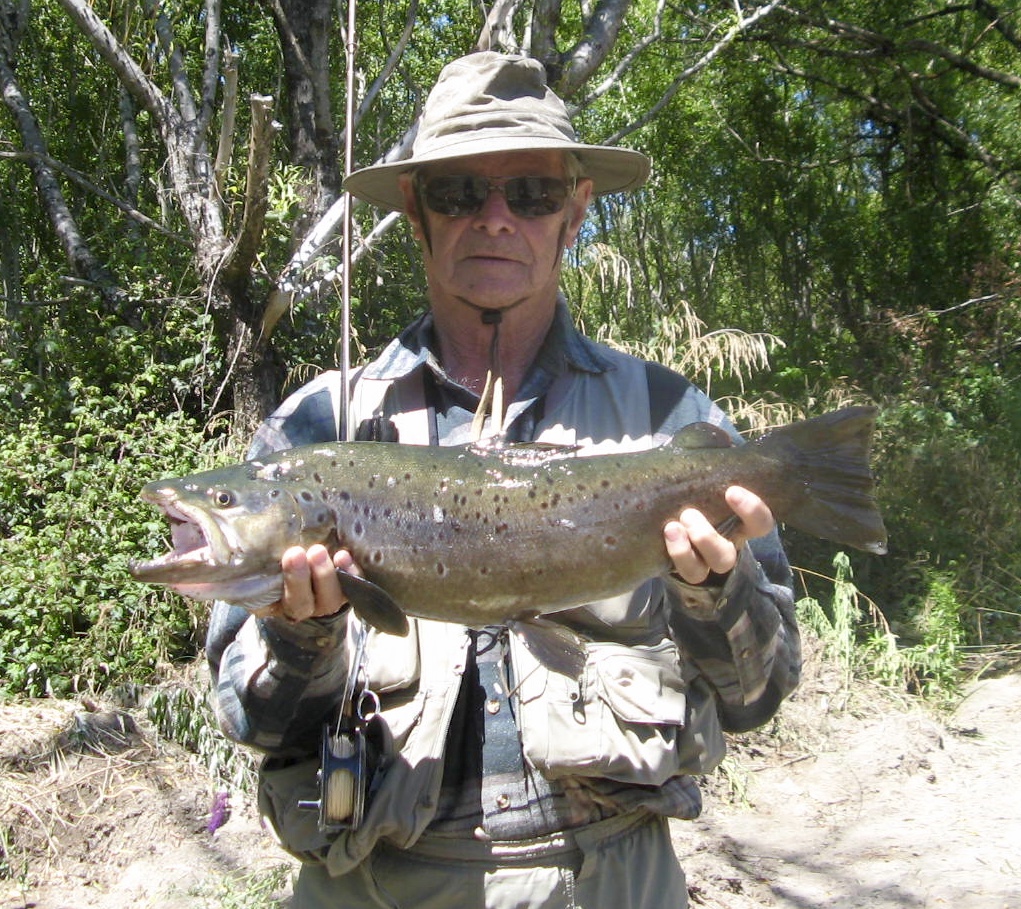
Frank Harwood returning from de Latours Pool January 2014.
Thanks to her aptitude with needlework, Carol gave him few opportunities to wield the blade, but still, for the first year of her tough apprenticeship she just stood behind her husband in the river, looking over his shoulder and listening. That was 16 years ago. Now this “five-foot-nothing old girl,” as she describes herself, has been admitted into the ranks of the New Zealand Professional Fishing Guides Association, one of only two female guides in what remains a male-dominated sport.
On her Turangi lawn, Carol took me through one of Frank’s diabolical exercises. The daisies were out in force, and she pointed out a clump of three about 10 m away. With a quick backcast she had the line in the air. She paused momentarily to let it straighten behind her back, then her forearm came down like a hammer, her thumb on the rod’s cork handle, sighting one of the flowers. The line shot forward like a whip, its tip patted the daisy’s head and left it quivering. One! A backcast, another daisy. Two! Another backcast and a miss, though not by much.
“Oops! I’ll do it again,” she said, her face focused as if she were threading a needle. One! Two! Three! The daisies quivered.
“Your turn,” she said. “Pick your flowers.”
I made a couple of false casts to judge the distance, then let the line fly and—lo and behold—the line-tip hit a daisy on the head!
“Excellent!” Carol applauded, “See, it’s not that hard!”
I smiled uneasily. Should I tell her? The daisy I had aimed for was another metre to the side.
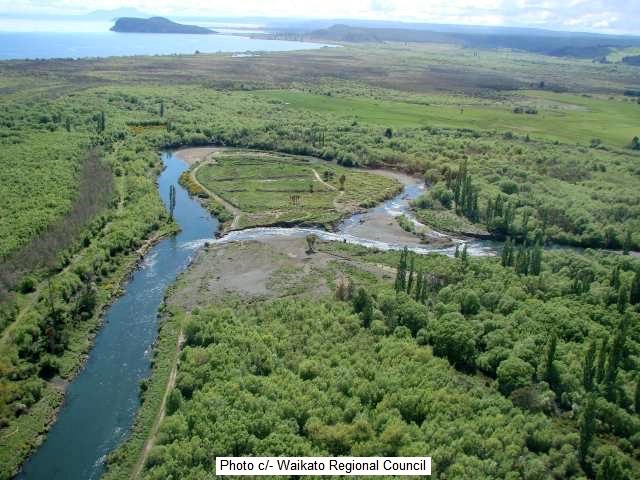
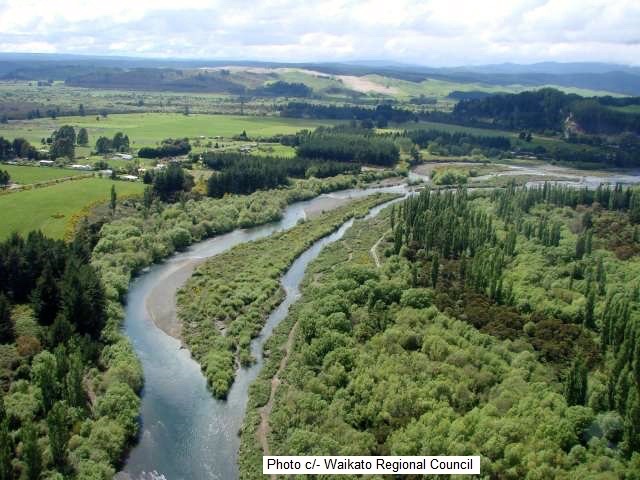
Above: de Latours Pool loop cut off when the main current broke directly through and bypassed it, after WRC wrecked the lower river in 2013 with the excavation of a canal – see photo below.
In a Turangi hostel shortly after New Year—the height of the summer angling season—I met Paul Adren, a 27-year-old Englishman whose lobster-tan face bore the unmistakable bug-eye imprint of his polarising angling sunglasses. Back home, he works as a casting tutor and representative for a fishing gear manufacturer, but every English off-season he comes to New Zealand for his share of the angler’s Arcadia. Where else but here, he asked me, can you fish for world‑class trout every day of the year for a mere $55?
“All trout and salmon rivers in the UK are privately owned, so fishing is exclusive and expensive,” he told me as we motored in his aluminium dinghy towards the Tongariro delta. “You pay the owner and get an allocated stretch of the river, say 200 yards of the left bank, from one fence to another. For a well-known chalk stream like the Test or the Itchen [from which some of New Zealand’s brown trout originate] it can cost you a hundred quid a day, (in 2000!) and you have to book months ahead. And these are the rivers where you can go. There are many more where you can’t, not unless you have a ‘Sir’ to your name.”
We beached the boat on a gravel bar and waded up one of the delta channels, thigh-deep in the water, volcanic sand squirting between our toes with every step. In a river, the trout nose into the current, so by walking upstream you can often sneak to within a good casting distance.
That day we surprised many fish. One which remains fixed in my memory lay in mid-stream, a big brown trout finning just enough to maintain its position. I cast repeatedly, but the fish refused all my offerings, sometimes ignoring them completely, sometimes coming in for a closer look, then turning back without a take. My hands shook every time I changed a fly.
“Here, try this,” Paul whispered over my shoulder. From his backpack, he produced a wooden box the size of a laptop computer, which, like a portable entomological museum, contained sheets and sheets of insects, all of them artificial. Earlier that day Paul had told me that, as a boy, he had owned a set of aquaria in which he kept not fish but bugs. He watched them grow and metamorphose, from eggs to larvae to nymphs to adults. He studied their behaviour and habits, then tied precisely matching imitations. Now he carried the fruit of this and other research in his wooden box: 8000 different flies in all colours and sizes—at shop prices worth about $20,000—covering most foreseeable fishing scenarios.
He handed me a large dry fly, which I tied on and cast. It floated on the surface like a bird’s feather and the trout snatched it the way a dog snatches a stick. My line went as taut as a guitar string and the water exploded around the fish. A few minutes later, I scooped the trout out with my landing net. Its body was flecked like greenstone, and just as cold. On the pilgrimage to Tongariro I had found my shrine.
We caught and missed other fish that day before dusk fell, and then a warm summer night. Stumbling in the darkness, we waded downstream, sweeping the way ahead for obstacles with our rods until the dagger of a young moon came out to guide us. At first, the outboard would not start, and when it did the boat’s lights short-circuited. We puttered at a snail’s pace, groping our way through the narrow channel from one marker to another, alone on the lake, laughing a lot. We seemed to step outside of time and into our boyhood again, playing Huck Finn and Tom Sawyer adrift in a clapped-out boat. I thought there was no other place I would rather be.
I returned to Taupo the following July because from late autumn to early spring, when the water is at its coolest, rainbow trout return to their spawning streams. What guides them? No one knows for sure. Perhaps it is the bouquet of tastes and odours peculiar to each stream. Perhaps the Earth’s magnetic field plays a part. But, almost unfailingly, they come back to their own birthplace to breed.
Unlike salmon, which die after spawning, trout can make their river run several times. But the journey of up to 20 km—an obstacle course of rapids and shallows, culminating in mating battles and the excavation of the spawning beds, the reddsis hard on a fish. On their way back to lake or sea, they often look emaciated.
At Taupo, when autumn has been dry and the river levels low, trout congregate in vast numbers at the stream mouths, waiting for rain. A downpour literally opens the floodgates, and the fish surge upriver. These piscatorial rush hours, when fish from the whole lake must pass through the narrows of the river mouths, are eagerly awaited by anglers, who, on days when the fish are running, form “picket fences,” rod-wielding human palisades which the fish must pass.
But pass they do—in astonishing numbers. On the upper reaches of the Whitikau Stream, across from the Rangipo Prison grounds, I witnessed the end of the journey: several hundred rainbow trout in water so shallow their backs were half above the surface while their bellies rubbed against the coarse gravel bottom.
With Turangi Department of Conservation fisheries scientist Michel Dedual, I crept along the stony bank to the water’s edge. The trout, preoccupied with the business of sex, were so close we could almost touch them.
Dedual, an affable Swiss ichthyologist who has been in Turangi long enough to acquire a Billy T James giggle, knows trout intimately. He has caught and eaten them, radio-tracked and dived with them and watched them for hours, yet even he could not contain his excitement at the sight of such abundance.
“Amazing, huh?” he exclaimed. “As a fisheries scientist, I follow closely what happens with fish populations around the world—in Alaska, Patagonia, and Europe. They all pale next to this. I know of no better place than Lake Taupo for wild rainbow trout. New Zealanders—even the locals—just don’t realise how good we have it.”
Taupo’s brown trout spawn earlier, Dedual told me, moving up the rivers in April and May, and the resident rainbows often gather just below the redds, feeding on eggs which get washed downstream. But the rivers that drain the Volcanic Plateau contain large amounts of pumice and small stones, some of which are similar in shape and size to trout ova. Dedual has caught rainbows with their bellies full of ova-size pumice. “They feel as crunchy as bean bags,” he said.
Why is Taupo such an outstanding fishery, I asked? “It’s a combination of things,” Dedual explained. “The water is very clean, because there is relatively little farming around the lake edges. There are buffer zones of forest along the banks of the inflowing rivers and streams, and their bottoms are composed of porous volcanic gravel, which purifies the water like a carbon filter. Then there is a profusion of smelt in the lake, which the trout can hunt with little effort. Also, the fish can spawn year-round. Although they prefer the colder months, you can see spawning runs happening in summer as well. But most importantly, the entire system is large, diverse and robust. If a cataclysm should strike at one end—a flood, localised pollution, or even a volcanic eruption—there will be rivers and streams at the other end that are unaffected. The trout population is healthy and self-sustaining. Even if severely depleted, it will bounce back quickly. And of course, we monitor it closely.”
They do so because in Taupo, where 60,000-70,000 fishing licences are sold annually, angling is big business, bringing close to $100 million a year to the local economy. Using echo-sounding surveys, DoC’s fisheries managers can estimate the number of fish of legal angling size in the lake. (It fluctuates between 80,000 and 220,000.) In summer, they make aerial sweeps, counting boats and assessing the fishing pressure. They interview and educate anglers, run a hatchery for public-relations purposes (being a self-sustaining fishery, Taupo does not need to be topped up with hatchery-raised trout, as Lake Rotorua and some other lakes do), set minimum legal sizes and bag limits and curb poaching. Their work seems to be paying off handsomely: the trout fishing at Taupo is as good as it’s ever been.
To gain a trout’s-eye view of the situation, I teamed up with local scuba instructor Damian McMillan for a drift-dive down the Waikato, the only river draining Lake Taupo.
“If you hear a thundering noise, we’ve gone too far!” McMillan told me, nodding to where, three kilometres downstream, the Huka Falls barricade the river, forming a natural dam that keeps fish downstream from the greater Taupo system. Then he lowered himself into the 12°C water and swam off in that direction.
The visibility was six or seven metres, and small rainbow trout seemed to hang in the current like seabirds riding the wind. Tiny twisters of gravel and sand travelled along the pale-yellow riverbed, which otherwise looked as barren as a moonscape. The world of the trout can be surprisingly austere and bleak, flushed by regular floods and almost devoid of colour, furnished only with rocks and occasional sunken trees.
To a terrestrial observer, trout may appear indolent, lying inside eddies, waiting for food to float past, but the truth is that, in a fast river, they do not have much choice. Every metre of upstream or cross-stream travel requires a major energy investment. While a lake trout can cruise its beat at leisure, snacking on a morsel here and there, the river trout must master the vagaries of the current.
When the river pours over and around obstacles, it swirls, buckles, and folds back on itself, creating pockets of almost-stationary water. These sheltered niches are a trout’s prime real estate, and there you find them, almost motionless, fins twitching with minor adjustments, only centimetres away from a swifter flow which, like a conveyor belt, delivers a continuous smorgasbord of insects, the trout’s “fast food.”
The current also brings oxygen, but before the water enters the trout’s gills, it passes through a series of comb-like gill rakes which sieve out the debris. These crude strainers, however, cannot remove fine silt, which can clog the gills and kill the fish. This is why you find trout only in relatively clean water. For them, a silty stream is like living in a continuous sandstorm.
Water clarity has a bearing on the size of fish, too. River trout hunt primarily by sight. In order to catch prey they need to see it coming well in advance, so that they have time to intercept it. The clearer the water, the better the hunting and the bigger the fish. The fact that New Zealand boasts such large river trout can be attributed partly to water purity. But in many parts of the country, that purity is under threat.
“Rivers will be tomorrow’s beech forests—the next environmental battleground,” predicts Bryce Johnson, national director of Fish & Game New Zealand, the statutory body that manages freshwater fishing and game-bird hunting. His organisation, which evolved out of the country’s two dozen acclimatisation societies in the late 1980s, represents the interests of the country’s anglers and shooters and is financed from the annual sale of fishing and hunting licences (in 1999, 123,000 and 34,500 respectively). Though characterised by some as a bloodsports lobby, it functions as a vocal and effective conservation group.
“You won’t find more vigilant environmental watchdogs than anglers, particularly fly-fishermen,” Neil Deans, Fish & Game’s regional manager for Nelson and Marlborough, tells me. “They spend a lot of time on the water. They study the river flows and the insect life, and they are the first to know if there is a problem. And because they’re so passionate about trout, they also take the initiative and act. Of the 25 water conservation orders [the equivalent of national-park legislation for rivers and lakes] covering the country’s signature waterways, such as the Mataura, Pomahaka, Rakaia, Buller, Rangitikei, Mohaka and Motu Rivers, 19 were initiated and seen through by anglers.”
Deans’ demeanour is far from that of a dreamy-eyed angler watching the mayfly hatch. He is a veteran of many courtroom battles on behalf of Fish & Game. Fluent in legalese, he speaks with enough let-me-finish determination to make the voice of the angler heard even during the most heated debates. “Hydro-electricity proposals, particularly on small trout rivers, used to be our main headache,” he says, “but now we have to deal with a host of other issues as well. Clean water is in such demand that our rivers are virtually under siege. In some cases the allocated water permits exceed the river flow. So although our job is to look after fisheries, in reality we find ourselves lobbying for sustainable water management, because this is the bottom line for trout—for the whole country, in fact.”
….Bryce Johnson is positive about the work of the trust, which provides resources to 350 landcare groups around the country, and praises the push towards sustainable land use, adding that, as a nation, we really have no other choice. Trout, after all, like their rivers the same way we do—refreshingly cool, crystal-clear and well shaded with trees. Even a quick glimpse overseas reveals a very unappealing alternative. Both the Wycombe Stream in England and Sonoma Creek in California, two of the very waters from which our brown and rainbow trout originate, have declined to the point of being described as communal sewers.
Satisfying the needs of development and recreational use is no easy balancing act, and it is worth remembering that trout make a significant contribution to the national balance sheet. “Trout bring around $600 million to the economy,” Johnson tells me, “but what they signify is not just about money. We have always lobbied against trout farming, the sale of trout, and any other form of putting a dollar value on the fish. In this country, we still have a lifestyle and environment that most of the world envies, and we can’t afford to squander it. Trout are a part of our heritage, and you can’t put a price on that.”
…And I think of the river that pours out of the lake and into a forested gorge, as good in the rain as it is in the sunlight, a river so clear I have no hesitation to drink from it. I like the feeling of its current pressing against my waist, squeezing the waders, and the wake forming on my downstream side as the river tells me, in a congenial sort of way, that I am, after all, just another annoying obstruction.
Soon I’ll be there, alone or with a friend, our only conversation the swish of fly-lines through the air. You don’t talk a lot when you’re fishing. You let the river do the talking. During those interludes of perfect stillness, there are times of concentration so intense that the world as you know it no longer exists, for a few moments at least. Some people go to Himalayan monasteries or gaze for hours at a candle flame to feel this. I prefer the river and the mesmerising flow of its muscular current. And who knows, perhaps one day I won’t even bother with a rod.
Ultimately, it doesn’t really matter whether we fish for trout or not. The important thing is that they are there. They have become more than just an angling quarry, food for table or soul, an excuse to venture into the outdoors. Trout have come to embody pure, cold fresh water—the very elixir of life. In New Zealand, they seem particularly at home.”