
These articles show how lucky we are in the North Island – compared to the pollution, irrigation, environmental and access issues facing anglers in the South Island…i.e.
Disgusted environmentalists quit water talks over claims of farming bias

The Hurunui in North Canterbury attracts thousands of people, many of whom, like Pete Dormer, left, and Guy Higginson, enjoy fishing from its stony banks.
Two major environmental groups have walked away from an Environment Canterbury water management organisation over accusations of bias towards farmers, saying it refuses to listen to their concerns and backs a “self-interested” rural community.
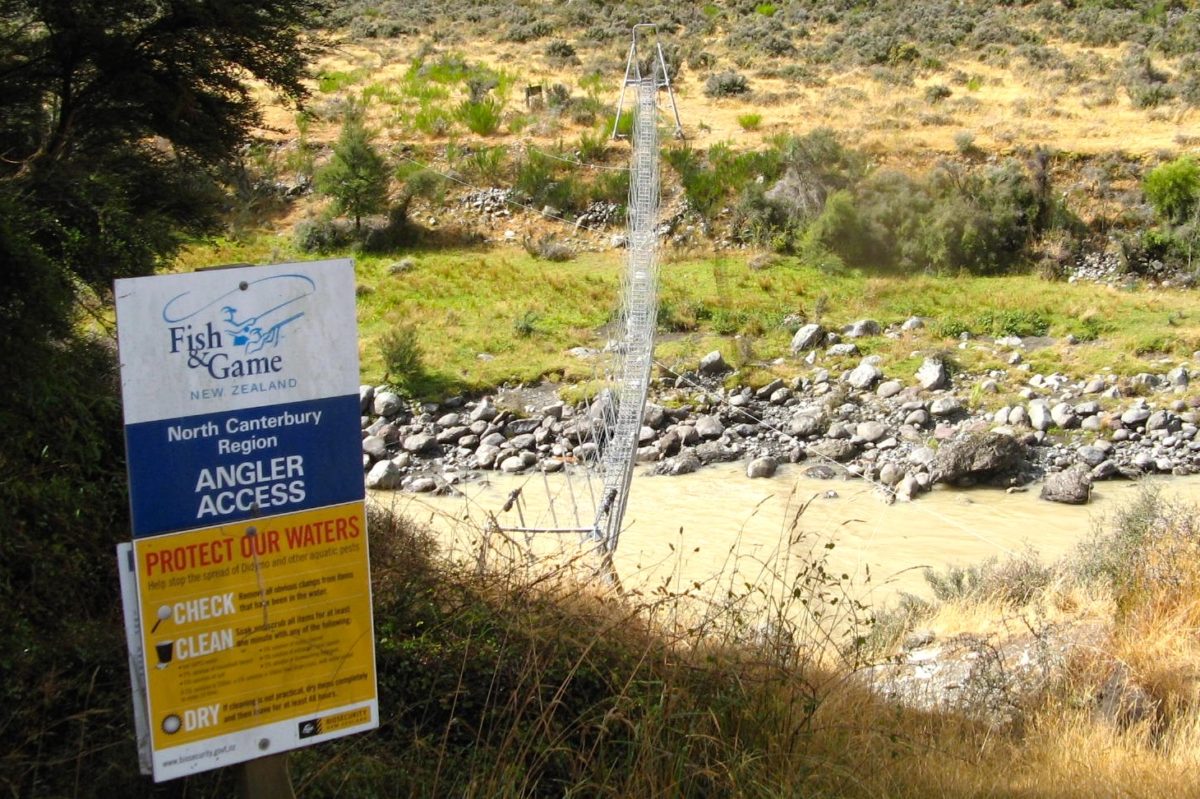 The Hurunui-Waiau water zone committee is supposed to promote “collective interests” rather than represent any particular group.
But the North Canterbury body is dominated by farmers, and after years of frustration Fish and Game has refused to attend any further meetings, claiming the organisation gives little more than “token consideration” to its views.
In a letter to committee chairman John Faulkner, Fish and Game environmental adviser Scott Pearson said: “The whole collaborative process in its current form is broken.”
READ MORE:
* ‘The water wars’: A council’s proposal ruptures a divided heartland
* Legal challenge over Environment Canterbury plan to help irrigation firm delay river flow rates
* Green campaigners hope to sink irrigation plan that could delay protection of Canterbury’s Hurunui River
* Irrigation schemes to continue despite withdrawal of taxpayer funding
Charity Forest and Bird has made a similar move, saying its opinions are “routinely dismissed” by a committee that does not reflect the community.
Environment Canterbury (ECan) chairman Steve Lowndes said environmental views were “well-represented” and urged them to keep contributing.
“Anybody is able to apply to go onto a zone committee, there is no restriction at all.”

Environmental groups Forest and Bird and Fish and Game claim their concerns are being ignored by a water management organisation that oversees the Hurunui River.
The two groups are fighting plans to delay increases in minimum water flows – levels which if flows fall below, irrigators cannot take water – on the Hurunui River, introduced five years ago to ensure its health as a long-term requirement under the Hurunui and Waiau River regional plan.
Amuri Irrigation Company (AIC) wants to put off the higher flows while it investigates building a dam for irrigation, saying to bring them in now would impose significant financial costs on both the company and farmers.
Under one option being considered, in which AIC would fund an “enhancement package” of environmental measures, new minimum flows might not happen until 2025.
 The 12-person zone committee discussing the idea includes seven farmers, including Hurunui District Mayor Winton Dalley, councillor Vincent Daly and an AIC director, James McCone.
Aside from a water management professor and ECan councillor Cynthia Roberts, an ecologist, no environmental groups are represented.
A Forest and Bird member applied to be on the committee shortly after it was set up but was rejected because of his charity association; a Fish and Game field officer was a member in the committee’s early days but stepped aside after realising its requirement of impartiality was at odds with his role with the sports fishing body.
Fish and Game was asked last year to put someone forward for consideration but declined.

Environmentalists are furious over plans to delay bringing in new minimum water flow requirements on the Hurunui River.
Writing to Faulkner – himself a farmer and shareholder in AIC whose irrigation water is supplied by the company – Forest and Bird conservation manager Jen Miller questioned why they should “waste [their] time” by attending meetings.
“Our views are routinely dismissed by a zone committee dominated by farming interests … and Forest and Bird and other environmental organisations are expressly excluded.”
 Miller said despite the Hurunui community being split between farming supporters and those concerned by its effects, “the divisions are not replicated at the zone committee, which only represents those that support the economic benefits of farming and expressly excludes those who may have another perspective”.
Committee members are chosen by ECan, and Miller accused the council’s politically-appointed commissioners of picking pro-farming members and excluding environmental groups “in order to advance the previous National government’s desire for increased irrigation”.
“Our interests are better served by keeping [a] watching brief and referring egregious actions to the Environment Court.”
Pearson claimed a report on when minimum flows should happen is biased towards a delay.
The zone committee’s focus in recent years was on “minimising or avoiding impacts on the farming community”, something “not surprising given the appointed make-up of a land-user dominated committee”.
Writing to tell Faulkner he too would no longer attend meetings, he said: “The high probability is that we would see token consideration of our concerns from the majority of committee members.”

Irrigation firm AIC wants to put back the rules so it can continue providing water for farmers while it investigates building a new dam.
Roberts urged the organisations to stay involved, saying they offer a “valuable perspective”, while Lowndes said “many of the farmers would be most upset if you didn’t think of them as environmentalists”.
“The issues which zone committees deal with need to have as many voices around discussions as possible. By withdrawing, Fish and Game and Forest and Bird don’t do themselves any service at all,” Lowndes said.
Meanwhile, Forest and Bird has withdrawn an application to the Environment Court asking it to declare that a potential agreement between ECan and AIC to put off a review of the company’s resource consents was unlawful.
A second application over resource consents for dryland farmers remains before the court.
– Stuff
‘I am ashamed’: A Canterbury river’s pollution starts a cultural debate
A rūnanga is opposing an application to increase the amount of nitrogen going into the Waipara River, arguing further pollution would be culturally unacceptable.
When Hoana Burgman goes away, she says goodbye to the river. She does not say goodbye to her house, or her town, because they are objects and the river is not.
In the small North Canterbury community of Waipara, a rūnanga is taking a stand against the pollution of the river, which has been significant to Māori for centuries.
It has done so by opposing a resource consent application by a large irrigation scheme on grounds rarely cited in such matters: cultural offence.
If successful, it would be a blow for the long-planned scheme, seen by some as vital to the economic future of a dry farming district. It would also send a clear message that freshwater pollution is not just an environmental issue, but increasingly a cultural one, too.

The braided river flows out to sea near Amberley.
For some Canterbury Māori, the agricultural pressures on the environment have gone too far, which has pitted two world views against each other: One in which rivers have mauri (a life force), and one where rivers are resources that can support a community’s economic livelihood.
The Māori proverb goes “Ko au te awa. Ko te awa ko au” (I am the river. The river is me). So what happens when the river becomes polluted?
For centuries, the mana whenua of Waipara, Te Ngāi Tūāhuriri, have traversed the rivers of North Canterbury. The Waipara River was part of the trail to the West Coast, and relics from that era – multiple Pā sites, middens, and rock art areas – still remain.
The river was once a meeting place for the many rūnanga that make up Ngāi Tahu, and until recently, was a place where mahinga kai was practiced.
But like many rivers, the Waipara has degraded. It is not yet among the region’s worst, but it is over-allocated for irrigation, and Environment Canterbury (ECan) deem it a “red zone,” meaning water quality outcomes are not being met.
For the rūnanga who serve as guardians, the decline of the region’s rivers has come at a personal cost.
“The degradation of the rivers has happened in my lifetime and I am ashamed to pass them on to my children and mokopuna in the state they are in at present,” Hoana Burgman, a Kaumātua (elder) of Te Ngāi Tūāhuriri, says.
“In my lifetime, this has happened. And it’s something I’m very sad about… my grandfather would be disgusted. We feel we’re letting down our tīpuna (ancestors).”

Hoana Burgman, kaumātua of Te Ngāi Tūāhuriri, says the pollution of the Waipara River must stop.
The rūnunga has made its stand at a time of public concern about the environmental implications of agriculture.
The Hurunui Water Project (HWP) has applied to add around 150 tonnes of nitrogen to land surrounding the Waipara River, on behalf of the scheme’s shareholders. It has asked for the consent to apply until 2050.
It already has permission to take and use the water, but needs approval for the extra nitrogen pollution that would come off the land as a result.
There was no public consultation for the application; the only parties deemed to be affected were Ngāi Tahu and Te Ngāi Tūāhuriri.
They both responded forcefully, arguing that any more pollution would be a violation of the river’s cultural significance. For Māori, a river (awa) cannot be split into its individual parts, but is seen as something whole; a presence with mana and spiritual characteristics of its own, more like a living being, with immense cultural significance.
 The degradation of the region’s rivers has been particularly obvious in the last 20 years, Burgman says. When she has visitors, she no longer takes fish from the river, but buys them from the supermarket: Whenever she has a day off, she visits the rivers she has known for nearly 80 years, and has watched them change.
The rūnanga has tried for years to advocate for the rivers, Burgman says, but has been repeatedly discounted.
“Next to my own family, those rivers mean everything,” she says.
“They say ‘where’s your technical knowledge, you’re not hydrologists’ – no, we aren’t, but we have a whakapapa there. I have eight generations of my immediate whanau who have fished on those rivers, so I don’t need technical advice, I can see it by looking, and fishing, and living on those rivers. I’m 78 and I can remember going to those rivers as long as I remember.”

The Waipara River, like many Canterbury rivers, is under pressure from surrounding agriculture.
The irrigation scheme has been 20 years in the making, and is increasingly seen by the district’s farmers as vital for economic survival. Some are still reeling from a savage drought two years ago, which was followed by the large earthquake centred in the district.
 The scheme has become polarising, however, amid a public backlash against freshwater pollution. The Hurunui District Council has proposed to buy shares, which has further exposed tensions and pitted some residents against each other and against the council itself.
For Chris Pile, HWP’s chief executive, the scheme would not just benefit farmers, but bring the life-giving properties of water to a dry district, where communities were visibly waning.
“There is overwhelming evidence that access to reliable water creates jobs and improves the regional economy,” he says.
“You only have to look at Ashburton, Timaru and Oamaru to see this evidence. In contrast, Hurunui townships are really struggling to sustain themselves.”
In regards to the consent application, he said the resource consent process was “very robust” within a set of highly scrutinised and strict regional rules. Farmers on the scheme would be strictly regulated, and were required to submit farm environment plans, do on-farm planting and fence off waterways.
The scheme itself, he says, went beyond what was required by law, and was committed to responsible environmental management.
“Our commitment to environmentally sustainable practices goes further than just complying with legislation,” he says.
“We have also taken advice from specialist advisors, water consultants and nutrient management experts to develop proposed consent conditions to ensure we have the tools to protect the environment.”
HWP had already and would continue to discuss Te Ngāi Tūāhuriri’s concerns with the rūnanga.

Hurunui Water Project chief executive Chris Pile.
The decision will be made by independent commissioners, on behalf of ECan, the regional council.
ECan has recommended the consent be approved, as long as HWP uses an an approach described as an “adaptive management regime”. Because there had been little previous monitoring of the river, there is uncertainty about the effects of the added irrigation; The adaptive regime would require more monitoring, and if there was evidence the river was degrading, farmers may be required to change their practices.
 For Ngāi Tahu, which submitted against the consent alongside Te Ngāi Tūāhuriri, it meant the river could be allowed to worsen, which it says is inconsistent with regional and national rules requiring water quality be improved.
“It is disappointing that Environment Canterbury, as the steward of the region’s freshwater resources, has interpreted and applied its planning documents in such a way that it has recommended that consent be granted,” its submission says.
“It is required to uphold the integrity of those plans. The grant of consent in this instance would undermine their integrity.”
It is a tightrope for Ngāi Tahu, which has many business interests in the rural sector, but has increasingly moved to oppose what it believes are environmentally damaging practices. It recently negotiated with the Lyttelton Port Company for tighter conditions on its dredging plan in Lyttelton Harbour, which the iwi believed would be environmentally unacceptable.

A dry sheep farm in Waipara during a drought in 2015.
In 2011, when the HWP scheme was approved in a larger form than currently planned, Ngāi Tahu’s submission was neutral.
Ngāi Tahu is itself a shareholder in HWP, via Ngāi Tahu Farming, and the scheme’s storage pond is proposed to go on Ngāi Tahu’s land. HWP’s board of directors once included a Ngāi Tahu appointee, which is no longer the case.
Ngāi Tahu declined to comment, citing the fact the resource consent process was ongoing.
 But Hoana Bergman says she speaks for Te Ngāi Tūāhuriri, not Ngāi Tahu – they are mana whenua, and believe something needs to change.
“It’s beyond belief what’s happened in the last 50 years,” she says. “It all comes down to economics, it’s all about money. It’s about people making money, and to hell with the river.
“When you have had generation after generation being able to fish and live on those rivers, it really does break your heart.
“They should always be passed on in a better state than we got them. That’s what’s so terrible for me and my brothers and sisters, that we can’t do that – we’ll be dead and gone and the rivers will be looking that way as well.”
HOW POLLUTED IS THE WAIPARA RIVER?
The Waipara River is unusual among Canterbury rivers because it has high levels of phosphorus, owing to the area’s geology.
The phosphorus, part of which is exacerbated by surrounding farms, causes the growth of periphyton, a nuisance green algae.
A concern about adding more nitrogen to the river is that it can produce cyanobacteria mats, which can be poisonous. Cyanobacteria is a growing problem in Canterbury, and leads to the closure of many swimming spots in the summer months.
ECan surface water scientist Dr Adrian Meredith said in his evidence that increasing the nitrogen load “is likely to further detrimentally change and effect the ecological health of the river,” and by changing the phosphorus/nitrogen balance, could lead to the presence of cyanobacteria.
The river’s health is largely dictated by its flow, he said, which can reduce to a trickle in the summer months. HWP argues that some of the surrounding groundwater takes could be given up once the scheme is running, which would reduce irrigation pressure on the river.

Fallen US TV star Matt Lauer’s access row over $13m Hunter Valley Station ‘political interference’

Matt Lauer hosted NBC’s today for more than 20 years before he was fired over sexual misconduct allegations.
Disgraced former United States TV host Matt Lauer can keep his high country station – but officials are still scrutinising a dispute over access rights to the Otago farm.
The Overseas Investment Office said on Friday while allegations of sexual misconduct were “troubling”, it had insufficient evidence to take proceedings against the American. He bought a $13m Hunter Valley Station on the shores of Lake Hawea last year – and because it is ‘sensitive land’ he had to pass a good character test.
The OIO opened an investigation into Lauer once the allegations became public to ensure he still met the character test.
Land Information NZ – which oversees the OIO – was also informed of concerns about access to Hunter Valley Station. And last year Conservation Minister Eugenie Sage asked it to examine local concerns about access to the Kidds Bush conservation reserve. Local trampers had complained a road into Terence Valley had been blocked off.
 Linz Group Manager Land and Property, John Hook said Hunter Valley Station is a working farm, which is impacted by public access.
“Linz has been informed of concerns about access to Hunter Valley Station. Linz has been advised that steps have been taken to change signage that could have given the impression that access was limited…The legalisation of the road to Kidds Bush was an action that had to be taken by Queenstown Lakes District Council…this is progressing,” he said.
“Linz officials have recently met with the New Zealand Walking Access Commission and Department of Conservation to explore options for increasing walking access to Hunter Valley Station.”
A source close to Lauer said there had been no complaints since the TV presenter took over the lease, suggested the ongoing row was “pure political interference” and said hundreds of walkers had enjoyed access in the last year.
“They [walkers] just need to check in with the farm – the access goes right past their house so it is not difficult.”

Matt Lauer raved about New Zealand calling it “sensational” after a holiday in the South Island.
The Walking Access Commission confirmed there was no “formal access dispute” at the moment. But in a report to its board in March, the Commission noted: “Since the sale of the Hunter Valley Station public access has been restricted over even local roads. The board expressed its concern about the actions of the Hunter Valley Station leaseholders and their sublessees and reiterated its wish for managed public access.”
Lauer’s Orange Lakes (NZ) Ltd company was granted consent in 2017 to acquire the lease for Hunter Valley Station, which stretches some 40km to the Southern Alps. The Crown remains the owner of the land.
As part of the OIO consent process the company consulted with local groups keen to get greater public access to the epic Otago landscape. The OIO imposed consent conditions that supported that improved access.
Access to the Hunter Valley, which stretches 40km to the Southern Alps, and Lake Hawea conservation reserve was in dispute before Lauer and wife Annette purchased the working farm.

A dispute over access rights at Hunter Valley Station has raged for years.
Locals had hoped for a breakthrough when he bought the land. As foreign buyers, they needed OIO approval – and officials set some conditions.
“The Consent Holder has demonstrated its willingness to facilitate, as lease holder, public access to several important sites on or around the land,” the OIO noted in its February 2017 decision to allow the purchase.
But since the sale went through, locals said that hadn’t happened – and said access to a public road which leads into the valley’s Terrace Creek has been blocked off.
Lauer also promised to invest just shy of $2 million over five years to improve the farm and boost stock numbers. The station was on the market for five years before the Lauers’ bid.
A keen fisherman Lauer gushed about New Zealand after a holiday. He told Tonight Show host Jimmy Fallon: “It’s the most sensational country on the planet. It’s beautiful.”
But months later he was fired over allegations about his behaviour at NBC.
– Stuff