As the new footbridge across the Tongariro River nears completion, the confusion and debate over the names increases. The bridge being replaced was known and named on DOC notices as the “Major Jones” bridge. This led to confusion with the nearby “Major Jones” Pool, which was located about 3- 400 metres downstream. So this is such an ideal opportunity for DOC to sort out the naming confusion as we have been advised they were responsible. The response from TRM viewers has been extraordinary both in volume and in different interpretations.
But the 70-year-old history of the name of the footbridge had nothing remotely to do with the Major Jones Pool. He was an Army Major from Waiouru who had been placed in charge of the engineer troop of soldiers who built the bridge. They were all 18-year-olds completing their CMT (Compulsory Military Training) and camped on the reserve at the end of Kutai Street – the old MOW depot. It was reported damaged after the 1958 flood but restored soon after.
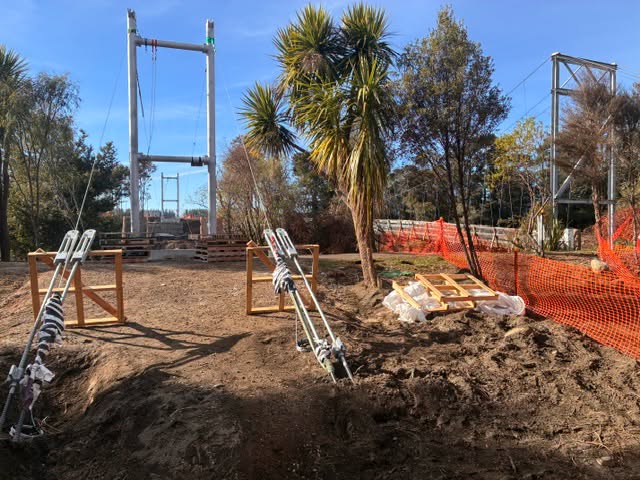
But now as that original bridge will be demolished after being replaced by a new structure, it is the ideal time for selection of a new name. If you are wondering why all the fuss about a name (?) then you don’t know fly fishermen who treat the names of river pools and bridges in a reverential manner. TRM can confirm this by the response to the bridge reports recently.
In all published reports from back then, the bridge was known as “The Birches Bridge”. This is repeated several times in the most referred-to 1975 booklet, Pools of the Tongariro by Allan and Barbara Cooper. This publication also contained a river map with pools named and dated 1928 and 1974. The footbridge at the end of Koura Street was always referred to as the “Birches Bridge”.

Somehow over the years we have to blame DOC for misnaming it on their signs as the “Major Jones ” bridge. This name was clearly an error but was never corrected and became commonplace. But now it is the ideal time for DOC to take the lead again.
Surely in the $800,000 budget they can afford a couple of newsy tourist information panels to end the confusion and clearly identify the Major Jones Pool and allocate a different name for the new bridge. Obviously, with history on our side, the new bridge should be called “The Birches”. Case closed!
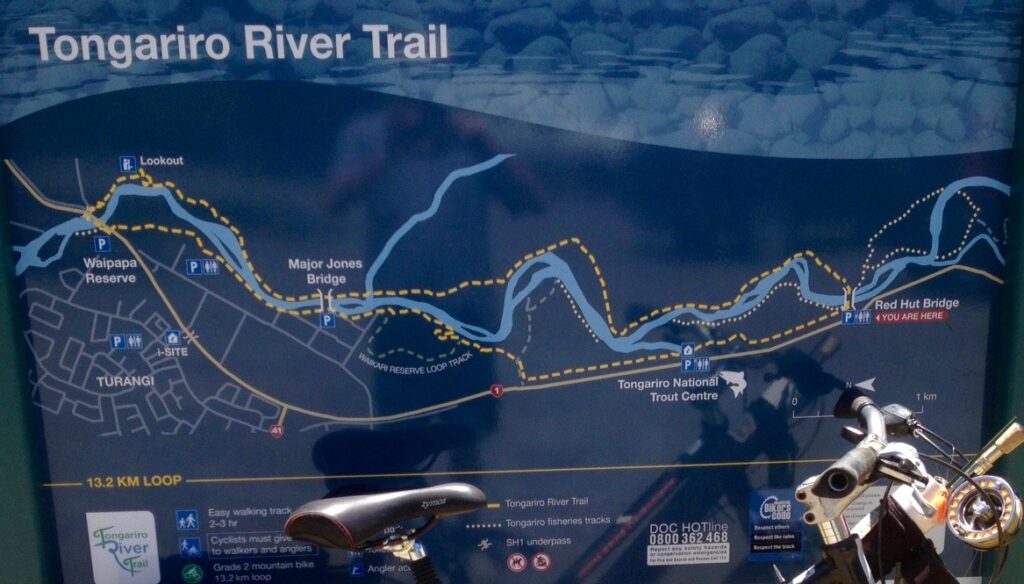
For DOC’s new tourist information noticeboard, an interesting history of the Major Jones Pool naming follows, although it is too “British” to mention that a commission in the Indian Army was usually acquired rather than earned, or that he usually wore a monocle when fishing…
Now, not unexpected, TRM viewers want more background on who the original Major Jones was.
The following TRM report was posted three years ago:

Who was Major Jones of the Major Jones Pool?
As the Major Jones Pool is one of the most popular Tongariro River town pools with one of the highest ratings – 17 out of 20 – on TRM’s Tongariro River Pool Map, anglers have again asked for background info on ‘who was he?”
There should be tourist information panels at all these world-famous Tongariro Pools to explain the history over the last one hundred years…
In 2021 TRM offered to fund them out of book profits but were not allowed…

We do not apologise for TRM’s blog from 2018, including a lot of useless, fascinating historical background info. As you all know, Tongariro anglers are so instinctively inquisitive and they need to know everything. (just like SWMBO!)
This delightful article is from research conducted by the late Arthur Parish, a local historian.

MAJOR RHYS WYKEHAM JONES
1863 – 1922
This is the story of Major Jones, after whom one of the most famous fishing pools on the Tongariro River is named.
At the time of Rhys Jones’ birth, Queen Victoria was on the throne, and although the British Empire was in the ascendancy, the Industrial Revolution was making many people unemployed. By good fortune, however, Rhys and his brother, who were orphaned at an early age, were taken in by a neighbouring family, the Massey family, the head of the household being a surgeon.
It was from this location that the boys grew into their teens, attending Ingham College in Surrey. Rhys, at 18, opted to ‘take the King’s shilling’ by enlisting in the Royal Sussex Regiment of Foot, the famous Thirty-Fifth.
After the opening of the Suez Canal in 1869, a French-British joint venture negotiated the right to operate the Suez Canal. Although Egypt at that time were part of the Ottoman Empire, it became clear that it was London and Paris, not Turkey, that called the shots. In principle, the economy of the country should have benefitted from the Canal, but under Khedive Ismail, the Egyptian Government was chaotic and relied on finance from oppressive taxes imposed on the peasants cultivating the rich soil in the Nile Delta. To ensure Egypt had the benefit of all the income from the Canal the Egyptian ruler was all for privatising the Canal – eliminating both the French and English from the deal. Trouble soon began and 35,000 British, and Indian troops were sent to Egypt to quell the uprising. This included the First and Second Battalions of the Royal Sussex in which Rhys Jones was serving, by now a lieutenant.
These two battalions were initially stationed at Alexandria, as part of General Wolseley’s Expedition and in 1884 became part of the Nile Expedition, an unsuccessful attempt to save General Gordon at Khartoum in Sudan.
Queen Victoria became Empress of India in 1876 and the stationing of British troops – to protect British interests and the local population from the renegade Black Mountain hill tribes of the North West Frontier – seemed quite justified.
Thus Lieutenant Rhys Jones returned from Egypt in 1885 with the 1st Battalion, but shortly thereafter left with the 2nd Battalion for India as a forerunner of the Black Mountain Expedition (1888) serving at both Rawalpindi and Gharial. On the 13th of April 1892 (aged 29) he was promoted to Captain.
The records show that Captain Jones was serving in the 3rd Battalion Border and eventually reached the rank of major. In 1906 he would have been 43, having served in the army for 25 years, and it is at this point that he resigned his commission and returned to England.
How Major Jones discovered the fishing potential of New Zealand is unclear. There were books published in the early 1900’s regarding the excellent fishing to be had here, and it is recorded that Indian Army Officers were seen fishing in the Tongariro/Tokaanu area, soon after. No doubt word of their success would have rapidly travelled through military ranks. In addition, the Major would have been aware that ova had been collected some years before from the rivers Wey, Wycombe, and Itchen for transportation to Tasmania and New Zealand to establish new trout fisheries.
Major Jones left England and arrived here in 1910 and either stayed at one or other of the Fishing Camps established on the banks of the Tongariro, or the Tokaanu Hotel which catered for people travelling North or South.
Now, how did the Major Jones Pool get its name? In those days, by gentlemen’s agreement, the first one to begin fishing in a pool each day had the right to remain there undisturbed till midday when someone else could move in. But the Major had an advantage – in that he had a motorbike – which would have enabled him to travel over the rough tracks and reach stretches of the river much quicker than anyone else! It is said that the Major, who stood 6’2” or 6’3” and weighed some 20 stone would bellow like a bull if anyone dared to enter HIS pool uninvited

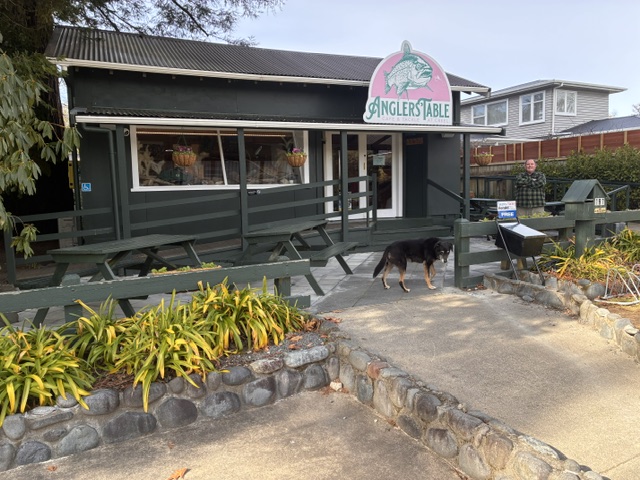
Major Jones befriended Joe Frost – who was an ex-English Corporal from the First World War and was running a tackle shop in Taupehi Rd – later to become Geoff Sanderson’s and was “resited” and moved – see photo below – to the front of Creel Lodge to trade as Creel Tackle House and now refurbished as the Anglers’ Table – the oldest tackle shop in New Zealand.

Taupehi Road was the main highway to Auckland in those days, just a dirt road with very little traffic. A survey conducted in 1922 recorded an average ten cars a day passing through ‘Taupehi Village’ as it was then known. (And it should be renamed Taupehi again!)

Joe, who by now would have been here a while, having moved from Wellington, would have acquainted the Major with all of the local fishing spots whilst acting as both guide and gillie. And it was Joe (a ‘dry Fly’ purist) who related to Vice Admiral Hickling (of ‘Freshwater Admiral’ fame) that “the Major landed all of his fish with the subtlety of a Warship weighing anchor and leaving in a hurry.” In his defence, the AVERAGE Rainbow caught in the Major Jones Pool in those days was recorded at 11 and a half lbs, so perhaps this was only to be expected! The Major hated brown trout, and would pay small boys to catch field mice during the daytime, which were then floated downstream at night in order to catch these leviathans.
Regrettably, Major Jones became unwell and returned to England in 1922 where he died (aged 59yrs) at the Church Street Surgical Home (in the City of Bath) on the second of August 1922.