
Spot the difference?
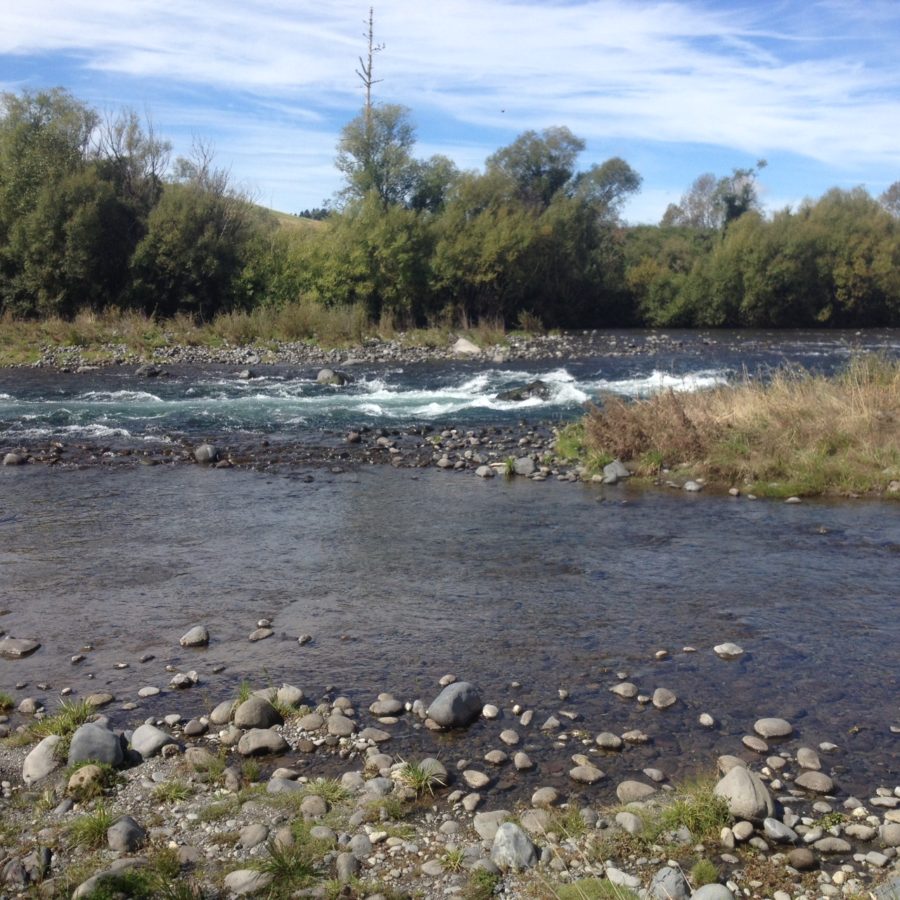
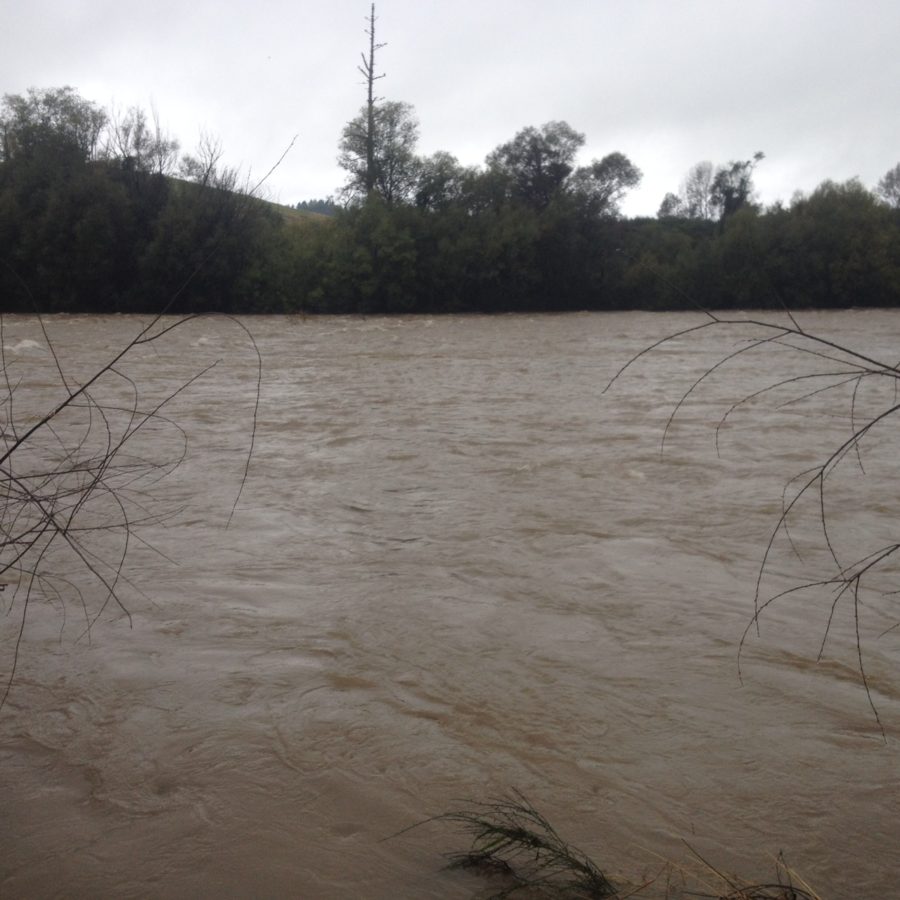 Another image of Tongariro taken at end of Te Aho Street (opposite TRM) where an anglers walking track usually leads across a shallow bypass onto the island above Judges Pool and below Island Pool.
This top photo was taken about 3.00 pm with the river raging about 300 cumecs.
The image below that taken from the same spot – see the dead tree on opposite bank for a reference point – illustrates the scene at usual flow of about 26 cumecs at Turangi.
SWMBO kindly offered to hold knitting lessons for TRM inmates who were biting their fingernails off after traveling all this way from Taranaki and Auckland and West Island and not being able to fish. She thought the rain would be good for the garden which needed a real soak.
The inmates could not leave anyway as the roads were closed in all directions.
TRM received the photo below from another dubious inmate from West Island claiming he caught this salmon in Lake Taupo on 1st April?
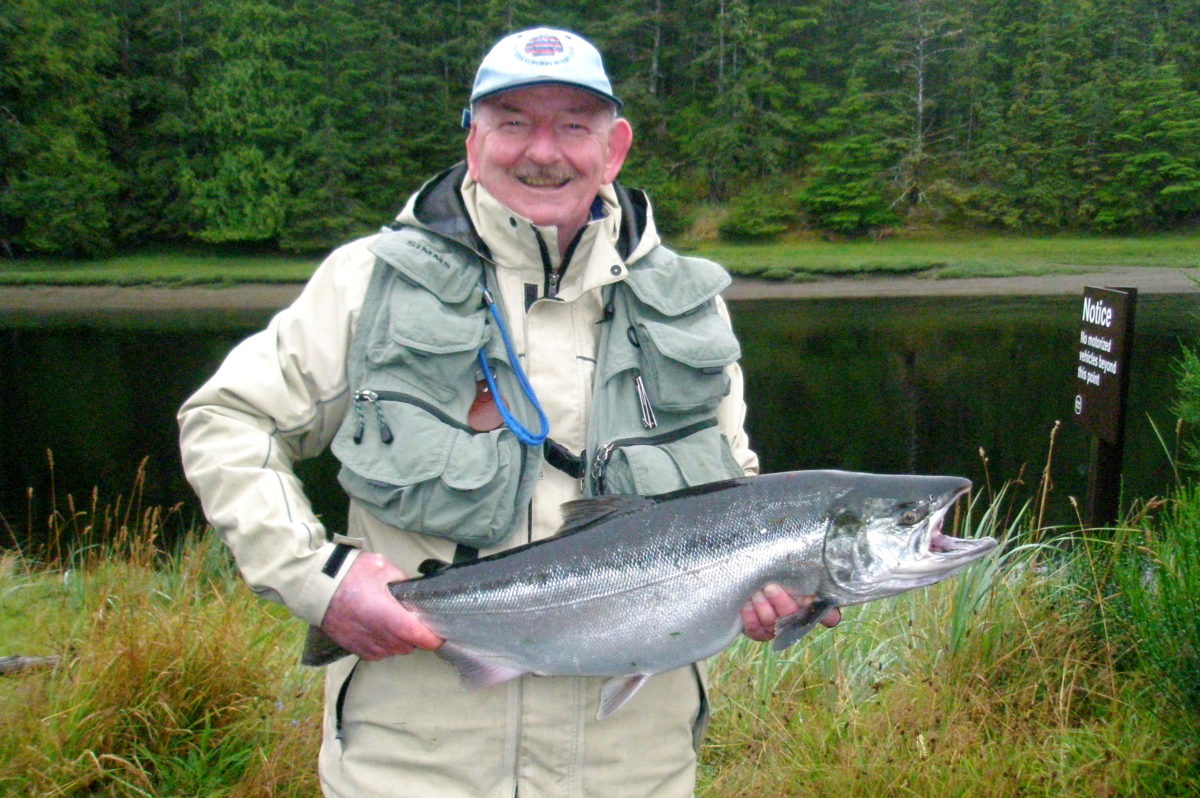
Sometimes – when we can’t go fishing we have to entertain ourselves by considering what the ‘other’ side are claiming… followed by some of the responses on fb.
Perhaps we should have posted it on 1st April?
Taking aim at Fish & Game over conflict of interests
The damage invasive species such as koi carp do to waterways is largely ignored by Fish & Game, Andrew McGiven says.
Why, for example, are we trying so hard to improve the health of our fresh waterways when the likes of Fish & Game are paid to protect invasive, predatory species such as trout and salmon, which actively decimate our native species such as koura (New Zealand freshwater cray)?
When sediment is such a major component of our water degradation, why is it that koi carp can pillage our river systems, collapsing river banks and stirring up soil, and yet this problem has been largely ignored by the organisation.
It is discouraging when farmers work hard at establishing wetlands and native groves only to have them poisoned in a few short years by wildfowl E. coli.
Yet Fish & Game chief executive Bryce Johnson denies there are too many introduced wildfowl species in number and kind, so this is not a problem either.
The issue for me is that I see a massive conflict of interest whenever I see Fish & Game comment about the health of our waterways.
They have a mandate to look after their members and their interests, which is clearly at odds with protecting our native flora and fauna.
The only reason they want clearer water is so that their members can see the trout/salmon with an improved focus and have a greater chance of hooking one.
I feel sorry for the members of Fish & Game who are railroaded into supporting the organisation that has a monopoly on the issuing of shooting and fishing permits.
As a farmer, I won’t allow anyone with a Fish & Game permit on my land because I am sick of the one-sided, biased propaganda that is issued from head office that often detracts from the outstanding work rural communities have already accomplished around improving water health.
How is it that this organisation has legislation enabling it to collect a compulsory levy to the detriment of our native biodiversity?
Perhaps they should be using this levy to assist in culling and containing introduced species such as geese, koi carp and the like that are fouling our waterways and wetlands. Instead of operating in the silo of their own narrow interest, they should get with the programme and work with other groups such as the Land and Water Forum.
It would be interesting to see how they would operate if they ever lost this compulsory levy. With a guaranteed income, they can afford to move outside of what their core competencies are, protecting introduced species for recreational hunting and fishing, so that the rest of the nation and economy must do that little bit extra to meet our environmental standards.
It appears the only accountability they are required to meet is to make some uninformed, inflammatory comments about the rural sector from time to time.
It certainly sounds like a pretty sweet deal to me.

– Stuff
Responses and replies include:


Fish and Game do NOT condone Koi Carp in our waters.You are encouraged bot catch and destroy them,in fact it’s illegal to return them alive to the water.They do make good fish bait for snapper!..
F&G return all licence fees to their duck and game habitats.
Trout and Salmon don’t like dirty water.The blame for Carp in Public waterways lays firmly in the hands of those miscreants who released them,NOT F&G.


Meanwhile…
NZ can’t ignore water warnings
(Distinguished Professor Dame Anne Salmond’s work spans a range of disciplines – mainly anthropology, but also history, Maori Studies, Pacific Studies, linguistics, history and philosophy of science, and the environmental sciences.)
University of Auckland’s Distinguished Professor Dame Anne Salmond responds to the OECD’s report on New Zealand’s environmental performance with suggestions on how the fresh water crisis might be tackled
The OECD’s report on New Zealand’s environmental performance is crystal clear. New Zealand’s 100% Pure reputation is at immediate risk from the degradation of many New Zealand lakes and rivers. International media, buyers of New Zealand products, tourism interests and public opinion polls have all been ringing alarm bells, and now the OECD itself has joined the uproar.
As the report notes, “fresh water is a fundamental asset underpinning New Zealand’s economy”, in primary production as well as tourism and many other industries.
While leaders in national and local government and primary production have tried to shut down freshwater scientists and others warning about the damage to New Zealand’s waterways, they can’t ignore this message from the international community. Decisive action to enhance the state of many springs, streams, rivers, lakes, wetlands, groundwater and aquifers across the country must be taken.
Although much was hoped from the Land and Water Forum, which for almost a decade has brought key stakeholders together to agree on ways of taking care of New Zealand’s water courses, the government has not listened to most of the Forum’s recommendations. At the regional level, too, collaborative processes have often been hijacked by powerful commercial interests.
In addition, iwi claims to proprietary interests in ancestral waterways have been upheld by the Waitangi Tribunal. In response, the government has argued that “no one owns the water”. Conversations between the government and iwi leaders about this are conducted in private, despite acute public interest in how fresh water in New Zealand should be managed.
The OECD recognises that iwi interests in waterways have to be resolved if freshwater management in New Zealand is to move ahead. The report highlights the need for the application of national standards at the catchment level to be independently monitored. It also notes that charging for the commercial use of fresh water and polluter pays charges might be considered.
Sir Eddie Durie and the New Zealand Māori Council have suggested that in order to bring greater consistency to the management of waterways across the country, and to recognise iwi interests in fresh water, an independent Waterways Commission might be established. If closely linked with the Office of the Parliamentary Commissioner for the Environment, this would have a number of advantages.
If charging for the commercial use of fresh water is introduced, it is imperative that this income flow is not privatised. All New Zealand citizens have a stake in the country’s waterways, and if water charges are introduced, this funding should be dedicated to improving fresh water quality for the benefit of all, including iwi projects to enhance ancestral waterways, as in Te Awa Tupua (Whanganui River Claims Settlement) Act.
The visionary recognition in Te Awa Tupua Act of the rights of waterways themselves could be extended to other waterways. Rivers, springs, streams, wetlands and lakes existed long before people arrived in New Zealand, and as both the Whanganui people and the OECD recognise, human beings depend on freshwater ecosystems for our health, prosperity and survival, as much as the other way around.
While the government cites William Blackstone (an early authority on English common law) to the effect that “no one owns the water”, Blackstone was equally adamant that no water user has the right to pollute, foul, corrupt or divert and stop waterways in ways that deprive others of their “lawful enjoyment”. This might be news to many dairy farmers, foresters and developers in New Zealand.
The legal rights of all citizens to enjoy waterways across New Zealand should underpin the work of a Waterways Commission. It is vital that the application of national standards for fresh water is nationally monitored by an independent body, to ensure that the management of waterways and any funding from water rights are not hijacked by private interests.
The OECD’s report is a call to action. Declining standards for fresh water in New Zealand must be decisively tackled. A Waterways Commission – one that is truly independent and well resourced, reconciles the rights and responsibilities of iwi with those of other citizens, and takes good care of our waterways – would bring urgency and national oversight to this task.
Dame Anne Salmond is the Patron of the Te Awaroa: 1000 Rivers project. She was the 2013 Kiwibank New Zealander of the Year.