
Tongariro anglers are always fascinated by the history attached to the Tongariro River pools. It is time suitable tourist information panels were erected to commemorate and remind us of this history over the last hundred years.
Now that all the emotional drama of Waitangi Day has passed, TRM’s post reminds anglers of some of the more obscure but factual Tongariro links with Waitangi Day.

Lord Bledisloe (Charles Bathurst, 1st Viscount Bledisloe), who served as Governor-General of New Zealand from 1930 to 1935, had a notable connection to the Tongariro River, primarily as an enthusiastic, high-profile angler
His connections to the river include:
- Angling Enthusiast: Lord Bledisloe and Lady Bledisloe were frequently photographed fishing for rainbow trout on the Tongariro River, specifically at famous spots like the Hut Pool and the Waitahanui River.
- Royal/Vice-Regal Fishing Tradition: He was part of a tradition of Governors-General and royalty (following the 1927 visit of the Duke and Duchess of York) who fished the Tongariro, specifically the “Duchess Pool”.
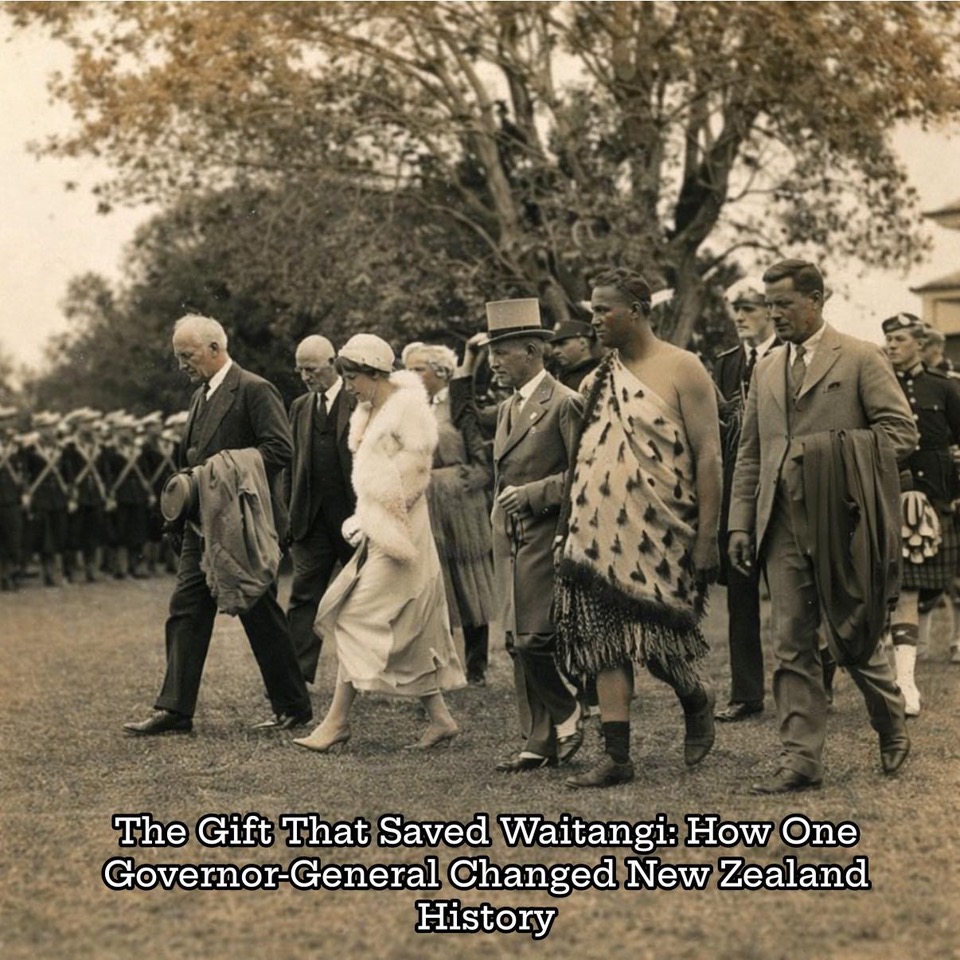
| An enthusiastic angler, His excellency is seen in this photograph at the Hut Pool on the Tongariro River. |
(Can you recognise where on the Tongariro River the Hut Pool was located? It is the TLB of lower bridge pool which has since been modified by Council bulldozers.)
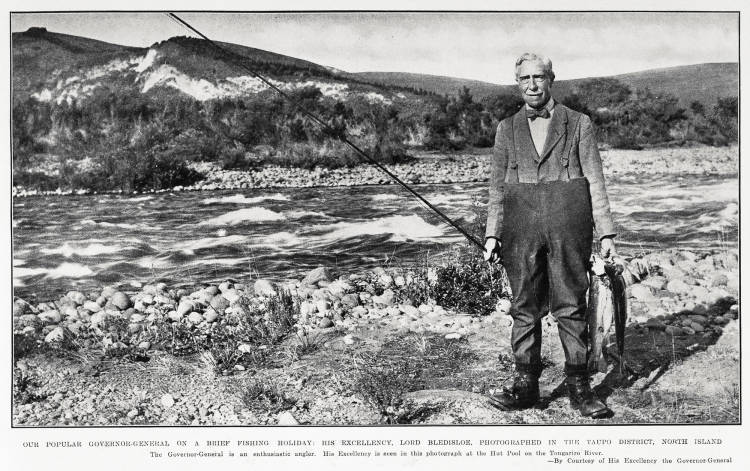
The Gift That Saved Waitangi: How One Governor-General Changed New Zealand History.
In 1932, at a time when the Treaty of Waitangi was largely forgotten by the wider public, one man took a decisive step that reshaped New Zealand’s national memory.
Lord Bledisloe, then Governor-General, personally purchased the Treaty House and its surrounding grounds at Waitangi and gifted them to the people of New Zealand. His intention was clear: to preserve the birthplace of the nation and restore the Treaty’s significance for future generations.
At the time, the Treaty House was privately owned, deteriorating, and at real risk of being lost to development. Bledisloe recognised that without intervention, the physical and symbolic heart of the Treaty would disappear. His gift ensured the protection of Treaty House and transformed Waitangi into a place of national reflection rather than a site of historical neglect.
The handover laid the foundations for modern Treaty commemorations, including the large ceremonial gatherings of the 1930s and the evolution of Waitangi Day itself. What began as a private act of stewardship became a cornerstone of New Zealand’s bicultural identity.
Today, every pōwhiri, protest, debate, and commemoration at Waitangi traces back to that single, defining gesture in 1932.

We have to wonder how Lord Bledisloe would view his gift, to celebrate and preserve the birthplace of the nation, now transformed into a sad day of protest.
Over the years, however, the Treaty has been re-interpreted to mean something entirely different. Everyone now has their own version. This is the TRM historically correct version:
Following a Court of Appeal decision in the 1987 Lands Case, where a Judge used the phrase “as if in partnership” as a metaphor for good faith, there has been an ongoing campaign to reframe the Treaty as a “partnership” between Maori and the Crown.
Maori rights activists in political parties, the public service, the courts, academia, the media, and advocacy groups claim the Maori translation, “Te Tiriti o Waitangi”, guarantees “Partnership, Participation, and Protection”. And as a result, official references to the “Treaty of Waitangi” are being systematically replaced with the reinterpreted political version, Te Tiriti.
But these actions do not withstand historical or constitutional scrutiny.
A ‘partnership’ requires two corporate entities capable of entering into a joint governance arrangement. But in 1840, there was no national Maori collective capable of doing so.
Nor was there anything in the Treaty’s text to suggest a “partnership” – the word does not appear in either the English or Maori versions.
And this, of course, is why Sir Apirana Ngata’s Explanation is so valuable. If the Maori version of the Treaty had contained any suggestion of a ‘partnership’, he would have mentioned it. Instead, his explanation is the antithesis of a partnership: Maori ceded sovereignty to the Crown and became equal citizens with everyone else.
In New Zealand, the Crown is the single, indivisible sovereign authority of the state – the sole source of law, the holder of executive power, and the institution to which all citizens owe allegiance.
If the Crown were to “partner” with Maori, it would no longer be sovereign but would instead share governance with Maori.
The effect of such a ‘partnership’ would be to replace Crown authority with 50:50 co‑governance divided along racial lines – a bastardised version of democracy that no other nation in the world has been foolish enough to entertain.
Previous TRM blogs reported the many historical connections between the Tongariro River and the Royals. i.e.
DUCHESS POOL
The Duchess – May 2005

Another pool which has changed considerably since the February 2004 flood is The Duchess. After the previous “Great Flood” on 24 February 1958, the Duchess also changed significantly; only the general location remains unchanged. Access is north along the TLB (True Left Bank looking downriver) riverbank – about 15-20 minutes from the Red Hut car park via Kowhai Flat. Please respect the access over private property
After the 2004 flood the most visual change immediately apparent from Red Hut bridge was the disappearance of the island above the bridge and changes to the course of the main channel – from the TRB to the TLB – these are indicative of significant alterations to the pools and river bed all the way down past The Duchess. Changes further upriver – to what was The Breakaway – were even more dramatic.

Prior to the 2004 flood The Duchess was fished from both sides but now it is more suitable from the TLB only. The depth of the pool has been reduced with the deep gut – hookup zone – now spread wider with the main flow on the TRB. The general pattern is to nymph below the big boulder or wetline at the head of the pool. The broad expanse of boulders extending from the Shag Pool indicates that the Duchess will continue to change in depth and character with each new flood.
Although this part of the river may take longer to access, it is still popular, but is now reported to be struggling to justify its previous reputation. However, despite this condemnation,

The Duchess pool still deserves compulsory attendance if only out of respect for its traditions and natural beauty.
In the 1960 book Freshwater Admiral, Harold Hickling describes the pool much more eloquently in technicolor prose as follows – …..In the precipitous cliff on the far bank are strata that range from white to deepest brown; nearby on lower ground rise tall poplars, like golden church steeples in the fall; and, as a pediment, the river, here white where it tumbles over the rapids, there in deep water an indigo blue changing to emerald and aquamarine as it shallows…. That is what I was going to suggest too.

Hickling suggested this might well be called the Royal Pool of the Tongariro due to the series of visits by Royals – named after the Duke and Duchess of York who camped and fished here in 1927 followed by Queen Elizabeth.
Devotedly following the early Royals are their subjects, in the form of various Governors General, who were obliged to confirm their aristocratic breeding skills by trying to improve on the Royals precedent by fly fishing The Duchess – just like shoal fish? These included angling Excellencies – GG’s including Lord & Lady Bledisloe, Lord & Lady Galway, Sir Cyril Newall, Lord Cobham, etc. Prince Charles broke the regal pattern in 1981, fishing the Birch Pool whilst anglers like Zane Grey did not even deserve a mention. So you are following in many regal footsteps.

Few river pools in the world could claim such a provenance of noble angling history, so it deserves a compulsory flick – just to say you¹ve been there, done that.
NOTE: Pool Reports for the Tongariro River are prepared from guest/anglers experiences. As such, Tongariro River Motel do not accept any responsibility for the opinions of other anglers who are traditionally acknowledged liars about their best fishing pools.
August 2006 Update

Generally there are no major physical changes to the Duchess Pool from 2005.
The new hot spots nearby – no-name pools above and the run below the Duchess, are reported to be increasingly popular but they could easily disappear – or improve? – after the next fresh. The braided river below the Duchess changes with each fresh and is worth a close inspection if anglers are already in the Duchess Pool. The river course above Duchess, below Shag, changes with each flood and are becoming more braided.

The pool at the head of Duchess, or below the old ‘Racecourse’ where the tumbling white water turns sharply left against the cliff, was originally known as Gentlemen’s Pool, but disappeared when the 1958 flood diverted the river into the old by-pass. The pool was so named because of the high number of jack fish that were caught here. After the 2004 flood, this pool has reformed at the head of the Duchess.
Naming History (X Barbara Cooper’s Pools of the Tongariro – 1975)

Duchess Pool is named after Queen Elizabeth, wife of George the Sixth, then Duchess of York, when the royal couple paid a visit to New Zealand in 1927. The Duke and Duchess expressed a wish to do some fishing while they were in New Zealand and a special camp was set up on Kowhai Flat. Later the buildings were moved to the Hatchery at the Birch Pool.
The camp was built with labour from Rangipo Prison Farm. To keep the visitors supplied with fresh bread, it was brought by horse-wagon from Waikune Prison which had the nearest bakery. The Duke and Duchess were taken to various pools but with indifferent success. The Duchess had remained in camp one day when the Superintendent of Rangipo Prison arrived with the supplies. He mentioned to the Doctor accompanying the visitors that they were camped near one of the best pools on the river, although it seems that until then they had not fished it. The Duchess went out and caught the best fish of the day there.