

Now the wet Easter is almost over we can look forward to another short week and a holiday to commemorate ANZAC Day.
So working towards ANZAC Day, we recount the history of Admirals Pool. Who was the Admiral? Most anglers imagined it was Rear Admiral Harold Hickling who wrote “Fresh Water Admiral”. They were wrong.
Hickling went to great lengths to measure and describe every pool in detail but before the book was published, the 1958 flood of over 1400 cumecs changed the river so much he had to rewrite the book.
But the Admiral’s pool was named after a much more illustrious angler, being the second Governor General of NZ, 1920-1924, previously the British Admiral of the Fleet in WW1, Lord Jellicoe.
First below is an old TRM report to describe the Admirals Pool technique of “Tag Fishing” – as this is supposed to be a fishing report – followed by an interesting description of Lord Jellicoe and why he deserved to have a pool named after him…
More interesting Jellicoe connections will continue with an account of the old “Jellicoe Pool” – once the most productive pool on the river, yet only TRM inmates ever heard of it. But wait until you read how anglers accessed it. Fly fishing back then was a more exciting, and challenging adventure!
Admirals Pool access explained

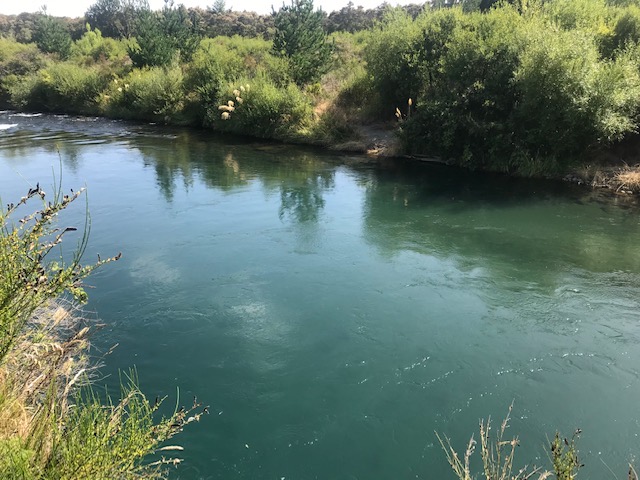
(Looking across the swirly current of Admirals Pool towards the car park on the TLB. Trout are usually easily seen waiting for anglers, so approach cautiously…)
TRM’s fishy inmates have often asked “How do anglers get to the TRB (True Right Bank looking down river) of Admirals Pool”?

(Image on right looking down TRB from the tail of Admirals Pool towards Kamahi Pool. If you lean forward you can almost smell the trout waiting in the tailout?)
Admirals Pool is often regarded as a barometer of the number of trout in the river. The trout are easily spotted from the high bank at the end of the anglers’ vehicle access – gravel road – down to Admirals (most turn off to Stag Pool car park). It is an ideal viewing spot to impress visitors, to indicate how many trout are in the river. Fat lazy trout can usually be seen resting and/or feeding in the tail of the pool along the TRB.
Tag Fishing
From the car park the TLB can be fished but needs a tandem team strategy. Local kids are the experts at casting a heavily weighted nymph from the high car park bank, where the trout are easily seen and can be individually targeted. After they eagerly take the nymph and the hook is firmly set, when the initial mad scramble settles down to a contest of strength and the trout starts sulking in the depth of the pool, then quickly rip-off plenty of spare line and the rod tossed down to their mate waiting in the shallows at the tail below for him to play and guide the tiring trout into the tail of the pool. Brilliant strategy.

After landing their trout in the shallows by sliding the spent trout onto the stones, their drill tactic is to swop positions.
The track down to the river bed leads from the other carpark about 20m on the left back from the cliff edge.
The elevated car park is also a perfect place to study nature at work – in terms of a visual example of nature’s ‘pecking order’ in the wild. You will need your polaroid glasses to observe how the biggest trout are usually at the front of the shoal and the smaller trout get chased out to the back of the feed line queue. The biggest are often more difficult to spot in the depths below the strong current but the size of the trout steadily reduces towards the tail.

(An older image looking up river from Admirals car park – the current has now spread across the run – see image below. This used to be known as Gun Club Reach named from the traps set up by the old Tongariro Gun Club for trap shooting.)
Recent changes to the flow force the main current across to the TRB almost out of reach even from the elevated bank. The sight of 10-15 trout waiting and even more bigger dark menacing shadows in the depths get anglers juices flowing and they feel compelled to investigate how to get to the TRB corner position. It is not too difficult.

The walking route is to park at the Koura Street swing bridge and then cross over and walk upriver. The entire route will take about 30-40 minutes each way.
Think about this if you want to keep the catch as it is a long way to carry three x 4-pound trout. It will get harder later in 2017 when DOC increase the daily maximum catch to six… The easiest most convenient method that makes it much more accessible is to cruise up there on a bike in less than half the time. Remember to take some fish bags to place in the bike-rack-packs available at reception. Waders are not needed.

After about 25 minutes turn off down the side access track to Kamahi Pool. Follow this about half way to Kamahi and count off the side tracks on the left. The third track provides the easiest unmarked access down a couple of steps into the usually dry overflow stony creek bed. Turn right and follow this to the riverbank and turn left upstream towards Admirals Pool.
Rather than bush-bash along the river edge, turn left up another larger stony overflow creek bed, which leads away from the river towards Cicada Pool. (This wider dry overflow river bed is clearly seen in the aerial image below on the right.) Take this and walk (? take care – more of a stumble – wading poles recommended) over boulders for about 200 m, looking out for a red ribbon tied to a Manuka bush.

That marks the turning point to locate a hardly discernible trail through the high secondary growth (beware of blackberry attacking waders) which emerges just below the corner of Admirals Pool. Simple.
It does take some effort, but it is well worth it. The only worry is walking all that way, only to find some other angler got there first. In that situation, nothing is lost – backtrack to Kamahi Pool, which is arguably just as good and probably the prettiest track and pool on the river. The sweet chorus and chiming melody from bird life around Kamahi is often reward enough. The fan tails are so cheeky.

(Looking up TRB from the corner of Admirals Pool towards the cliff above Cicada Pool)
Best approached on a cloudy day or when there is enough gentle breeze to blur the surface and mask the vision so the trout are not so easily spooked, or after a fresh when there is more colour in the water.
Admiral’s Pool is named after Admiral of the Fleet, Lord Jellicoe, the second Governor General of NZ 1920-1924. In the 1920’s he used to stay at Taylors Camp on Taupahi Road (as Tongariro River Motel was not built until 1959)…
(View from cliff above Cicada Pool looking down river towards Kamahi Pool in distance.)

Admiral’s Pool
Timed perfectly for ANZAC Day, this was to commemorate Admiral’s Pool centenary.
Who was the Admiral whose illustrious name lives on in the Admiral’s Pool on the Tongariro River? Everyone using SH1 must have noticed the AA signpost about 1 km south of Turangi pointing down a gravel anglers access road to the pool. TRM often sends fishos to Admiral’s Pool lookout whenever they complain that the fishing is hard and there are no trout holding in the river. From the car-park on the TLB they can look down through the surface sheen and easily view ten, twenty, or more big trout holding in the strong current. It is interesting to observe the pecking order – how all the biggest trout (7-8-9 pounders) are at the top of the pool having chased the smaller tour (3-4 pounders) to the shallow tail.
Sadly there is no information board or tourist signs commemorating the significance of such a historic pool. TRM have now published a book, “TONGARIRO SKULDUGGERY” to raise funds for the establishment of information boards to explain the background of some of the more famous Tongariro Pools.

Usually, the pool is fished from the TRB with access from the anglers access track leading down to Kamahi Pool – the next pool lower in the Tongariro River. Alternatively, when the pool is loaded with trout reaching back to the shallow tail, it can be accessed from the car-park. About twelve years ago we were entertained by two young locals tag-fishing from the high bank. One would heave a very heavy “hare & copper” bomb into the head of the pool and soon hooked up easily. After a brief fight as soon as the trout tired he would throw his rod down to the other kid, waiting below in the shallows, who would beach it in the tail of the pool. Then they would swop over. Please don’t ask about the legalities of their method!
Back to the Admiral – the most common question asked by tourists and anglers is “who was the Admiral?” He was arguably the most famous and most controversial Governor-General of New Zealand about 100 years ago (i.e. before “Aotearoa” had been invented). The pool was named after Lord Jellicoe, First Sea Lord, Admiral of the Fleet and second Governor-General of New Zealand from 1920 to 1924. A brief biography below describes the controversy when he was sacked from the Admiralty (for negligence!) after WW1 and dispatched to the colonies, where (West Islanders will love this!) he preferred NZ to Australia.

To qualify as GG, they also had to be a competent fly fisho to succeed on the Tongariro River. Several more GG’s followed him and stayed in the anglers’ camp on Taupahi Road, which was the main north-south road until the new village of Turangi was developed from about 1965. The basic accommodation was the only anglers’ camp available for many years, apart from the huts near the bridge, with shared “ablutions” block and shared kitchen facilities.
Back then the Tongariro flowed at natural levels, before the 1960’s hydro scheme redirected about half the flow through the turbines at the Tokaanu Power Station. For the much larger flow around 40-50 cumecs, the casting rods were 15 to 17 feet (4.5 m to 5 m) rods designed for Scottish salmon rivers. Flies were tied exactly to Scottish patterns – Silver Doctor, Jock Scot, Durham Ranger were all popular, tied on 1/0 or 2/0 hooks. Even women fished with these huge rods – see photo of the Duchess of York – the Queen’s mother – fishing the Tongariro River at Kowhai Flat in 1927. By the late 1920’s a whole new range of NZ patterns had been developed of which the Matuku, or bittern, was by far the most popular. It was lucky for the bittern that it was later protected.
Until the 1920’s only the pools below the road bridge were fished intensively. Above the bridge the access was too difficult. On a tourist map of 1929, only the Major Jones Pool, the Admiral’s, the Hatchery, the Dukes Camp, the Tawaka Pool (possibly the site of Red Hut Pool), and the Dreadnought were shown.

BIOGRAPHY: John Henry Rushworth Jellicoe was born at Southampton, England, on 5 December 1859, the son of John Henry Jellicoe, a master in the merchant service, and his wife, Lucy Henrietta Keele. At the age of six he attended a preparatory school, at 11 he went to Field House, Rottingdean, and at 12 (in 1872) he entered the Royal Navy. Later he qualified as a gunnery specialist. During a varied service he participated in the Egyptian war of 1882, survived the loss of the Victoria following a collision in 1893, and was badly wounded while leading a naval brigade during the Boxer Rebellion in China in 1900. On 1 July 1902 he married Florence Gwendoline Cayzer, with whom he would have six children.

While serving at the Admiralty during the first decade of the century, Jellicoe was heavily involved in the development of the British battle fleet, as it adjusted to the demands of new technology and the threat posed by the growing German navy. During 1907 he was promoted to rear admiral and made a KCVO. After the outbreak of war in 1914 he took command of the Grand Fleet. At the battle of Jutland two years later he twice put the German fleet in extreme jeopardy, but was unable to defeat it decisively, an outcome that would become a matter of great controversy in Britain after the war. Jellicoe became First Sea Lord in December 1916. Again his tenure proved controversial as the Allies sought to counter Germany’s unrestricted submarine campaign, and he was eventually dismissed in December 1917 because the British prime minister, David Lloyd George, was convinced that the Admiralty had been negligent. Even so, for his war services, he was raised to the peerage as Viscount Jellicoe of Scapa in January 1918, and in the following year was given a grant of £50,000 from the nation and promoted to the rank of admiral of the fleet.
In February 1919 Jellicoe was dispatched on a year-long mission to advise dominion governments on naval policy. Conveyed by the New Zealand, first to India and Australia, he reached New Zealand on 20 August 1919. During the next six weeks he visited ports throughout the country and carried out many social engagements, while preparing a three-volume report for the government. This emphasised the necessity of a Pacific fleet with adequate docking facilities to counter a possible threat from Japan, and set out ways in which New Zealand could contribute to the fleet. Financial stringency prevented the full implementation of his recommendations, but New Zealand did follow his suggestion in creating, in 1921, a New Zealand Division of the Royal Navy.

Even before his empire mission, Jellicoe had been keen to obtain the New Zealand governor-generalship, even declining, ostensibly on financial grounds, an offer of the Australian post. He saw such an appointment as a dignified and happy way of erasing the hurt caused by the manner of his dismissal as First Sea Lord. Moreover, he admired New Zealand’s staunchly loyal attitude to the empire. When arrangements for replacing Lord Liverpool fell through, the way was opened, and he assumed office on 27 September 1920.
Jellicoe was regularly consulted by William Massey, the prime minister, about imperial affairs, and often took the initiative in providing comment on dispatches passing through his hands. On naval policy, which both he and Massey regarded as an imperial matter, his involvement breached the convention that the governor general not intervene in domestic politics; at the time, both Liberal and Labour parties were attacking the government’s policy. Massey could with justification describe Jellicoe, who was always careful to give his advice discreetly, as ‘an invaluable counsellor’. Their relationship was helped by their shared interest in British Israelism and, from 1922, Freemasonry. Jellicoe bolstered the government’s resistance to any change in the constitutional framework of the British Empire which might seem to weaken imperial unity. During the Chanak crisis of 1922, he prompted New Zealand’s almost instant offer to send troops in support of the empire against Turkey.
A wider constitutional question was raised when he privately advised Massey to protest against the British Labour administration’s decision in 1924 to end work on the Singapore naval base, the key to British power in the Pacific region. In making suggestions as to the wording of the cable to be sent to the imperial authorities in London, he took a stance against the British government, which he represented in the dominion.
Jellicoe was an active governor general, travelling widely throughout New Zealand and enthusiastically participating in sports such as cricket, golf, fishing and shooting. He was especially active in yachting, helping found the X-class boats and presenting the Sanders Cup; he took part in the first Sanders Cup series, and other national contests, and was patron of many yachting clubs. He also presented a challenge trophy for competition in rifle marksmanship between schools. The grand master of the Grand Lodge of New Zealand from 1922 to 1923, he served as patron of many charitable organisations and was especially interested in all ex-servicemen’s matters.
So quickly did Jellicoe make an impact that Massey described him in 1921 as ‘the most popular man we have had’. The fact that he was a man of action, who had risen to the top of his profession without the benefit of wealth or social standing, appealed to many New Zealanders. He was almost a working man’s aristocrat. Dispensing with many formalities, he mixed easily with New Zealanders of all classes, who were impressed by his ‘simple unassuming manner’. He also made a point of meeting with Maori. Even the Labour leader, H. E. Holland, in 1924 extolled his popularity and his appreciation for ‘the atmosphere in which the rank and file of the people lived’. Jellicoe’s strong imperial patriotism struck a chord with most New Zealanders, and he created a firm preference for distinguished servicemen as governors general.
The admiration was mutual. For Jellicoe, the incomparable scenery was complemented by the hospitality and loyalty of the people. By the end of his term he could profess, with sincerity, to ‘love the country and the people’. It was with much reluctance that he departed on 26 November 1924. His governor-generalship was thought to have strengthened one of New Zealand’s few formal links with Britain. Several geographical features recall his presence, including the channel between Little Barrier Island and Cape Rodney and a point on the eastern shoreline of Lake Taupo. A ward named after him at Napier Hospital was destroyed in the 1931 earthquake.
Shortly after Jellicoe’s return to Britain, where he took up residence near Ventnor, on the Isle of Wight, he was advanced to an earldom. Massey had seen him as virtually a naval ambassador for the dominion, and Gordon Coates’s government formalised this role by appointing Jellicoe as one of New Zealand’s delegates to the inconclusive Geneva Naval Conference in 1927 – an arrangement that fellow delegate Sir James Parr later described enthusiastically as ‘a great stroke for New Zealand, giving us a decided importance in the Conference’. Because of Jellicoe’s strong opposition to further cuts to British naval strength, the British Labour government ensured that he was excluded from the London Naval Conference in 1930, though New Zealand’s delegate, Sir Thomas Wilford, did use Jellicoe’s views to buttress his arguments against the British policy.
Jellicoe was president of the British Legion from 1928 to 1932. He was actively involved in many organisations, including the Boy Scouts’ Association and the National Rifle Association. He died in London on 20 November 1935, and was buried in St Paul’s Cathedral, alongside Horatio Nelson and other naval heroes. He was survived by his wife, Florence, four daughters and a son.

Ever heard of Jellico Pool?
That is enough historic fishy reading for one day, but tomorrow TRM’s blog is all about the lost and confused location of the Jellicoe Pool. Of course, most Tongariro anglers have never heard of it yet back in Jellicoe’s time in the 1920’s it was the most popular pool on the river. A clue – The walking trail to it involved crossing a plank or a crude board-walk for about a km across a swamp. The walking trail was neglected years ago and is now overgrown and is no longer accessible. But the history is fascinating…
