

Is fly fishing the new yoga?
About three years ago I asked one of the Taupo Fishing Club ladies what was her secret recipe for encouraging so many women into fly fishing? She had been very instrumental in boosting female membership of her club and had been asked to speak at so many clubs and women-only meetings. She replied it was easy! To launch her address, to keep their undivided attention, she told them that fly fishing was better than sex!
The recent top-rating news story of the Black Ferns’ meteoric rise from obscurity to immense popularity as world champions may have been the biggest sports headline news in 2022.
Now, for 2023, we anticipate an even better story of the rise of a team of enthusiastic dedicated ladies who share a passion for fly fishing.
TRM first met them almost by accident over four years ago. TRM’s incentive to promote women’s fly fishing started in 2019 when a lady inmate was hoping to join her husband on a fly fishing course in an up-market lodge at Taupo. They declined her application as it was restricted to men only. Wow! SWMBO immediately plotted revenge. (She Who Must Be Obeyed usually has nothing to do with fishing but this was a top priority matter.) To match them she sponsored a more competitively priced “women only” tournament at TRM to be held at the same time. The Taupo Lodge charges $thousands. TRM’s event was free! Needless to suggest, it was a roaring success and has been repeated ever since. That success was mainly due to the enthusiastic members of Taupo Fishing Club who managed the “tournament”. It was not a strict competition but more of an informal get-together to introduce novices and giggle their way through three days of fishing.
To indicate how women fly fishing can more than match their rugby counterparts… Currently, there are about 22,000 female rugby players in New Zealand; 15,000 are Small Blacks; 5,100 teenagers; and 1,500 are aged 20 and older. OK? So to be fair for comparison purposes only 1500 aged 20 or over should qualify for comparison.
Now compare that to NZ fly fishing ladies: In NZ, 24% or 25,981 (of the total licences of close to 80,000) are wearing shapely waders! WOW!

SFFNZ is pleased to announce the team to compete at the 2023 World Ladies Fly Fishing Championship.
The event is being held in Kamloops, Canada, between 24-30 September.
Congratulations to the team:
· Rachel McNae (Captain)
· Louise Stuart
· Suzie Foggo
· Heather Carrington
· Sarah Delany
Co-managers
· Lesley Hosking
· Chris Pritt
And they are all members of the Taupo Fishing Club!

International comparisons:
In the UK womens’ fly fishing has become a glamour moment with licence sales up 230%. In the UK Marina Gibson has 61,000 subscribers to her YouTube channel, 48,200 on Instagram, and thousands more fans on her Facebook live chat shows. (That is almost as many as SWMBO!) Gibson is filming a 12 part video series for YouTube.
The Canadian version has April Vokey with a hit video series on Steelhead (they are the same trout species as NZ Rainbow trout, only smaller) with 125,000 fans on Instagram.
Women anglers make up 32% of the 6.5 million American anglers who fish. That is over 2 million!

etc…
In NZ professional guides and tackle shops are organising female-friendly workshops. Some, like Taupo Fishing Club, stress social benefits at “Wine Women Waders” meetings. Therefore it is no surprise to discover that all members of the NZ Womens Fly Fishing Team are from the Taupo Fishing Club.
New workshop lures more women into fly fishing
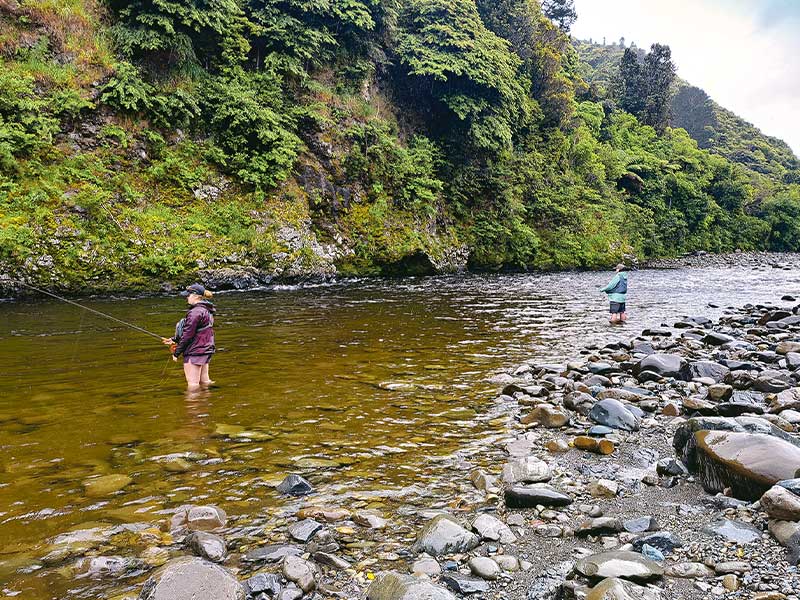
A new workshop launched in Wellington last November aimed at encouraging more women into fly fishing.
The workshop was set up by Leigh Johnson of Women on the Fly, who says she wants to help women engage in the sport and see participation numbers increase.
Fish & Game NZ sells around 100,000 freshwater fishing anglers’ licences each year, with around one-third of participants being women.
Johnson says she wants to help shift that demographic, and so with the help of the Kapiti Fly Fishing Club and Fish & Game, she launched the Women on the Fly workshop for women from the Wellington region, on the banks of the Hutt River trout fishery.
“The target audience for the Women on the Fly workshop is women who want to learn about fly fishing and give it a go, as well as those who wish to develop their skills, confidence, general knowledge, and friendships,” Johnson says.
Barriers to overcome
Johnson says there are many barriers for women taking up fly fishing as a recreational activity, including a lack of female role models, a lack of women in fishing clubs, and the physical aspect of the sport.
“I’ve met women here locally who’ve been along to our fishing club, and they said they’ve often been the only woman going along and things haven’t gone quite how they expected to, or they didn’t feel as welcome as they thought they should.
“And they haven’t stayed as members because there aren’t the friendships to be made by having enough women involved. There aren’t the role models – who do you know who’s an experienced angler who will get you out fishing?”
Johnson says some women are also nervous about the physical side of fishing.
“They’re worried about accessing rivers. But you don’t need to wade in water up to your hips to be successful, which I know is what prevents some women from taking up the pastime.
“Fly fishing in New Zealand is so accessible. Not only are we recognised as having the best trout fishery in the world, but almost all Kiwis also have superb angling right on their doorstep, with most rivers, streams, and lakes holding healthy populations of fish.”
Johnson says there are numerous benefits to fly fishing.
“Women’s lives can be stressful given the challenges associated with juggling work and family, and fly fishing is a wonderful way to decompress and destress. When I was running my business in Wellington, it was an incredibly hectic period in my life. I wish I had maintained an active interest in fly fishing, rather than returning to it in my retirement, as it would certainly have helped me unwind and re-centre at a time when I needed balance.”
Johnson drew on her business nous to project-manage the event, which involved successfully applying for an underwriting grant from Wellington Fish & Game, arranging guest speakers and presenters, and door-knocking potential sponsors.
“The support we’ve had from everyone is just fantastic. Hunting & Fishing and Manic Tackle Project were our key sponsors. It was a superb event, and I can’t wait to see a cohort of women head off on their own exciting angling journey and reap all the rewards that the pursuit has to offer. ”
Weekend workshop

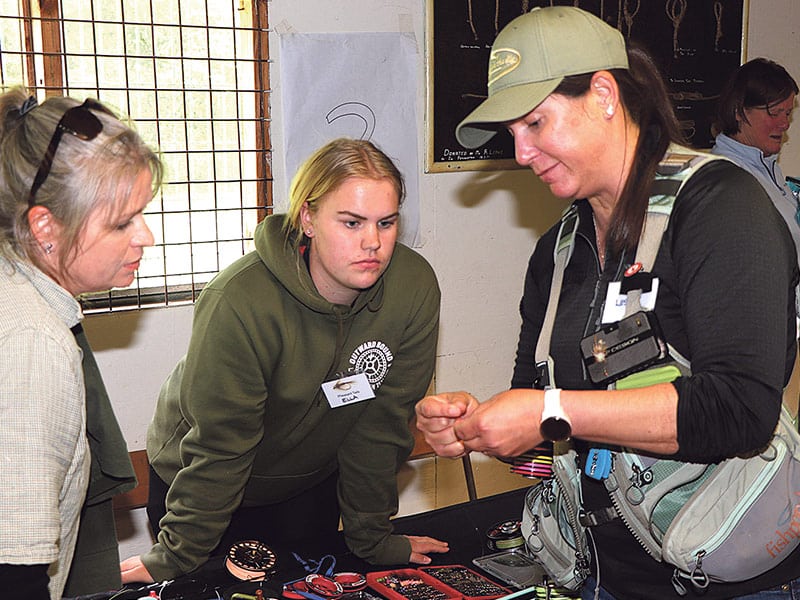
The workshop ran over two days on 26 and 27 November and involved practical workshops with experienced facilitators, all of whom were women flyfishers. The workshop saw 28 women take part.
“I was able to draw on the networks that I’ve made and was able to get some real role models along,” says Johnson.
“A key aspect of this workshop was to bring in experienced female fly fishers from around New Zealand to share their skills and experience over the weekend.”
Johnson says one of the aims of the workshop was to enable people to make friends and meet people you could go fishing with.
“About a third of people who came along were absolute beginners. The rest were able to come along and learn skills you’ve never tried before, to build up your confidence. It can be quite intimidating to go out on the river and be surrounded by people who seem to know what they’re doing when you feel like you don’t.”
The second day of the workshop involved taking the women out to Hutt River and out on the water.
“Some of these ladies have never held a rod or never been in the water,” says Johnson. “So it was a real opportunity to try and give it a go.”
Corina Jordan, Fish & Game NZ’s first female chief executive, was the keynote speaker for the workshop. Jordan says the initiative was exactly what angling needed.
“We’re currently embarking on a nationwide survey of our women licence holders to try and find the drivers for their involvement, and how we might use that to bring more female anglers into the fold,” she says.
“But these events like Leigh has organised at the grassroots level are so valuable for helping drive recruitment and setting up support networks for anglers starting out.”
For more information, visit womenonthefly.nz.
Attempt to lure more women to the delights of catching trout
Kathryn Vinten wants to see more women chasing trout.
Kathryn Vinten is on a one-woman mission to get more females trout fishing.
Like shooting deer or rabbits, angling is a Kiwi tradition but it one mostly enjoyed by men.
The Petone resident recently began fishing the Hutt River for brown trout and was struck by how few women there were on the river.

So she set up a Facebook page troutgirl.nz@gmail.com and contacted other female anglers to create a support network. She is also part of a Fish and Game run project aiming to see New Zealand reach American levels, where 30 per cent of the six million fresh water anglers are female.
“In the US they are calling fishing the new yoga.”
In the 1970s she fished Lake Taupo with her father. For the last 25 years she had been a regular on the Tongariro River, chasing elusive rainbow trout.
Personal safety, the lack of suitable gear for women and a perception that angling involved long hours standing in cold rivers all contributed to the low numbers, she says.
Just in case you did not follow NZ’s other religion…
Last year’s women’s Rugby World Cup was a ground-breaking tournament for the champion Black Ferns, as they captured the “hearts” of a rugby-mad nation.
The Black Ferns dared to dream throughout their pursuit of rugby immortality, while many rugby fans around the world cast them aside as nothing more than a pretender for the sports ultimate prize.
Less than a year out from the World Cup on New Zealand soil, the Black Ferns made their return to international rugby with a disastrous end-of-season tour to England and France. After losing two test matches against both teams – and by emphatic margins as well – the Black Ferns’ dream had seemingly taken a hit before it’d even begun.
But under the tutelage of super coach Wayne Smith, who was later named World Rugby’s Coach of the Year, the Black Ferns etched their names into New Zealand sporting folklore.
After getting off to a slow start against rivals Australia at Eden Park to begin their tournament, the Black Ferns were a class above in their other matches as they charged into the semi-finals.
But then, a chance to rewrite history awaited the Black Ferns. And that’s exactly what they did.
Watch this space for the womens’ fly fishing team…