
Further to TRM’s fishing report yesterday, we are often asked by tourist anglers whether Catch & Release (C&R) is compulsory?. Our standard reply was ‘No”. C&R is encouraged on remote fragile rivers with a lower resident population, where angling pressure is likely to influence the trout population, and where trout density is naturally low. But in the Taupo fishery it is not necessary.
At this time of the year dead trout are often seen drifting down the Tongariro. Some of these are undoubtedly from poor C&R techniques. Yet many times we hear sad anecdotal reports of trout released after being dragged over the stones, flapping about while the hook is removed, then subject to torture from squeezing during prolonged photographic sessions, measuring, weighing, and then thrown back with minimal chance of survival.
Below is a C&R research paper that suggests: In Lake Taupo, a study found that the majority of trout survived after release (85-98%) but fish caught at depth with downriggers had the highest mortality rates (Maclean 1997) C&R fishing will no doubt continue to be popular among anglers in New Zealand. Voluntary changes in angling philosophy, rather than the development of regulations, are likely to continue to be the major factor influencing future trends in angling (Dedual et al. 1998)
DOC’s suggestions from their facebook, to improve the chances of survival:
 (Images from TRM library – Harry releasing a superb Rainbow Trout in lower Bridge Pool)
Releasing trout so they survive – at this time of year anglers will regularly encounter trout that are recovering from the rigours of spawning. These ‘kelts’ or ‘slabs’ don’t make good table-fish so anglers will often choose to release them. Unfortunately, a proportion of these fish die due to poor handling and eventually wash up on the shore. The good news is, there are simple things we can do to reduce this problem.
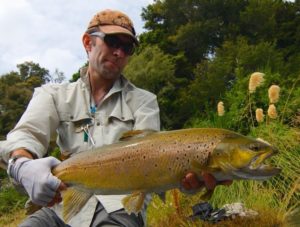 (Jason Klivington releasing a BIG brown trout in Cattle Rustlers Pool.)
Key things to remember:
• Always try to land a trout quickly to minimise stress and exhaustion.
• Use a knotless net to land a fish or bring it carefully to the bank or boat.
• Make the decision to keep or release a fish while it is still in the water.
• If you decide to release it, try to unhook the fish in the water.
• If it is necessary to handle a fish, ensure you wet your hands first and turn the fish upside-down to relax it.
• Ideally remove the hook using long-nosed pliers or forceps.
• Process the fish quickly and support it in the water prior to release – the fish should actively swim away.
• Barbless hooks make it much easier to release fish.

(TRM fishing guide – Richard Mowforth releasing a good brown in the Tongariro River)
There are also important things that anglers should avoid:
• Never let trout flap around on the bank or on the floor of a boat.
• Never rip the hook out.
• Never squeeze a fish or put your fingers in or around the gills.
• Never throw a fish back into the water.
The gills and internal organs are very easily damaged. A trout that is bleeding from the gills through being hooked or squeezed may swim off but will die shortly after.
However… there is much more to it than that. For those who do practice C&R religiously, below from Fish & Game’s 1999 report is an extended researched version of C&R material from Cawthron Institute:
EXECUTIVE SUMMARY:
Catch and release (C&R) is becoming more and more popular in New Zealand and the majority of trout caught in backcountry rivers are now released. However, there is not much information on its success. In this report I have reviewed a range of international studies relating to C&R angling and comment on their relevance to New Zealand fishery management. This report is an extended version (including references) of material presented in a recent article in Fish & Game New Zealand magazine (Young et al. 1999).
C&R should only be considered where angling pressure is likely to influence the trout population, and where trout density is naturally low. Most fish that are released will survive, but changes in behaviour of trout after being caught and released appears to alter trout catchability and has the potential to reduce the growth rates and carrying capacity of trout populations. In most situations anglers are supportive of C&R regulations, especially when they lead to increases in catch rates and fish size. In some cases in North America, this popularity has resulted in severe overcrowding with limits on the number of anglers allowed on certain stretches of water.
Although the results from North American C&R research are useful, we must remember that New Zealand fisheries are unique in many ways. Nevertheless, C&R will undoubtedly remain popular among anglers in New Zealand and will be increasingly important in maintaining acceptable catch rates of large fish in the future.
1. INTRODUCTION
Over the past 10 years, C&R has been widely adopted by many anglers in New Zealand. Fishing magazines have supported C&R practices and almost all photos of anglers and their catch now show live fish about to be released back into the water. Most angling guidebooks also encourage people to limit their catch and even consider no-kill in specific fragile fisheries. In most cases the development of a C&R philosophy among New Zealand anglers has been through education and voluntary means rather than regulation. However, there are already regulations on several rivers and lakes in Southland, Otago, North Canterbury and Taranaki and maximum size limits for trout on some parts of the Eastern, Hawkes Bay, and Wellington Fish & Game regions. Despite the increasing popularity of this technique in New Zealand we know relatively little about the success of C&R and any benefits or costs associated with it for our fisheries. In this review I consider results from scientific studies of C&R, most of which have been conducted overseas, and relate their findings to our situation here in New Zealand.
2. SUCCESS AND FAILURE OF CATCH & RELEASE REGULATIONS
In New Zealand C&R generally refers to complete no-kill regulations where all fish must be released back into the water alive. The interpretation of C&R overseas is somewhat wider and includes areas with low bag limits ( 2 fish) and incorporates maximum and minimum sizes for legal harvest. Under certain circumstances C&R regulations have proved very successful for trout fisheries (Behnke 1987; Barnhart 1989). Improvements in catch rates have been spectacular in Montana (Wells 1987), Wisconsin (Hunt 1987), Idaho (Lewynsky & Bjornn 1987), Colorado (Nehring & Anderson 1984), Yellowstone National Park (Varley 1980; Jones 1984; Jones 1987), Connecticut (Orciari & Leonard 1990), and New York (Barnhart & Engstrom-Heg 1984). Increases in the mean size of the catch have also been widely reported (Marcoux 1979; Varley 1980; Jones 1984; Nehring & Anderson 1984; Gresswell 1987; Jones 1987; Wells 1987; Orciari & Leonard 1990). Many of these fisheries were traditionally maintained by yearly releases of takeable sized fish, but with the advent of C&R regulations such “put-and-take” tactics are no longer required (Barnhart & Engstrom-Heg 1984). As a result of such releases, hatchery reared fish were replacing native species such as cutthroat trout (Gresswell 1987; Wells 1987). C&R regulations have improved the state of native fisheries in many cases (Gresswell 1987; Jones 1987; Thurow 1987; Wells 1987).
In high altitude coldwater streams C&R regulations have failed to result in increased catch rates or an increase in the average size of fish caught (Nehring & Anderson 1984). In such systems, temperature is the primary factor controlling fish growth and there are high natural mortalities as a result of the harsh winter conditions (Nehring & Anderson 1984). A combination of low growth rates and short life expectancy produces stunting in these populations.
Success of C&R programmes must also depend upon the original aim of regulation changes. In some cases, C&R has resulted in higher catch rates but no increase in the average size of fish caught (Wells 1987). If the original aim was to increase average fish size then these programmes are considered to have failed. In populations where natural recruitment is more than sufficient to maintain trout populations, reductions in angler harvest may increase density dependent interactions among fish resulting in increased numbers of small fish (Wells 1987; Perry et al. 1995). Success of C&R programmes also depends upon the species of trout present. The best success has been with populations of cutthroat trout, which are highly susceptible to angling (Nehring & Anderson 1984;
Griffith 1987; Jones 1987). Rainbow trout appear to have an intermediate level of susceptibility (Griffith 1987), while brown trout are generally considered to be more difficult to catch and therefore their response to C&R is generally less pronounced (Barnhart 1989). Nevertheless, C&R has resulted in improvements in some brown trout fisheries (Orciari & Leonard 1990).
3. HOOKING MORTALITY
Many anglers must wonder “Will the fish that I’ve just released survive?” The general consensus from several studies is that most fish (>90%) will survive (Taylor & White 1992; Schisler & Bergersen 1996; Schill & Scarpella 1997). Cases of individual tagged trout being caught and released up to 13 times have been reported (Griffith 1987) while Schill et al. (1986) calculated that cutthroat trout in a section of the Yellowstone River were caught an average of 9.7 times during one season. A further test of the durability of trout can be seen with the survival rates of fish that have been used in radio tracking studies (Dedual 1996; Strickland et al. 1999). Despite the stress of being caught by anglers and the subsequent anaesthesia and surgical implantation of transmitters, both brown and rainbow trout have shown good survival and apparently normal behaviour. The stress associated with implantation of the transmitters would no doubt exceed that experienced by most trout that are simply caught and released by anglers.
Several factors affect the survival of fish, however. Fish that are hooked in the gills or stomach, as is often the case when using bait, bleed heavily and have lower survival rates than fish hooked in the mouth or corner of the jaw (Taylor & White 1992; Schisler & Bergersen 1996; Schill & Scarpella 1997). Prolonged handling of fish also decreases their chances of survival (Schisler & Bergersen 1996). Removal from the water for an extended period seems to be particularly harmful (Ferguson & Tufts 1992; Schisler & Bergersen 1996). After an exhausting period of ‘exercise’ the last thing a fish needs is to be lifted out of their watery surroundings to an environment where they can’t breathe. Warm summer temperatures have been associated with lower rates of survival among fish that are released (Schisler & Bergersen 1996; Wilkie et al. 1996), so particular care should be taken to quickly return fish to the water under these conditions (Schisler & Bergersen 1996). Another factor that affects fish survival is the depth from which they are caught (Maclean 1997). Clearly this is not a problem in river fisheries, but in lakes the swim bladders of fish that are hauled to the surface may expand rapidly resulting in internal injuries and buoyancy problems (Shasteen & Sheehan 1997). Shasteen & Sheehan (1997) actually showed that survival of largemouth bass caught at depth may be improved by puncturing the swim bladder before release.
Fish size has also been related with mortality rates. In some cases, large fish had higher survival rates after release than small fish (Loftus et al. 1988; Schisler & Bergersen 1996) while in other studies the opposite trend was observed (Taylor & White 1992). Large fish are more able to swallow larger hooks leading to higher mortality rates (Nuhfer & Alexander 1992). In addition, the physiological stress of angling has also been shown to be higher for large hatchery fish (Wydoski et al. 1976; Ferguson et al. 1993). However this pattern of physiological response has not been observed in populations of wild fish (Booth et al. 1995).
There have been many debates about the use of barbed vs barbless hooks. The major interest by anglers in barbless hooks is that they are thought to allow fish to be unhooked and returned to the water more easily and quickly than is the case with barbed hooks. Early reviews that addressed this question showed no differences among hook types (Wydoski 1977; Mongillo 1984). Subsequently, Taylor & White (1992) and Muoneke & Childress (1994) have suggested that mortality rates were higher where barbed hooks have been used. However, the strength of these claims, particularly by Taylor & White (1992), has been questioned (Schill & Scarpella 1997; Turek & Brett 1997). Some angling guides now think that barbless hooks may be more harmful than barbed hooks because they penetrate further into fish’s flesh. It seems clear that any differences among hook types are very small and unlikely to affect rates of population exploitation (Schill & Scarpella 1997).
4. OTHER EFFECTS
Even if fish don’t die after being released, they are likely to experience a variety of non-lethal effects. A large number of studies have examined the physiological effects of angling stress on fish. Exhaustive ‘exercise’ decreases stores of ATP, glycogen and phosphocreatine (Booth et al. 1995; Wilkie et al. 1996) and increases the concentrations of lactate in a fish’s muscles (Tufts et al. 1991; Ferguson & Tufts 1992; Booth et al. 1995; Wilkie et al. 1996). Decrease in the amount of oxygen carried in the blood has also been observed (Tufts et al. 1991; Ferguson & Tufts 1992). Warm temperatures (18-23 °C) appear to increase the rate of recovery from ‘exercise’ but may also make fish more vulnerable to postexercise mortality (Wilkie et al. 1997). Physiological disturbance from angling in ‘bright’ salmon that had recently returned from the sea was high compared with kelts that had recently spawned (Brobbel et al. 1996). This was primarily due to the longer time required to fight the ‘bright’ salmon to exhaustion (Brobbel et al. 1996). Recovery after angling takes a considerable amount of time. For example, pH levels took 2 – 8 hours to return to normal in Atlantic Salmon while stores of glycogen did not recover until 12 hours after disturbance (Tufts et al. 1991; Booth et al. 1995). Pickering et al. (1982) found that brown trout refuse to feed during the first three days after being handled, but thereafter resume normal feeding activity. A similar study on rainbow trout found that after disturbance most fish resumed feeding within a day (Wedemeyer 1976). So we might expect that rainbows wouldn’t show such an extreme response to the disturbance associated with C&R.
There have been suggestions that stress may cause a reduction in the reproductive success of fish (Campbell et al. 1992). Therefore it is possible that angling may limit the reproductive success of fish that have been caught and released. However, studies of gamete viability have shown no differences between angled and non-angled fish (Pettit 1977; Hooten 1987; Booth et al. 1995).
C&R in some areas has resulted in a large proportion of the fish population having hooking scars (Griffith 1987; Wells 1987). Over 50% of the trout population in a C&R section of a river in Idaho had hooking scars and were in poorer condition than fish that were not scarred (Griffith 1987). Anglers are not happy with catching fish that exhibit obvious hooking scars (Wells 1987).
Behavioural changes in trout after they have been released are also likely. Lewynski & Bjornn (1987) showed capture and release disrupted the dominance hierarchies of wild cutthroat trout in an Idaho River. The largest (and dominant fish) were the most vulnerable to capture and in 3 out of 4 cases the released fish permanently lost its preferred feeding position to another trout (Lewynsky & Bjornn 1987). In the same study, the authors found that susceptibility to angling decreased over time for hatchery rainbow trout suggesting that the fish were learning to avoid hooks. They also observed a small increase in the proportion of fish caught every 3-4 weeks, perhaps indicating that such learning and memory only lasts for 3-4 weeks (Lewynsky & Bjornn 1987). Lewynski & Bjornn (1987) also observed that wild cutthroat and rainbow trout were more susceptible to angling in a river that was closed to fishing than others where constant angling pressure was applied. Again, this may infer that trout show some capacity for learning, but it may also indicate that only the more wary fish remained in the streams where angling was allowed. Wells (1987) reports that anglers on the Madison River, Montana have noticed that older and larger fish are more difficult to catch than younger, smaller fish which again suggests a capacity for learning in fish that have been caught and released. In New Zealand, Jellyman & Graynoth (1994) reported on the results of a questionnaire sent to experienced guides and anglers. Of 35 replies, 23 respondents had noticed a change in the behaviour of trout during the years they had been fishing. Some anglers considered that trout occupied traditional feeding spots less often and mainly at times when feeding was most profitable (Jellyman & Graynoth 1994). Decreases in the susceptibility of trout to anglers over the duration of the fishing season were also reported although it was not possible to remove the effects of temperature from the effects of angling pressure. Ten of the anglers considered that the settling down period for trout after being disturbed had increased, while 18 anglers thought that there had been no change. A recent experiment that we conducted on brown trout behaviour in a remote river in Kahurangi National Park showed that trout responded to fishing pressure by hiding more and becoming more difficult to catch (Young & Hayes unpublished data).
5. ANGLER RESPONSES TO CATCH AND RELEASE
Another important issue relating to the success of C&R fishing is the response of anglers. In many rivers where compulsory C&R regulations have been applied there was an initial decrease in usage, followed by an increase several years later in response to increased catch rates and fish size (Marcoux 1979; Barnhart & Engstrom-Heg 1984; Jones 1984; Hunt 1987; Jones 1987; Orciari & Leonard 1990). There seems to be a general acceptance of C&R regulations among the majority of anglers (Anderson & Nehring 1984; Behnke 1987; Thurow 1987). This acceptance has gone to extremes in several cases where there are now major overcrowding problems on rivers with C&R regulations and limits to the number of anglers allowed on specific waters have been suggested (Griffith 1987; Hunt 1987; Wells 1987). In the USA, regulations imposing C&R on certain fisheries have been the major impetus changing anglers’ habits. However, together with these regulations there has been a strong movement towards an angling philosophy that balances between the tradition of harvesting fish for food and the realisation that anglers must release large fish for the long-term sustainability of the fishery (Quinn 1996). In some cases C&R regulations have followed requests from anglers under the expectation that lower bag limits will improve the fishery (Quinn 1996). Educational programmes for anglers, and the wider public, on ecological principles and different management strategies are considered important for the maintenance of fishing quality and ecosystem integrity into the next century (Quinn 1996).
6. ENVIRONMENTAL LOBBY GROUPS
One concern regarding C&R is its ethical basis. For some non-anglers, C&R may be seen as torturing fish for no apparent reason. Animal rights lobby groups are beginning to actively protest against C&R fishing and such protest has lead to a prohibition of C&R angling in Germany (Spitler 1998). Anglers and fisheries management agencies need to educate the general public about the difference between fishing for food and fishing for fun. They also need to emphasise anglers empathy for fish and how anglers are a major force supporting the maintenance and rehabilitation of aquatic ecosystems.
7. CATCH AND RELEASE IN NEW ZEALAND
In New Zealand, there are many anecdotal reports of trout being released and caught again shortly afterwards while most angling guide books advocate C&R practices in the ‘fragile’ back country rivers. However, only a very small amount of research has been done regarding C&R angling. In Lake Taupo, a study found that the majority of trout survived after release (85-98%) but fish caught at depth with downriggers had the highest mortality rates (Maclean 1997). Studies of angling pressure on the Greenstone and Caples River have shown that the majority of fish caught are subsequently released, despite a one fish bag limit (Walrond 1995; Kroos 1995). An increase in the proportion of fish released over the last decade has been observed in both rivers (Greenstone 1987/88 – 80%, 1994/95 – 93%; Caples, 1988/89 – 83%, 1996/97 – 96%, T. Kroos & C. Walrond pers. comm.). In a more recent study of backcountry anglers in Nelson/Marlborough and Otago, returns from angler diaries showed that 6830 out of 7408 trout (92%) were released after capture (Walrond 1999). Non-residents had higher release rates (98.8%) than resident New Zealand anglers (80%). Guided anglers, who were primarily non-residents, released a higher proportion of trout (99.6%) than unguided anglers (81%) did. As mentioned earlier, Jellyman & Graynoth (1994) analysed replies from a questionnaire to guides and expert anglers and found that there was a perceived change in the behaviour of trout as a result of increased angling pressure. Three experimental C&R zones have been set up on rivers in Southland (Mataura, Oreti, Eglinton). To date there is some evidence of an increase in trout populations in the Mataura and Oreti C&R zones compared to neighbouring reaches with standard regulations (Rodway 1998). However, there appears to be no difference between neighbouring reaches in the Eglinton River (Rodway 1998). These studies have also emphasised that experimental C&R sections need to be reasonably large or at least of a size in keeping with the scale of the river and the degree of residency expected in the trout population.
C&R fishing will no doubt continue to be popular among anglers in New Zealand. Voluntary changes in angling philosophy, rather than the development of regulations, are likely to continue to be the major factor influencing future trends in angling (Dedual et al. 1998). An assessment of the impact of C&R fishing, however, is required. Hill & Marshall (1985) calculated that in a short time just a few anglers could potentially capture a significant proportion of the trout population in some of our smaller back country rivers. Angling pressure in New Zealand’s backcountry rivers is generally lower than in most of the rivers studied overseas, but recent evidence of the age of brown trout in some of our headwater fisheries (up to 15 years old) suggests that recovery from angler harvest could be slow (Young & Hayes in review). We have also begun to find evidence for migratory life histories of backcountry trout (Young & Hayes in review; Strickland et al. 1999). The significance of this is that trout may continually be replenished from downstream and that management of the fishery needs to extend beyond the immediate confines of the backcountry.
The overseas and New Zealand evidence shows that most fish released by anglers and especially those caught on artificial lures or flies will survive. C&R practices will probably be important in maintaining acceptable catch rates of large fish, especially in our high country rivers. However, behavioural and habitat changes in fish that have been released may decrease their availability to anglers. Shifts in the habitat occupied by trout to avoid angler disturbance may result in them taking up less profitable feeding positions and thus resulting in decreased growth rates and population carrying capacity. So overall we should continue to monitor the use and effectiveness of C&R angling and ensure that its benefits outweigh the costs.