
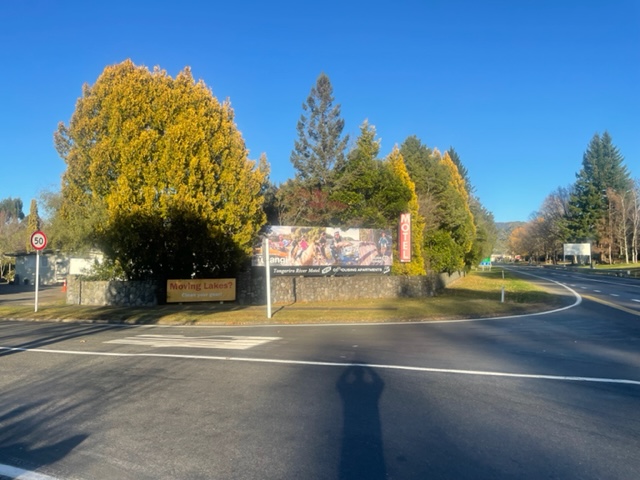
Above photo before the corner trees were harvested. Mt.Pihanga could not even be seen.
TRM’s frontage to Piri Road looks quite different now – compare the ‘before’ above and ‘after’ below..
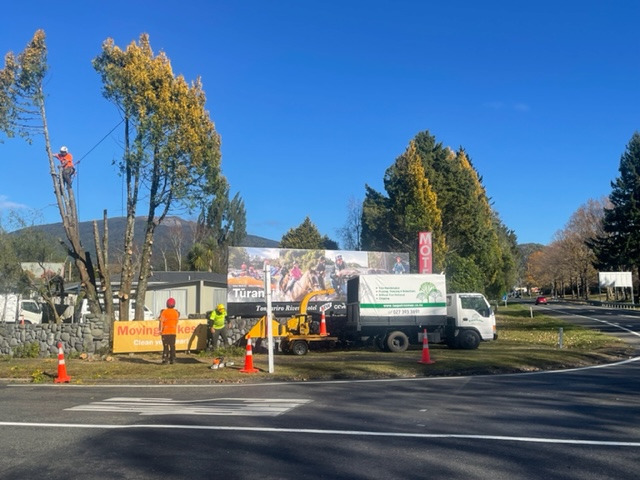
Going, going, gone…
Yesterday the old out-of-control scruffy conifers were bowled over which has extended the views over the park opposite. The sixty year old spindly trees suffered severe storm damage a few months ago and most were struggling to survive. TRM was lucky – across the SH1 several much larger mature trees were blown over. The remaining struggling shelter belt trees had to be put out of their misery and converted into firewood.
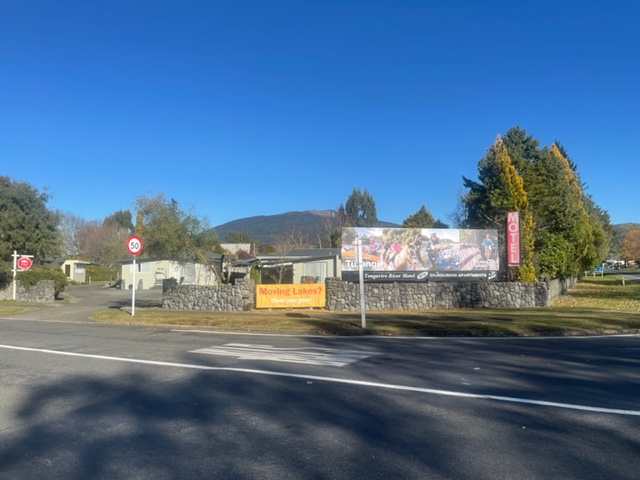
The new street appearance reveals views of Mt Pihanga beyond the existing motel.
Now the road appearance is quite different. Tourists can even see the motel hiding in the background, instead of an overgrown hobbiton forest. Beyond the motel, Mt. Pihanga (1326m) dominates the skyline, sheltering Turangi from the cold southerly blasts. Please take special note of the clear blue sky and beautiful fine weather – It is always like that in Turangi, according to SWMBO.
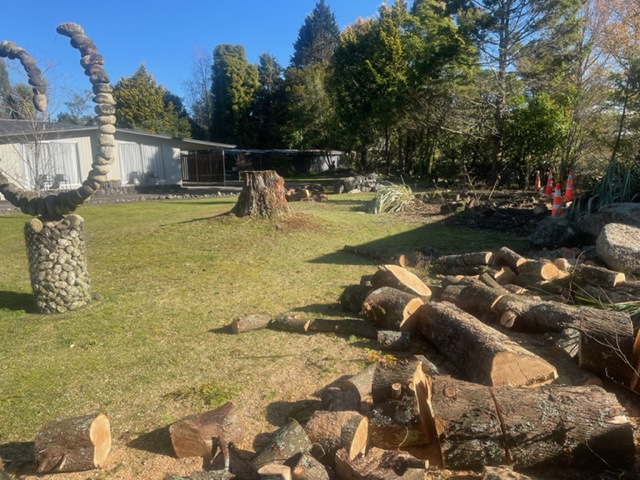
After eight months, TRM are still waiting for resource consent approval from Toe-paw Council before it can proceed any further. One of their planners main concerns was our ‘common house’ – to replace the forest adjacent to the Piri Road entrance. The cohousing apartment proposal features a ‘common house’ (similar to any village centre that is an essential meeting place in retirement villages) as a place for guests and resident inmates to mix and mingle, which is planned immediately adjacent the entrance from Piri Road. Beyond the common house a wide parking strip is proposed to separate and absorb SH1 traffic noise away from future residential apartments. Therefore most of the shredded jungle had to go while retaining a much trimmer mature shelter belt extending along the main road – SH1 boundary.
This cohousing apartment development should not be confused with the ‘retirement village’ category. SWMBO is far too young! It might age in place and one day become a retired anglers haven, but in the meantime there is no age barrier to prospective purchasers. We have been delighted with response so far. Many are considering investing in a new TRM apartment for use as a holiday home when they are fishing the Tongariro River. What a surprise! Instead of buying a sixty year old house in the village they were delighted to discover the TRM option is very $ price competitive. All their worries about maintenance and security have been addressed. The new TRM Mews can be managed for them.
We have thoroughly tested this concept. For the past 16 years some units have been independently owned by inmates who bought them for fishing holidays. During the rest of the year they were let as part of the motel to cover all outgoings such as rates, insurance, power, maintenance, refurbishment etc. for the owners. That made the concept very affordable, almost irresistible. Therefore TRM have had about 16 years to market-test this model and are confident it will appeal. For more detailed information contact TRM during your next fishing trip.
If you need more background on the cohousing conceptual basis in wider NZ, have a squiz at the May issue of North & South magazine below. The ten-page feature headline is “A new approach to an old idea that could solve the housing crisis”. As such, naturally SWMBO thinks Government should sponsor Her. This article was previously mentioned in the TRM blog on April 27 as follows:

Were the hippies right?
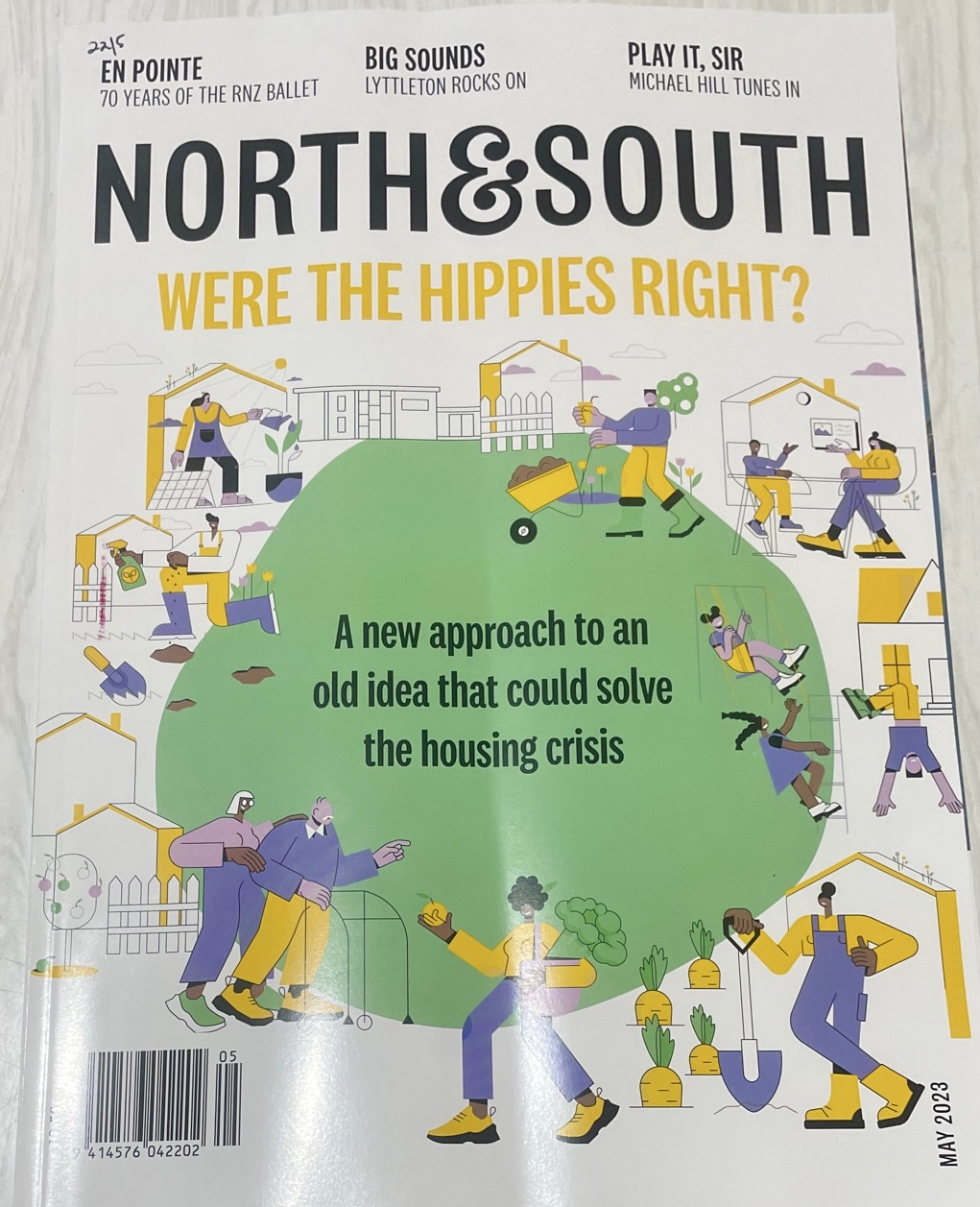
This was the question asked on the cover of the latest May issue of North & South magazine. Their lead article provided a history of cohousing attempts in NZ and is very informative for those interested in TRM’s (Tongariro River Mews) proposal. The ten-page feature starts as follows:
COME TOGETHER (By Eric Trump)
Is communal living a wiser use of resources and a counter to societal ills like loneliness? With the cost of newly built and older homes rocketing and a lack of supply, proponents of shares or cohousing say it’s time to reconsider once-radical options.
Cohousing is the latest iteration of “intentional living” in New Zealand. At its heart, cohousing brings together private dwellings around a shared space and facilities, refining what a neighbourhood looks like. The pleasures of privacy are braided with community – one that is planned, owned and managed by the residents themselves, usually without a property developer…
Mark Southcombe, an associate professor at Victoria University of Wellington’s School of Architecture and an expert in the history and design of cohousing, says cohousing is an arrangement whose time has come. He believes that one day, it could compose 5 to 10 percent of New Zealand’s housing sector…
Many aspects of the history and difficulties and advantages of cohousing and other options are discussed with various successful (and failed!) precedents in NZ.