
Each Sunday in 2016 TRM Daily Reports have been prepared by anglers reminiscing on their Tongariro experiences. These stories from anglers have been most entertaining and instructive. Many thanks to all contributors.
TRM invites any other anglers to provide their memories of the Tongariro.
IT’S ALL JIMMY BLACK’S FAULT
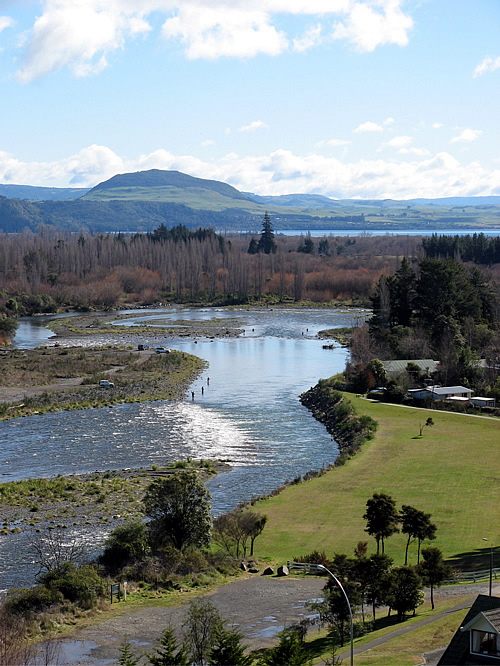 I suppose it would be a considerable extension of the truth to call me a Tongariro fisher. I have managed to get over from Melbourne to TRM three times now and, while the big runs do rather seem to appear in my absence, I have succeeded in landing a few fish. I do not as yet have a favourite pool or much in the way of fascinating stories or forgettable/unforgettable days but such as I have I will pass on to you and I’ll pad the rest out under Ross’s catchall “Anything else would you like to add”.
So let me begin at the beginning. A few months back there were floods in what was once called Cumberland in the UK. This brought back my holiday memories of what was then the village of Dalston, just outside Carlisle. My Dad was born in an old stone house there, three quarters of the way down from the Blue Bell pub in the village towards the Bridge End pub a mile or so south on the road that ran alongside the River Caldew. A warning: Never play dominoes with the old buggers who drink in either place. Back in the 60s, at a penny a game and halfpenny a ‘knock’ you can be down five bob in no time! I looked the old house up on Google Maps and it had been sand-blasted, double-glazed, carriage-lamped and gentrified to within an inch of its life. It is now a far cry from the home of my grandparents in the 1940s and 50s. They lived in a strange perpendicular-structured two rooms and an attic. The main room was on the ground floor with the bedroom above and the attic above that. Water was provided by a tap down the end of the back garden shared with the other four families and transported in buckets up to the mini-galley kitchen under the stairs. The water, the food and the house were heated by a big black coal fire and range with swinging arms, heating plates, kettle stand and an oven. When the dishes were washed after every meal the dirty water was carried out, down the path, over the B5299 and dumped in the nettles and weeds on the river’s edge. Gas mantles provided indoor light and you needed GPS to find the ablutions block down at the end of the garden. (Fortunately everyone had their own personal guzunder for night-time!)
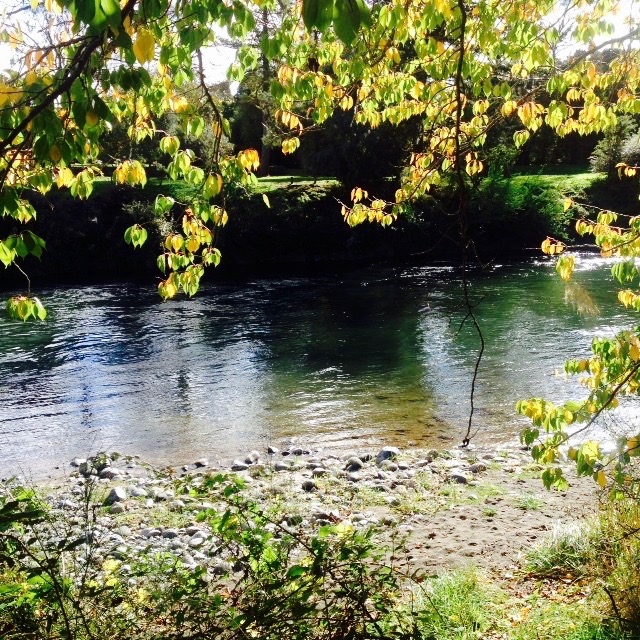 I loved the place. Ten paces and I disappeared into the world of the riverbank: exploring bird’ nests, blackberry, nut and ‘conker’ picking and fish spotting but mostly living imaginary boys own adventures. It was the nearest thing to heaven for a skinny ‘townie’ kid from Newcastle. Then one day my Grandad introduced me to Jimmy Black who lived in the ‘apartment’ at the front. To say Jimmy was taciturn is a major understatement and on the rare occasions when he did speak, he had the most unintelligible Cumbrian accent I’ve ever heard and I’m a ‘geordie’ from only 50 miles away across country. There is a long tradition of fly-fishing in the north and I had been quietly fascinated with fish and water as far back as I can remember and Jimmy was the local ’gun’. Early one Easter holiday morning around 1954, I think, he took me with him. All I remember of his gear was the rod. It was home made from a WWII tank aerial. We walked up past the Bridge End. It wasn’t open or I doubt we’d have got further! Over the field you come to what I think is Buckabank Weir. Jimmy stared at the water for a while, pointed at something, a rock (maybe) and grunted. A quick flick, a few seconds drift and out came a small brownie. Nothing before or since has so amazed, beguiled and enchanted me. That was it. I was hooked for life. It was magic. Jimmy caught several more and took a canvas bagful back to the house. There was fresh butter from the farm, Nana had made bread and Mam had been out collecting field mushrooms. That was a breakfast to remember. I never did fish the River Caldew and the more time that passes, the more I fear to do so. Some things are too special to risk spoiling but everywhere I have fished since, I have done so searching and aching for the return of that feeling of magic. It remains elusive in that naive child-centred form but the grown-up echoes are not so rare and I have found these many times although it usually takes thought and effort to prise them from the weft and weave of a day’s fishing.
 Despite the lust to fly fish, the usual temptations of the young male were overpoweringly strong and I fiddled and footled around with various forms of angling for another 25 years before, in the early 80s, Percy, an alcoholic cordon bleu chef in London, finally took me in hand and taught me the basics – albeit for the concrete impoundments and private stewponds of the south of England. The legendary chalkstreams of Hampshire and Wiltshire were, of course, way out of my financial league until many decades later.
I arrived in NZ (for the second time) in 1986 to work in Dunedin and my angling education really took off. Much though I love the lower South Island I have always hankered to fish the Tongariro. I blame it all on those books by Hintz, Parsons, Draper, Hickling et al – you know them. I also have to mention Hammond and Parsons fabulous ‘treasury’anthology and, of course, my prized possession, a very ‘foxed’ first edition of the Anglers El Dorado remaindered for 10 cents from Dunedin Public Library.
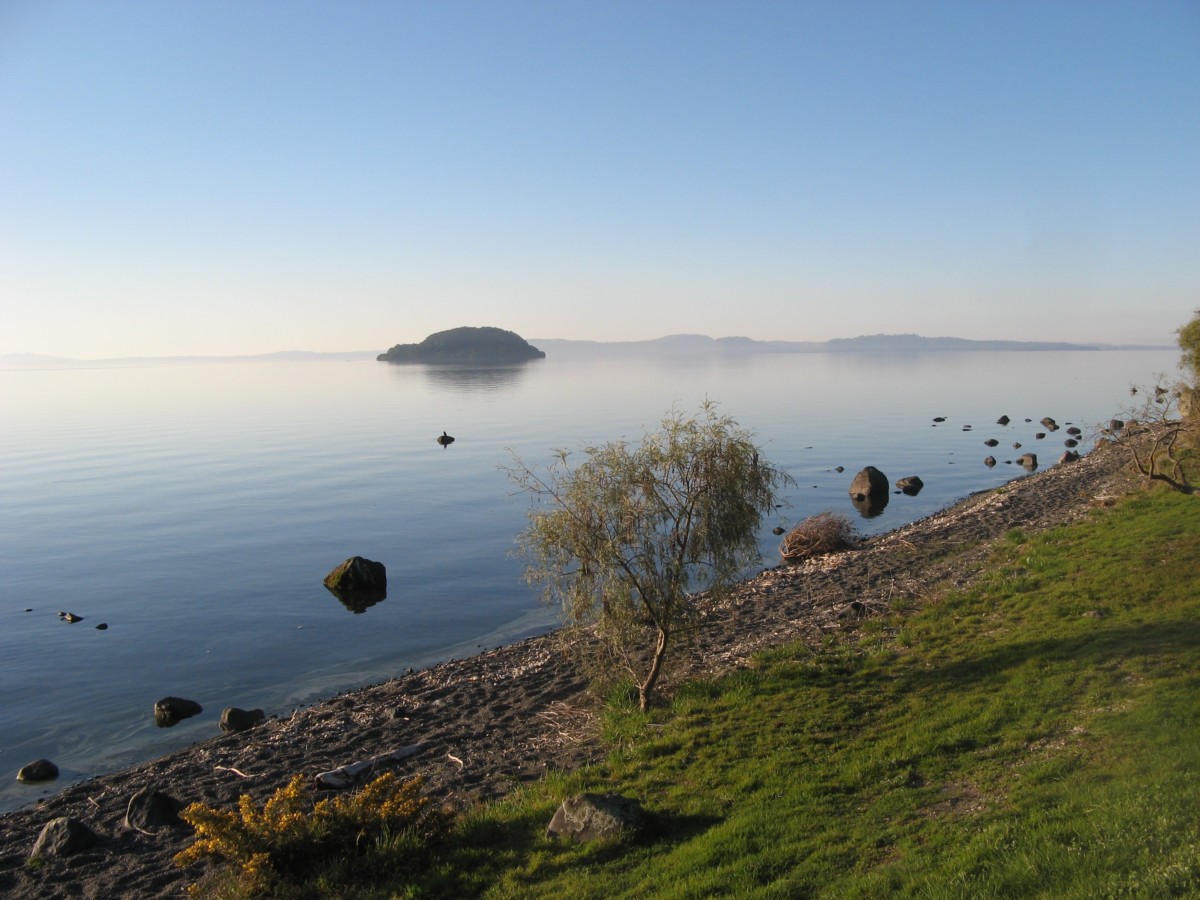 The nearest I have had to an unforgettable day on the Tongariro, would be during last October. In the ripple at the bottom of the Major Jones just above the Island Pool, I was fortunate enough to intersect with what I assume was a resting pod and landed fourteen, mostly fresh run, fish in some 45 minutes. That includes, because I am a loyal friend and fishing companion, wasting ten minutes to go down to the Island Pool to inform Mac of the bounty up above. (The idiot ignored me!) It was shallowish water so I used a size 14 tungsten beadhead pheasant tail nymph with a 14 PT spider on the point. I mention this detail because a couple of hours earlier we had looked at the Blue Pool. It was occupied by what I presume to have been a father and daughter in the throes of a casting lesson. Mac went up above and I asked the residents if it would OK for me to try the lower part of the pool. They agreed and I was tackling up when a small flotilla of kayaks appeared and lined up to disembark. In the event, it was my good fortune because it sent me further down into the longish ripple below the pool. Walking down I saw a number of fish resting in depressions, around rocks, etc and began to fancy my chances. Tackling up with the combination mentioned above, I steadily worked my way back up. I should think I covered more than 20 fish. OK some may have been further into spawning mode but the two I did persuade were again fresh run.
 This brings me to the rationale behind this little essay. Why two there and fourteen later? Why is it magic sometimes and not others? For me this question is the essence, the central question, underpinning imitative fly fishing. I appreciate that there is a raft of possible explanatory variables of greater or lesser likely significance and I am a hypothesis tester by formal educational training. I am happy to include lots of secondary variables in the analysis but I want to catch fish and require high reliabilities and/or significant probabilities for my primary variable. Of course, they may have taken my PT for food but why, many years earlier, did a 4 lb brown in the Waikaia in Southland take a UK reservoir style size 8 fluorescent yellow marabou lead head? Not for food I am certain. To the uproarious laughter and mockery of the Otago Streambashers and Fly Flingers Club I once advocated the formation of a society with the rather splendid acronym of APRICOT – the Association for Piscatorial Renaissance by Inspiring the Curiosity of Trout. Needless to say it never got off the ground.
I have read many splendid erudite books by extremely knowledgeable anglers but the more knowledgeable the writer then the more humble and circumscribed they appear to become in presenting their ideas. That, I think, is how it should be. Fly fishing success is in indeed perplexing to foretell.
You may not have heard of one of my heroes, Bronislaw Malinowski. He is usually considered to be the father of modern anthropology and in 1931 he wrote “Man resorts to magic only where chance and circumstances are not fully controlled by knowledge.” He has hit the nail on the head. For me, from the very beginning, fly fishing has been about the search for magic and sometimes the Tongariro is a magic river.