IS TROUT FISHING DECLINING? By Tony Orman – Previously published in “NZ Trout Fisher” Winter 2023 issue.
As an angler and hunter and an observer on rivers and in the backcountry, even around town and even in the garden, I have noticed disturbing trends of declines in many species. Examples are insects, kingfishers, shining cuckoos. In the absence of scientific studies, it’s called anecdotal.
Trout and rivers are just one part of the bigger picture, i.e. the total ecosystem. This article is not meant to be unduly pessimistic. It’s intended to be a wakeup call to trout fishers to shed their apathy, to maintain and enhance the resource of rivers and trout and arrest the decline and reverse it.
Frankly it’s a wake-up call to the ”authorities” too – Fish and Game, the Department of Conservation, regional councils, government and cabinet ministers and a few others to boot.
It needs examination, thought, open minds and discussion and a will to rectify the situation.
Nevertheless, there is no one silver bullet that will fix it, which frankly is why nobody has. The solution is bigger than anglers. Bigger than Fish and Game. Bigger than agriculture, bigger than towns. It needs system changes, cultural changes within government, government administrations and even Fish and Game, the latter with a bigger vision and stronger advocacy.
I set about writing a discussion paper for the Marlborough Freshwater Anglers Club. The more I researched and delved deeper the more I unearthed. I imagined the paper might be a thousand or so words. It ballooned out to well over 10,000. Here is just a small segment.
One should be wary in jumping to conclusions that may be hasty. I have to admit I do less trout fishing than say ten years ago as I have discovered saltwater fly fishing for kahawai to be a diversion from trout. But in recent seasons, the Wairau River has been more and more disappointing. A classic chalk stream Spring Creek several kilometres north of Blenheim, holds far, far less fish than thirty years ago. The Goulter, once a magnificent stream is a mere shadow of its former quality of the 1970s and 1980s.
I remember about 1991 after a 20 year absence returning to a Wairau tributary Top Valley Stream and being dismayed at the reduced flow compared to 1970, the result of the valley now a monoculture of pines. Those pines have grown since, their water intake has exploded upwards.
In April last year when I visited, I was shocked to see the stream, once an important spawning stream and an excellent fly fishing water especially before Christmas, was bone-dry a couple of kilometres upstream from the road bridge.
Once it flowed all year round. I caught trout in the 1970s that were 2-3kgs and a friend Geoff took a splendid double figure brown trout. But that was years ago, not today.
The decline is stark and the outlook bleak.
Generational Amnesia
In getting the dire situation over to much younger anglers, there’s a hindrance in communication encountered.
The problem in convincing many, especially younger folk, is “generational amnesia” a term used by Mark Feldman in an excellent letter in 2017 to a national fishing publication. Mark wrote that the term describes the tendency for each generation to “forget” or depending on age, be not even born and therefore unaware of the experience of the generation that went before. Younger trout fishers, perhaps not even born in 1980 – 40 year olds now – just do not understand and realise the quality that once was there – and more importantly that it no longer exists.
I’m not alone in my concern. And some, far better qualified than myself, have expressed their alarm.
Twenty years ago, Wayne McCallum, North Canterbury Fish and Game’s Environment Officer, wrote in the November 2000 issue of the magazine ”Southern Fishing and Boating” about lowland trout rivers and said that “on careful study, there appears to be more than a problem. Rather the evidence points to a wholesale crisis.”
Wayne McCallum’s expert views received little or no comment. The impression was that Fish and Game and North Canterbury in particular, did not want to know about it.
There was “a state of denial”
Wayne McCallum obviously felt the same. He wrote “perhaps the biggest factor in causing frustration is the failure to acknowledge the existence of a crisis at all.”
Predictably Wayne no longer works for Fish and Game and at a guess probably left out of frustration.
Maruia River
Several years ago, Bud, a friend and experienced fly fisherman, who had made regular annual trips over 43 years from the Wairarapa to the Maruia River in the Lewis Pass area of the South Island, reflected on his 2013 trip as his “worst ever” of 43 years. He meticulously kept a diary of his 43 annual fishing trips to the Maruia.
On his visit in late January, 2013, Bud caught his 424th (“catch and release”) trout. He had annually fished the Maruia for over 43 years – he was well acquainted with the river.
Bud’s assessment of the 2013 visit as “the worst fishing trip” he’d had in 40 years to the Maruia was based on in his words “fewest trout seen, in spite of the number of hours of hard work and in perfect conditions of clear sky, full sun, no wind, clear water and perfect water level”
Bud’s diary recorded this decline in fish numbers with extensive notes of falling numbers beginning Feb. 7, 2006 and the same comments of decline every year to 2013. Bud went on to say in his letter, “in 2013, it was such wonderful weather and easy casting and because wading/crossing was easier it was very pleasant. But it became clear that I was fishing water that once held numerous fish 20, 30 and 40 years ago, now held very few.”
“In all, my latest visit was characterised by glorious weather and beautiful water – but no fish. I bring this to your attention because in my home region in north Wairarapa, I have seen the same trend of declining trout numbers.”
And on the “state of self-denial” Bud told the Nelson Marlborough Fish and Game Council that “It seems to me to be wrong – and dishonest – for fish and game councils claiming the best fishing for years as some councils do. I understand selling licences has a need for income but that should not obscure the reality of the decline in trout numbers in many rivers. The Maruia seems yet another example of diminishing trout stocks.”
The reaction from the then Nelson-Marlborough Fish and Game was virtual silence. His letter was politely fobbed off.
Isn’t silence really denial?
Crisis Undeniable
But Bud back then saw the situation as a crisis – needing attention and with questions that urgently need answering.
What are the causes
Increased dairy farming further up the valley? The use of agricultural chemicals and leaching? Pesticides such as DEW 600 applied for grass grub and known to be lethal to aquatic life? Extensive and successive aerial dropping of 1080 poison for an imagined possum pest? Had Fish and Game researched changes of bottom fauna and water chemistry changes with this intensive dairy farming or increased 1080? So many questions!
Bud said the answer to NZ rivers would not be found by denying the decline. “It’s up to Fish and Game to find it out,” Bud said at the time. And then he candidly added “otherwise Fish and Game is negligent, the fishery declines and Fish and Game’s income, i.e. licence money, will dry up.”
My assessment is that to some degree, the outlook of Nelson Marlborough Fish and Game has changed since Bud wrote his letter six years ago. With a change in managership, Nelson Marlborough Fish and Game are now more alert and concerned. The evidence is showing up in drift dive surveys.
But what a pity the concern nationally was not shown over two decades ago when Fish and Game scientist Wayne McCallum sounded a loud public warning.
It must be born in mind that rivers or any ecosystem invariably undergoes cyclic changes. In the case of the Motueka River which I lived near for a decade, the cycle appeared to be four years, at one extreme numerous trout of a kilogram or slightly above and at the other extreme, fewer but larger individual fish. However Bud Jones’ diary over four decades shows an uninterrupted and undeniable decline.
It’s not only trout but koura and eels too. The whole freshwater ecosystem is under threat. Which invites the question, where is the Department of Conservation in advocacy for clean, flowing waterways which after all are the habitat of native fish?
Instead DOC has at times blamed trout as predators as the reason for declining native fish species instead of recognising habitat is the all-important issue.
Habitat
Habitat is undoubtedly a key.
Trout habitat comprises the three requirements of environment (quality and quantity of flow), cover and food.
What seems unappreciated by local councils is that river flows and the aquifer, i.e. total water resource, is finite. Yet councils are still issuing consents for water takes. For example in Marlborough, the rapidly growing monoculture of vineyards in Marlborough is swamping valley floors. And pine forests for commercial forestry and the ludicrous carbon farming using pines is proceeding apace on hills and with central government’s encouragement.
Then there is the vexed question of agricultural and horticultural sprays such as diazinon for grass grub.
In 2011, the EU implemented a ban on its use.
The US National Pesticide Information Centre (Oregon State University) says “studies investigating the toxicity of diazinon to freshwater fish have found diazinon to be moderately to highly toxic to freshwater fish on an acute basis”.
Environment Canterbury (ECan) reportedly sprays rivers beds annually with Glyphosate a broad-spectrum systemic herbicide and crop desiccant and an organophosphorus compound, with inevitable damage to the soil structure, invertebrates and indeed the whole ecology.
Nitrates
Great research work in recent years by the NZ Federation of Freshwater Anglers led by president Dr Peter Trolove has shown alarming levels of nitrates in Canterbury rivers. High nitrate levels are toxic to aquatic life, whether trout, young salmon returning downstream or native fish.
Again where is the Department of Conservation?
Nitrates are not only a health risk to fish and aquatic life but to humans where a Danish study of 2.7 million people revealed direct links with colorectal cancer. Canterbury and Southland – both with intensive dairying areas – have exceptionally high – world leading – colorectal (lower bowel) cancer rates. Nitrate leaching and run-off are directly linked to intensive dairying.
Forestry
Foreign corporates own some 80% of New Zealand’s forest industry. More recent data is incomplete but foreign ownership appears to have further increased with government actively giving incentives to overseas investors to buy up large in New Zealand for carbon farming.
Clear felling of commercial lumber forests exposes whole catchments to any rains and subsequent runoff of silt and debris into streams, rivers and ultimately estuarine
areas. Recent studies of the Marlborough Sounds revealed alarming levels of sedimentation – metres deep – with adverse effects on inshore ecosystems and fish numbers.
The same sedimentation occurs in streams and rivers when forests are clear-felled, smothering bottom fauna invertebrates and degrading trout and salmon spawning areas.
Sources point to one detrimental aspect being acidification. The pH level (degree of acidity) is important to both bottom fauna and subsequently trout. Alkaline streams support more abundant invertebrates. If the pH drops below 5.5 (increased acidity) then invertebrates are fewer and long term damage to the fishery, both native and trout, occurs.
According to another Google source, the basic rule for drinking pine is 10 gallons of water for every single inch of tree diameter. That means a 12-inch (30 cms) plant will absorb nearly 120 gallons of water. There are also records that average pine trees can absorb up to 150 gallons of water a day when there is unlimited water. One healthy 30 metre-tall tree can take 11,000 gallons of water from the soil in a single growing season. Think of thousands of trees in a commercial planting and the huge water extraction becomes obvious.
Another source says a pine tree uses 85 litres of water a day whereas a native tree, dependent on species, uses considerably less. Water from a pine forest with a “bare” pine needle forest floor has quicker runoff compared to a typical native forest area with shade- loving undergrowth. In a few words, native forest has a higher water retention factor leading to full and more consistent stream flows.
Anecdotal evidence points to streams much reduced in flow once monocultures of pines have been established. For example, long-time residents in the Marlborough Sounds have observed the same diminished flow after extensive monocultures of pine forests were established. I observed it in the Wairau Valley’s Northbank area on tributary streams like Top Valley as I related earlier.
Fish and Game should be advocating for:-
(a) Better harvesting regimes (as practiced in Europe) should be implemented, i.e. (two cuts contour wise, 12 months apart be mandatory)
(b) Local council zoning of land should avoid extensive commercial forestry monocultures.
(c) Buffer zones (50 or more metres – perhaps 100m?) should be mandatory along all rivers and streams.
Marlborough has developed a monoculture of pine plantations and again this is expanding. Political factors such as government’s short sighted “one billion trees” /carbon farming programme will intensify the monoculture. In early summer clouds of pollen can be seen. This has adverse health consequences for many humans; does it have health consequences for the ecosystem and in particular freshwater ecosystems?
What can you do?
Become an active advocate. As a foundation member off the NZ Federation of Freshwater Anglers and a life member, I get frustrated with the apathy. Too often the Federation has to implore anglers to stand for the executive. In the case of Fish and Game regions, cases occur where there’s not enough nominations to fill the required council seats.
I get frustrated with professional fishing guides who after all, make money – profit – from the resource. Only one or two have shown interest to stand for the Federation’s executive. One or two others are like “one night stands”, here with a brief flirtation and then gone.
I get frustrated with a collection of fine writers who might pen magazine articles and have written books but who have never publicly advocated for the resource of clean healthy rivers.
It needs not just one or two who poke their head above the parapet.
It needs an army of anglers to shed their apathy, writers to put their egos aside and to collectively crusade on behalf of water, rivers and trout and salmon.
And don’t be afraid of politics because most of the threats are political in origin – it’s simply “cause and effect,” as my deerstalking, dry fly and political mentor the late John Henderson used to say.
Footnote; “NZ Trout Fisher” is a quarterly magazine that deserves the support of every trout angler. You can subscribe direct for NZ $36.
Contact editor/publisher Peter Storey at <peter@nztroutfisher.co.nz>
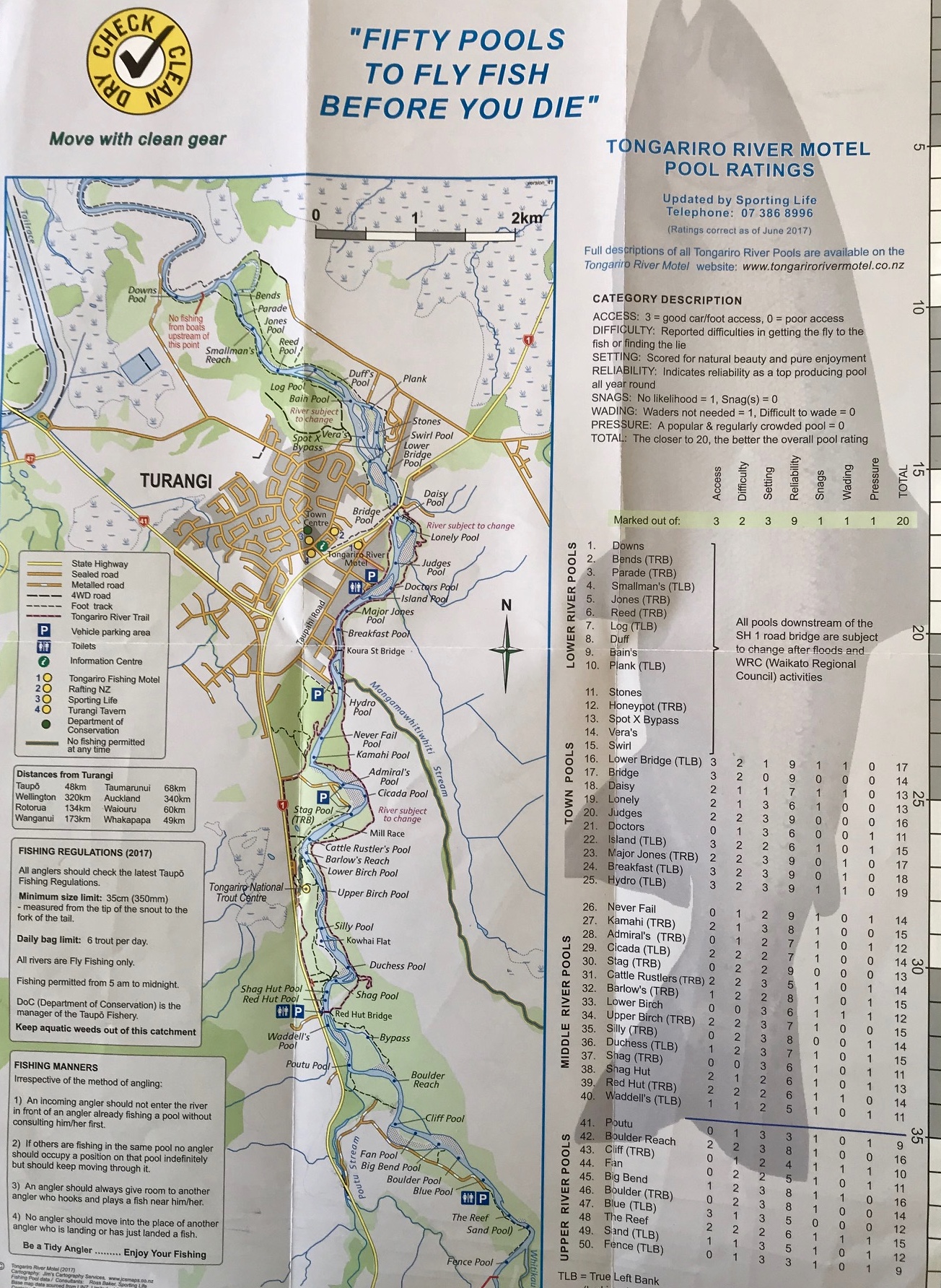
(The above article explains why we live in Turangi and why so many other anglers have moved here over the last decade… The condition and size of trout landed (the big ones all escape) during the last couple of years have been as good as any season in the last twenty years!)