
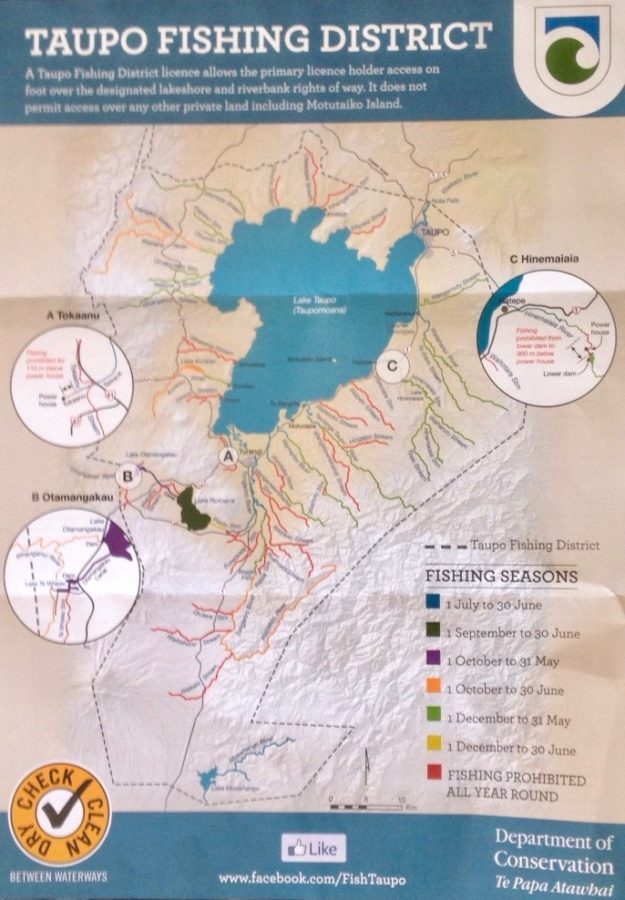
 Some challenging interesting essential background weekend study for Taupo anglers… (when it is too windy to go fly fishing)
On Friday TRM Daily Report commented: “TRM seriously wish some of them would direct their concerns and complaints directly to DOC instead of to TRM…” To confirm how passionate and concerned they are about the Taupo Fishery, these anglers requested TRM to post DOC’s own consultant’s report to reiterate changes that are needed and to indicate how important the Taupo Fishery is to Turangi and Taupo region. Their negative responses to DOC’s map ranged from genuine concerns to anger to exasperation to disgust to frustration to just plain pissed off… Due to TRM subjecting you to Daily Fishing Reports over the last decade or more, they claimed TRM have a ‘duty’ to expose DOC by advancing their contrary views. Mmmm…
They believe they deserve and expect something better than the A4 sized map – on right – provided as part of their licence fee to inform licence holders of the various rules and regulations for over 100km of fly fishing including over 40 rivers, etc. They feel cheated. Anglers have long memories, or is it just election year fever?
You be the judge:
 In 2013 the Taupo Fishery Management were subject to a wide ranging report to chart their future. It has taken four years for the report recommendations to be followed with reviewed licences – such as reviewing trout size and daily bags – so the concerned anglers are still waiting and watching to see if the rest of the report recommendations will be followed by Taupo Fishery management.
Tosupport their views they submitted the following main issues from DOC’s own 2013 Survey:
Executive Summary:
 The town of Tūrangi markets itself as the ‘Trout Fishing Capital of the World’, Taupō’s waterfront is home to a large trout sculpture to welcome visitors to the town, and the region is home to the Tongariro National Trout Centre near Tūrangi.
A study by APR Consultants, commissioned as part of this review process, has confirmed the importance of the Fishery to the economic and social wellbeing of the region, with an annual economic contribution of up to…
$29m per annum and close to 300 jobs dependent on it.
 It became clear in the course of the review process that effective management of the Fishery needs to focus more specifically on the important contribution to the Taupō Region (and beyond) that the Taupō Fishery currently makes, and could make in the future. In essence, an overarching management goal should be focused on maximizing the full value (in the broadest – economic, social, cultural and environmental – sense of the word) that the Fishery can deliver. This goal must then be used by the Department to establish objectives and targets, set budgets, and drive progress reporting.
The Department of Conservation initiated this review process with several broad factors in mind, with the key trigger points being:
 *Rethinking how the fishery is managed in the context of a renewed commitment from the Department to work with others to help New Zealand flourish socially, economically and environmentally (and for New Zealanders to benefit from that management);
*Concerns from anglers and the wider community about the health of the fishery; and
*Declining participation rates and licence sales.
 Through the review process, we found a fishery that is fundamentally in good shape. But it is also a fishery where there are huge opportunities that could be realised through a fresh management approach. To realise these opportunities, and maximise the value of the fishery, there must be a shift from the strong focus on the biological aspect of the fishery, to a broader consideration on managing all the different components of the fishery. In the Report, unsurprisingly, no single solution is identified. Rather a range of opportunities have been highlighted that focus on:
*Establishing an overarching goal for the fishery;
*Governance and management structures and processes;
*Ensuring there is clear direction focused on maximising the full value of the Fishery.
………..
The report went on to mention:
 What we found is that there are some tensions and uncertainties about how the agreements reached between the Crown and Ngāti Tūwharetoa and the provisions of the Conservation Act fit together; there is little effective engagement between Ngāti Tūwharetoa and anglers (and hence no processes to align interests); and that anglers are frustrated with what they see as their negligible influence on management….
And further under Heading 7
Anglers and licence holders
 In respect of the relationship with anglers, we identified the need to greatly improve the interface they have with the Department.
Improved licencing options, better communication and more effective marketing of fishing opportunities in the region were all identified as aspects needing improvement. We confirmed that participation rates (like in many places) have steadily declined from a peak in the 1980s, and most significantly there has been a 20% drop in licence sales over the past five years. Given the major economic and social contribution to the region from the Fishery, and given that it is licence fees that pay for fisheries management, this is a significant issue that needs considerable focus and attention.
Then under Heading
Relationships
 In particular we believe that there are obvious opportunities to improve the effectiveness of the Department’s relationships with Fish and Game (given they are in the same ‘business’). Currently the relationship appears to be disjointed and ‘competitive’ rather than collaborative. There are also opportunities to develop stronger relationships with the tourism and wider business sector in the region (for mutual benefit), and with the Lake Rotoraira Trust.
These complaining anglers have long memories as they also referred to:
10
Working Effectively with Anglers and Increasing Participation
 In relation to the existing licencing system:
Put in place an on-line system in close collaboration with Fish and Game;
Develop a national licence option;
Offer a fuller range of licence options, with the priority being a family licence, a weekend licence, and a 12 month licence; (which DOC have now done – four years later…)
 In relation to the destination product

Develop and implement a marketing and communications plan to raise the profile of the fishery nationally and internationally; and
Initiate the development of a collective vision and a strategic plan for the Tongariro River to address the competing demands on the river and surrounding land.
In relation to improving access to the fishery:
Expand opportunities to learn to fish for all people, including expanding the kids ‘fish-out’ days to a daily occurrence for all visitors (not just children);
Working with Anglers and Increasing Participation
 There were clear messages in the review process around the need for the Department to focus more on understanding the needs of anglers (past, present, and potential), to invest more effort into building support for the Fishery, and to lift participation rates in fishing.
At this time, and because the Fishery is currently managed on a cost-recovery basis, increasing participation rates of anglers is essential to achieving the overarching management goal for the Fishery.
Participant growth in the Fishery is also important to the local economy.
The messages are consistent with the current management focus on maximizing recreational opportunities for anglers, and the broader strategic focus of the Department to see more people actively engaging in recreation.
The focus of the discussions was that the Department should be actively removing existing barriers (perceived or otherwise) to participation, and be doing more to actively engage with the community and promote the Fishery.

After considering the above recommendations we can understand the disappointment from anglers…
As such the report recommendations deserve more attention. Your feedback is invited…