

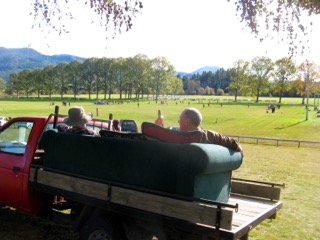
 The images of a corporate box at the Saturday footy game are typical examples of the difference in life style in the provinces.
 They obviously do not realise that those of us fortunate enough to be struggling in the ‘regions’ – outside of the main centres of population – Wellington & Auckland – usually do so by choice.
  i.e. Consider the headline in last Saturday Herald front page:
 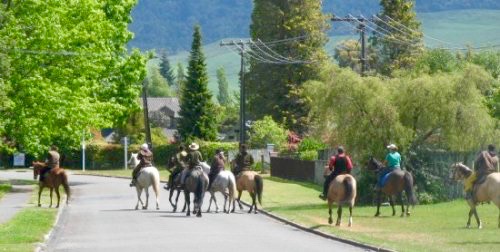 Compare our image – gridlock on Taupahi Road – a severe traffic jam in Turangi…
  Here in the under-paid under-populated struggling provinces, we really have no idea of what ‘gridlock’ is and have no intention of finding out. Given the choice of their claimed higher standard of living, frustrated, sitting, waiting, wasting their life choking in traffic queues daily, compared to our boring peaceful pace of life, it is obvious to us who have experienced both situations, that the cost is excessive and not worthwhile.
  Compare the image on right of local crowding – a committee meeting on the banks of the Tongariro River.
  If you believe there are limited opportunities, (?) may we remind you that the biggest business in NZ is tourism. Tourism has never been more important – it is now NZ’s biggest export earner contributing $14.5 Billion or 20.7 % of NZ’s foreign exchange earnings for the year ended March. That is the only real industry in such towns. Many of those tourists are drones escaping the cities to discover what real life is supposed to be all about in heartland New Zealand.
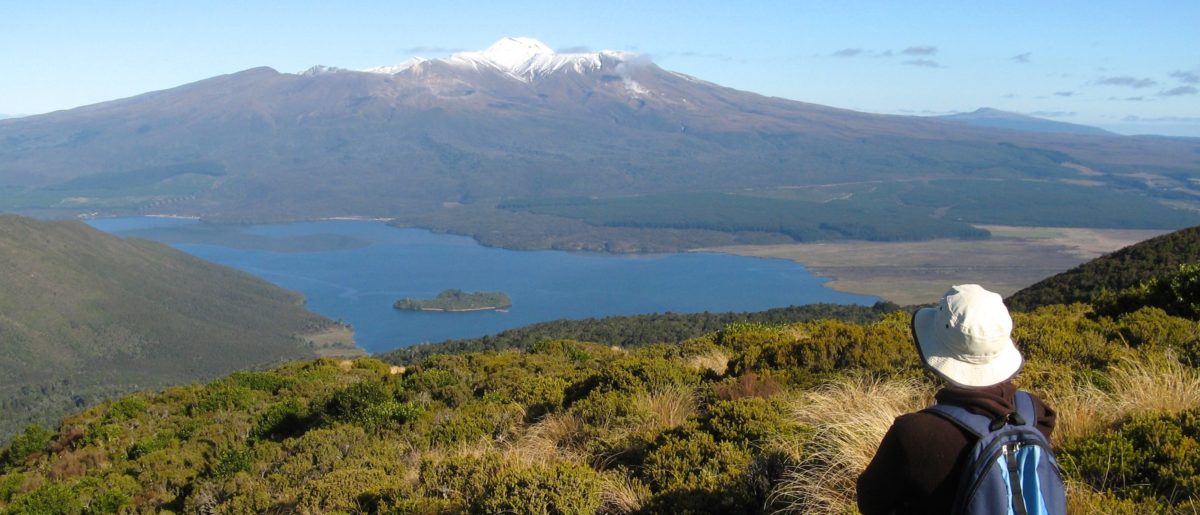 For many years the village of Turangi has been guilty of squatting on hidden tourism gems which could secure the future economic growth. (TRM Daily Reports will elaborate on these with our Christmas ‘wish list’ – commencing tomorrow) When we consider future growth plans we have time to pause, to carefully consider the above awful gridlock options and ask, is it really worth it? For many the response is a definite resounding NO!
The critical article states: Our regions are growing further apart. Incomes after adjusting for living costs have risen significantly in Auckland and Wellington. The commercial and political capitals are pulling away from other regions.
 So? We provincial simpletons believe other very basic survival considerations of retaining good health and happiness and peace of mind and relaxed life style are more important. We intend to sleep peacefully all night. We even have time to look out for each other. Our homes are affordable. We prefer to lean towards other human behaviour traits than just income comparisons, to ensure we make the most of enjoying what life has to offer. Just earning more $$$ does not automatically improve health or life expectancy, yet that is his sole barometer used for comparisons in the article.
 I am sure the well qualified writer of the article has a city house/flat/apartment worth far more and his car is much more modern as he is paid much more and has a fancy job title, so he assumes he must be better off – but at what cost…? Possibly one day he might mature to realise that simple provincial living enhancing health and happiness are more important ingredients to achieve a really successful rewarding life than simply comparing wages. OK?
Plight of regions: hope v futility
“There is strong evidence of growing divide across our regions. There is hope: there are policies and strategies we can try. But evidence suggests many of them will be futile,” Shamubeel Eaqub says.
OPINION: I have been reading Rebooting the Regions, a book published by Massey University Press about the plight of some of our regions and what we should do about it.
Regional development is back on the policy agenda and the Northland by-election suggests it will become even more important in the 2017 general election.
But the book makes clear that while there are options, successful regional development is extremely difficult.

The commercial and political capitals are pulling away from other regions.
Throughout the book is a palpable sense of needing to do something, finding hope in possible approaches, but warning of futility when fighting structural decline.
READ MORE:
* Shamubeel Eaqub: Treasury fiscal review ‘dense waffle’
* Blowing Bubbles: Bubbles are normal and rational, and then they pop – Shamubeel Eaqub
* Shamubeel Eaqub: Disaster economics
The two most impressive chapters look at the income inequality in and between our regions, and how to manage decline gracefully.
Our regions are growing further apart. Incomes after adjusting for living costs have risen significantly in Auckland and Wellington.
The commercial and political capitals are pulling away from other regions.
Astonishingly, of the remaining 14 regions, only six have experienced real income gains over the last three decades. That is, eight regions have seen declines in real incomes over a three-decade period.
The regional divergences we see today are not new, nor unique to New Zealand. We see similar patterns in other advanced economies around the world too.
While incomes are growing much faster in Auckland and Wellington, there is a large gap between high and low income earners. In contrast, incomes are more equal in the provinces, but more equally low incomes.
The income divergence across our regions is rooted in deeper economic and demographic changes.
Changes in the economy, towards more services sector jobs, is favouring urban sectors.
Globalisation and technological change are offshoring or mechanising manual work – which is affecting provincial economies harder.
Our thinking in local government and economic policy is based on an expectation of continuing growth. Stagnation and decline are seen negatively.
Yet, that is reality of ageing populations and young people leaving the provinces for economic and other reasons for urban centres.
The policy response to stagnating or declining population tends to fall in three camps: doing nothing; trying to reverse it; and accepting it and making the best of the situation.
After some years of neglect, regional development has switched from doing nothing to counter the growing divide by fostering growth.
There is a strong view that decline, sometime in train for decades, can and will be fixed.
Accepting and facilitating decline is politically unacceptable.
“Governments are often subject to short political cycles with minimal policy windows, whereas demographic trends take decades to play out and are often not understood by the government – let along the general public.”
But we know that some places do vanish. In an old and ageing Japan, there is good evidence that ageing and declining populations are normal. And that communities can disappear from time.
The role of the government may be to manage that decline, so that those who continue to live in these communities have a reasonable standard of living. This is particularly important
The international evidence from the United Kingdom, United States and France for growth fostering measures is troublingly mixed.
While regional interventions often work for the specific region, it comes at the cost of neighbouring comparable regions.
There is often no net gain for the country as a whole. Worse, once the programmes finish, the benefits also tend to fade in most cases.
Where the growth fostering policies have worked, they had some inherent strength in their location or economic potential, for example natural resources and weather amenable to year round tourism.
Regional development is a topic that needs much further research and attention. There is no recipe that will work in every occasion.
There is strong evidence of growing divide across our regions. There is hope: there are policies and strategies we can try. But evidence suggests many of them will be futile.
We should try, but we should also develop robust and sensible strategies for graceful decline.
If we can’t save a place, at least make sure we don’t abandon the people who live in these communities.
– Stuff
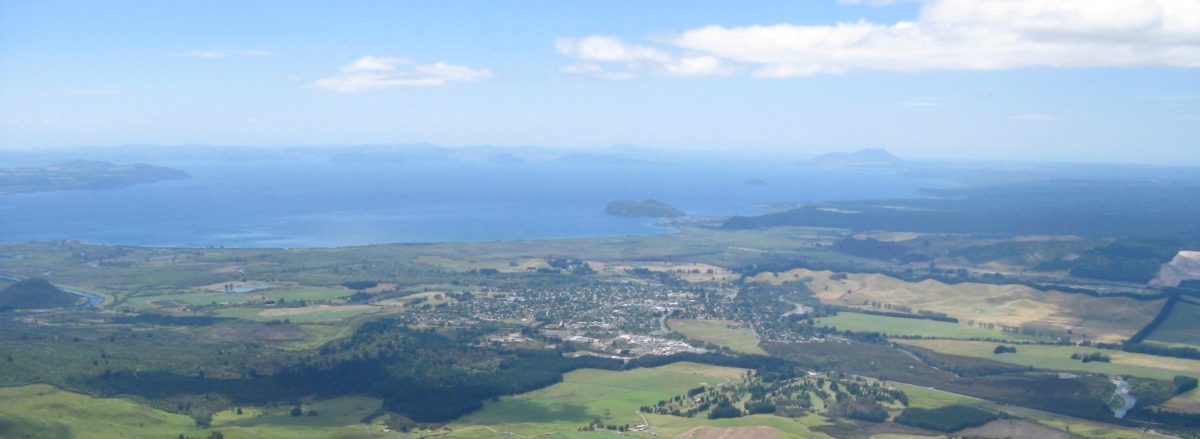 Turangi – what a wonderful place to live…