
Debunking the big myth
Save for a wet Sunday’s reading…
We have often heard from male-dominated trout fishing club members about their hopes on how to appeal more to women to increase their club membership, or in some cases to save their clubs. The Taupo club in particular may have been responsible for the increase in recent interest by so many women but SWMBO knows who is really to blame – Brad Pitt!

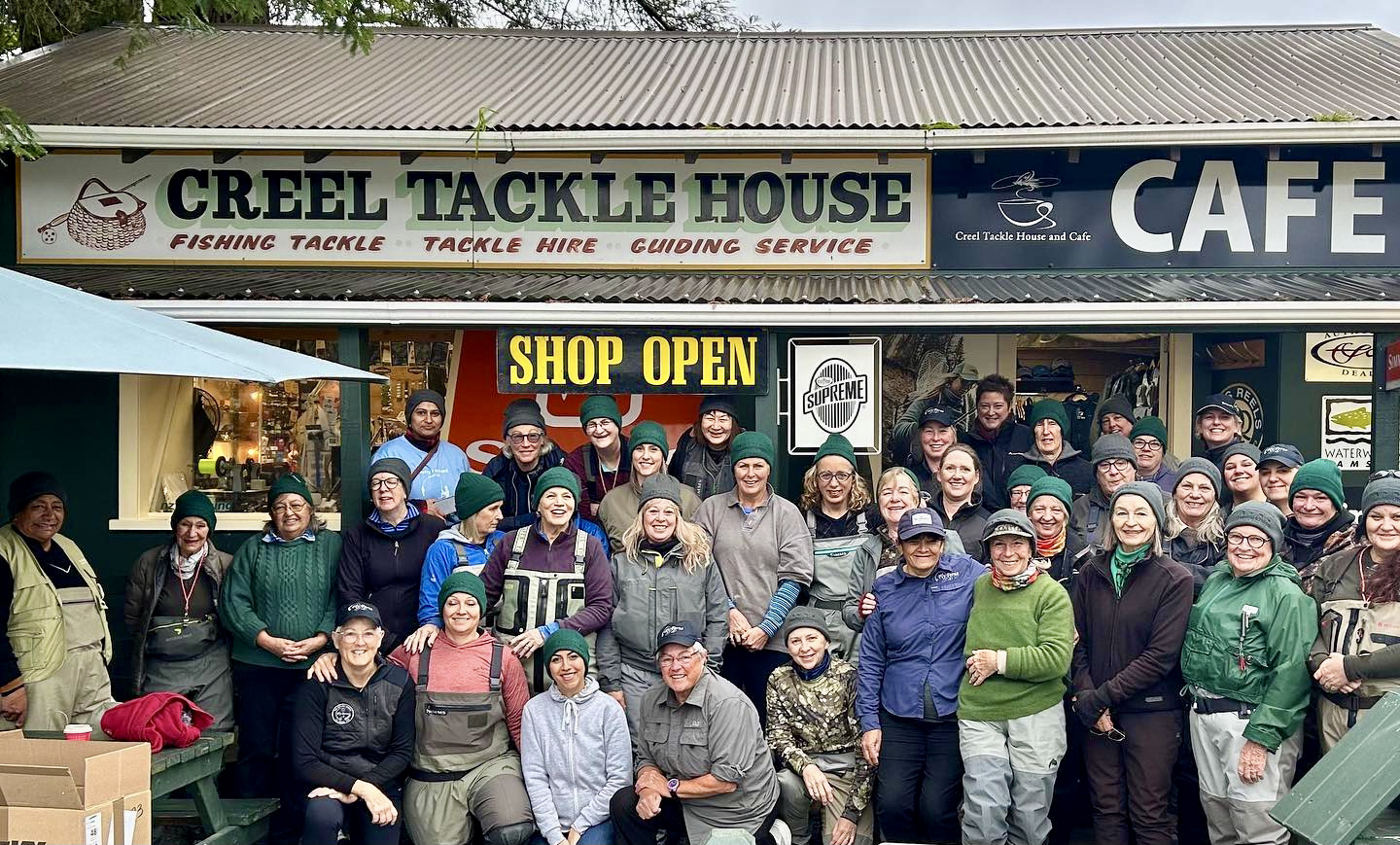
TRM tried to increase interest by sponsoring the Ladies Tournament in 2019 – see photo above. This tournament has continued successfully and the number of participants (not competitors!) below in 2023 was evidence of the increased interest and success. Taupo Club members have since been invited to address other clubs on their secret recipe to attract more women. But they are just scratching the surface compared to American clubs – read on.
The award for the biggest trout in the 2023 tournament went to Janny Tracey below.

Industry leaders in North America say women are the only growing demographic in the sport, which is why they are so crucial to cultivate.
But back to Brad Pitt – consider the following:
ROANOKE, Va. — Kim Brannock became fascinated by fly-fishing after watching “A River Runs Through It,” a 1992 film starring Brad Pitt. Years later, a co-worker taught her to fly-fish during lunch breaks, when she practiced casting underneath the St. Johns Bridge on the Willamette River in Portland, Ore.
“Besides falling in love with Brad Pitt, I fell in love with that cast,” said Brannock, who lives in Bend, Ore., and designs fly-fishing gear for Patagonia. “I was hooked.”
Women are now the fastest growing demographic in fly-fishing, one of the most male-dominated outdoor sports. That has presented a host of challenges, including finding proper gear, navigating the pitfalls of social media and even developing an awareness for self-defense skills in the outdoors.
Industry leaders say women are the only growing demographic in the sport, which is why they are so crucial to cultivate. Women make up about 31 percent of the 6.5 million Americans who fly-fish, according to the most recent study by the Recreational Boating & Fishing Foundation. In 2016, more than two million women participated in the sport, an increase of about 142,000 from the previous year.

More recent growth in membership by “Kapiti Women on the Fly” is a further confirmation of how fly fishing can be enjoyed by so many women – see following evidence
Copied from: Hunting & Fishing New Zealand
When Leigh Johnson joined the Kapiti Fly Fishing club in 2020, she found there were only two female club members. That’s when she decided to start Kapiti Women on The Fly NZ, with a sole focus on getting more female club members. Leigh wanted other women to enjoy fly fishing and had two simple questions – why don’t they, and what’s stopping them?
The organic expansion from just Kapiti Women On The Fly to a wider reaching Women On The Fly group has come about due to the demand in the Wellington region and further afield. Women are looking for opportunities to learn from and enjoy the company of other female anglers.
The WoTF community is now a network of approx. 100 women from across Wellington and further afield. As a result, the Kapiti Fly Fishing Club’s female membership has increased, along with those of the Hutt Valley and Wellington clubs. Support has come from Fish & Game New Zealand, Manic Tackle Project, Hunting & Fishing New Zealand, Hutt Valley and the Kapiti Fly Fishing club.
Leigh’s mental health journey over the past decade means she knows there is a huge benefit to be gained from spending time on the water, regardless of whether she is catching fish or not. With a major mental health crisis in 2013 and subsequent extended recovery, having something like fly fishing to lose herself in keeps Leigh grounded and focused on many levels, and is just the mindfulness exercise the doctor ordered.
Fly fishing requires concentration and focus on the present moment and a connection with nature has been shown to reduce symptoms of anxiety, depression, and improve overall well-being.
Women on the Fly NZ will continue to grow as long as there is a demand from women and the support of the wider fishing community and we can’t see any sign of that slowing down, especially with the drive and enthusiasm of Leigh and the team behind it.
To register interest go to www.womenonthefly.nz and give them a follow on Facebook and Instagram!
#huntingandfishingnz#outtheredoingit#womenonthefly


But NZ clubs still have a long way to go – other American clubs’ female membership shows stronger growth – i.e.
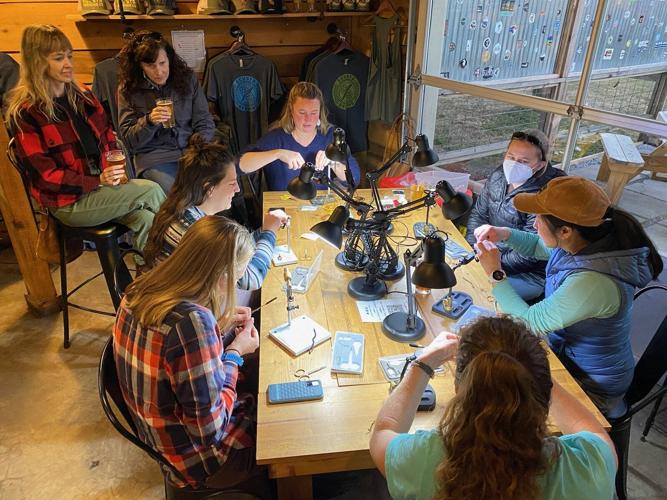
Women tie flies, too. The Wednesday night events at Ecusta Brewing draw consistently big attendance.
A slew of lamps shone bright on vises clamped tight on long shank hooks as fly tyers crowded around a back table at Ecusta Brewing to wind thread and attach rubbery legs on the creation de jour: a Girdle Bug, a large spidery bug big trout find delectable — until it’s too late.
Every seat was spoken for — by women fly tyers. Tyers shut out of space sat on bar stools (and sipped craft beer) to oversee who was making what and how.
Welcome to Wednesday night women’s fly tying in Brevard.
The weekly sessions at Ecusta Brewing on the town’s east side are a seasonal ode to what can only be described as an explosion of interest in fly fishing by women. Indeed, participation by these women who tie flies — and cast those surreal bugs on Transylvania County streams — is the local embodiment of a national trend that represents the fastest growing segment — by far — of a multi-million dollar industry.
Pull up a chair
The Pisgah Area Women’s Fly Fishing Group has hosted the October through February winter series at Ecusta for nearly five years (COVID-19 crimped in-person gatherings but Zoom calls filled the gap until recently. Even then, 10 or more women dialed in each week.) The group was formed to support and encourage women to venture into the sport, including the intricacies of tying their own flies. Tyers and non-tying onlookers get to know other area women who are already avid fly fishers or novices ready for the first dip of their boots in the cold waters of the fish-filled Davidson and French Broad rivers and other regional streams. (The almost 500 member group is very active on Facebook.)
Debbie Gillespie, the Wednesday night leader and a professional guide for seven years at Davidson River Outfitters, said tying is one attractant, but what draws women too is “they go with the intention to make friends and make connections to fish. I think a lot of people who come want other ladies to fish with and have a fishing companion.” Many attendees, she said, show up not to tie but find their interest piqued and end up fly fishing.
Gillespie ties many of her own flies and calls tying “pretty relaxing. It slows me down and makes me chill.”
‘Relaxing’ is one of several repetitive themes among the tyers.
Nicole Gorry, of Pisgah Forest, has fished only a few months but has become a Wednesday night regular.
“My New Year resolution was to fly fish and meet new people,” she said. “It’s relaxing and fun.”
Her friend Erica Zaveta, of Brevard, called the Wednesday night gigs “A super great, fun group of people. You’re not intimidated since fly tying is taught step-by-step.”
Tyers bring their own equipment or avail themselves of lights, vises and other materials supplied by Davidson River Outfitters and Headwaters Outfitters.
Gillespie sees another tangent among the group: tyers also tie for their husbands. “My guy clients say ‘my wife doesn’t fish but she would like to’,” she said, a positive sign that men will actively introduce their spouses to the sport.
Debunking the big myth
As noted above, another oft-repeated theme on Wednesday nights is less intimidation. That factor plus a supportive, non-competitive environment is a plus for most women.
To be sure, Gillespie said fly fishing has elements that can create reluctance among first timers.
“Wading can be intimidating and (the act of fly casting) is technical,” she said, owing to handling “small lines and flies. “But we offer an environment where women don’t have to be intimidated.”
A short 8-to 12-foot cast will put a fly in front of hungry trout. Long, elegant casts worthy of the 1992 hit film “A River Runs Through It”? Not by any means.
That men should rule the water also raises the eyebrows of some women. “Women are naturally better at fly fishing” than men, said Mary Bradford, of Rosman.
Where men might try to muscle lines or make a long cast for the sake of long cast, women have finer motor skills. Whippy rods and supple lines themselves reward a delicate toss.
“Women have more finesse, not just slamming it on the water,” says Steph Adams. Fly fishing is “not brute force.” As veteran anglers know, slamming lines and flies can spook wary fish.
Bradford and Adams should know. Both are experienced regulars on local streams. Bradford has fished for eight years and alternates between two and five weight rods, and Adams is often seen carefully handling big trout before she returns river monsters to the water.
Samantha “Sam” Miranda, who has tossed flies for three years and tied for two, added another touch fisherpeople of any stripe can relate to: it’s fun yet there’s “more of a sense of accomplishment to catch fish on your own fly.”
Closing gender gap
So fly fishing is no longer a men-only realm. Far from it. Women have stampeded through that door and flicked it aside.
Cases in point: Maxine McCormick, the women’s world champion fly caster, is a teenage girl from Indiana. She also outscored all but one entrant in the men’s division — her coach.
In what may be world record prices, salmon flies crafted by the late English tying master Megan Boyd have fetched upwards of $15,000 — per fly. Boyd’s steady clientele included Prince Charles.
Closer to home in Transylvania County, women account for an ever-larger percentage of fly fishing excursions at local shops. Gillespie estimates 40 percent of her clients are women, while Jessica Whitmire, of Headwaters Outfitters in Rosman, pegs her shop’s total closer to 50 percent. Both are higher than in years past.
Fly fishing industry national statistics reflect what is seen locally. The Recreational Boating & Fishing Foundation (RBFF) reports a huge surge in women taking up fly fishing, enough to partially offset an overall decline in fishing participation. The RBFF said “in 2019, the gender gap in fishing participation continued to close.” It estimated 22 percent of women fly fishers were first timers just when overall fishing participation nationally is on the wane.
“The category’s participation grew the most,” the organization said.
Even a New York Times article cited RBFF statistics that women account for nearly one-third of fly fishers in the U.S. Of note: South Atlantic states, including North Carolina, boast the highest percentage of women fishing participants.
Industry paying attention
It’s no wonder the dramatic influx of women to the sport has drawn the attention of fly fishing apparel and gear makers, albeit somewhat late.
While Gillispie said “the industry is doing a better job of growing the sport,” gear makers relied on superficial elements in an initial less-than-comprehensive bid to attract the business of women.
“I was here doing ordering when companies missed the mark big time,” said Whitmire. “They made things in pink and teal blue and that’s not what women wanted. We want (clothing, waders, boots, etc.) that fit well.”
Since those first stumbles the industry has taken the women’s category seriously, according to Whitmire, by hiring women designers and more aggressive promotion of the sport to women.
“I think anytime you have an industry, women are going to demand change for the better,” she said.
The industry also mirrored what Brevardians see in the ‘welcoming’ tone of the Wednesday night sessions.
“We demanded it be more welcoming” to not just women, said Whitmire, but to people of color, the LGBT community and other underserved communities.
And now it’s time to fish
The Wednesday night conclaves at Ecusta have wrapped up for the winter season although the Pisgah women’s group is prepping spring schedule to be posted on social media.
For now, however, it’s time for members to test their flies — and skills — on the water.
The Pisgah Area Women’s Fly Fishing Group hosts numerous yearly outings for the novice and experienced angler alike and is all too willing to pair fishers. The group emphasizes no experience is necessary. Just be ready to have fun and enjoy being on the water.
But SWMBO is convinced She knows who they really admire…
