
Tracking Tongariro trout – conclusion…
 Continuing on from the DOC trout radio tracking project which started in 1995 and ended in 2004…(Any comments added by TRM are in blue. Shirley has been holding her breath for this cliff-hanger since Sunday)
Even to briefly summarise the main findings has been a big project for TRM’s extensive research team, but the huge effort that went into it by DOC over all that time is a credit to the dedication of the fishery management team back then.
So in their March 2004 issue 45, Target Taupo reported a total of 108 Rainbow trout were captured (without harming them!)and surgically implanted with radio transmitters before being released to continue their monitored spawning runs up the Tongariro River.
This followed a similar experiment in 1995. In the seven years between the studies the Tongariro River changed significantly as a consequence of the 1995 & 1996 eruptions on Mt. Ruapehu and the July 1998 floods.
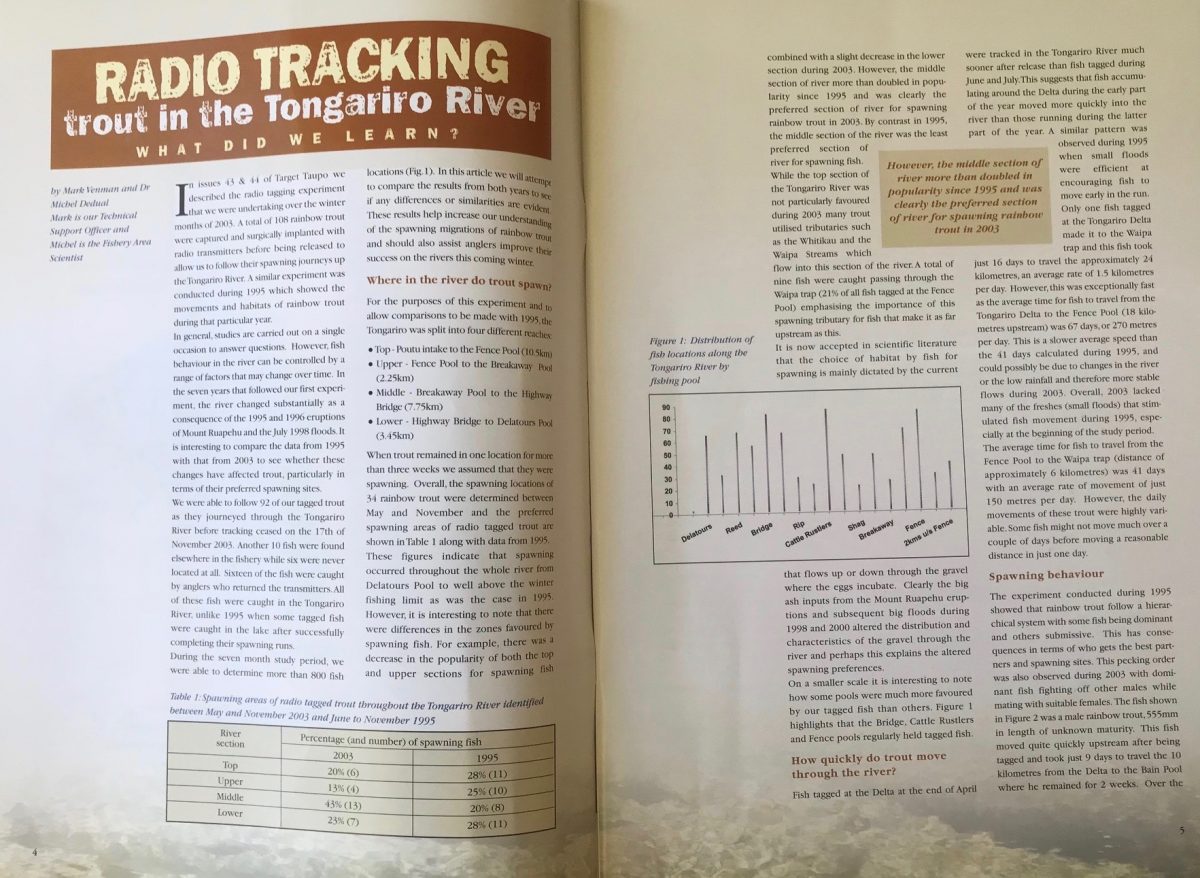 DOC followed 92 of the released trout until November. Another ten trout were found elsewhere and six went missing completely. During the 8 month study DOC determined more than 800 fish locations with a spread as follows:
A comparison of the spread pattern between 2003 & 1995 follows:
LOCATION 2003 1995
Top river 20% (6) 28% (11)
Upper river 13% (4) 25% (10)
Middle river 43% (13) 20% (8)
Lower river 23% (7) 28% (11)
Top river was above Fence Pool to Poutu Intake (10.5km)
Upper river was Fence Pool to Breakaway Pool (2.25km)
Middle river was Breakaway to SH 1 traffic bridge (7.75km)
Lower river was SH1 bridge to De Latours Pool (3.45km).
(The Breakaway Pool used to be above the Cliff Pool & below Big Bend. Nature decided to bypass it.)
(Sadly, De Latours Pool has also gone, now bypassed and destroyed by “flood protection” (?) works. No thanks to WRC (Waikato Regional Council) who excavated a new canal down to Reed Pool. The lower river is still a recovering mess and still changing every season. Delatours was an important brown trout nursery in the big loop at the end of Grace Road below the Bends Pool. See map below.)
 The differences in preferred spawning locations, between 1995 and 2003 were due to big ash deposits from Mt Ruapehu eruptions and subsequent big floods in 1998 and 2000. On a smaller scale it was interesting to see that the three most favoured pools back then were Bridge Pool, Cattle Rustlers and Fence Pool.
(Would you have chosen the latter two?)
How quickly did trout move through the river?
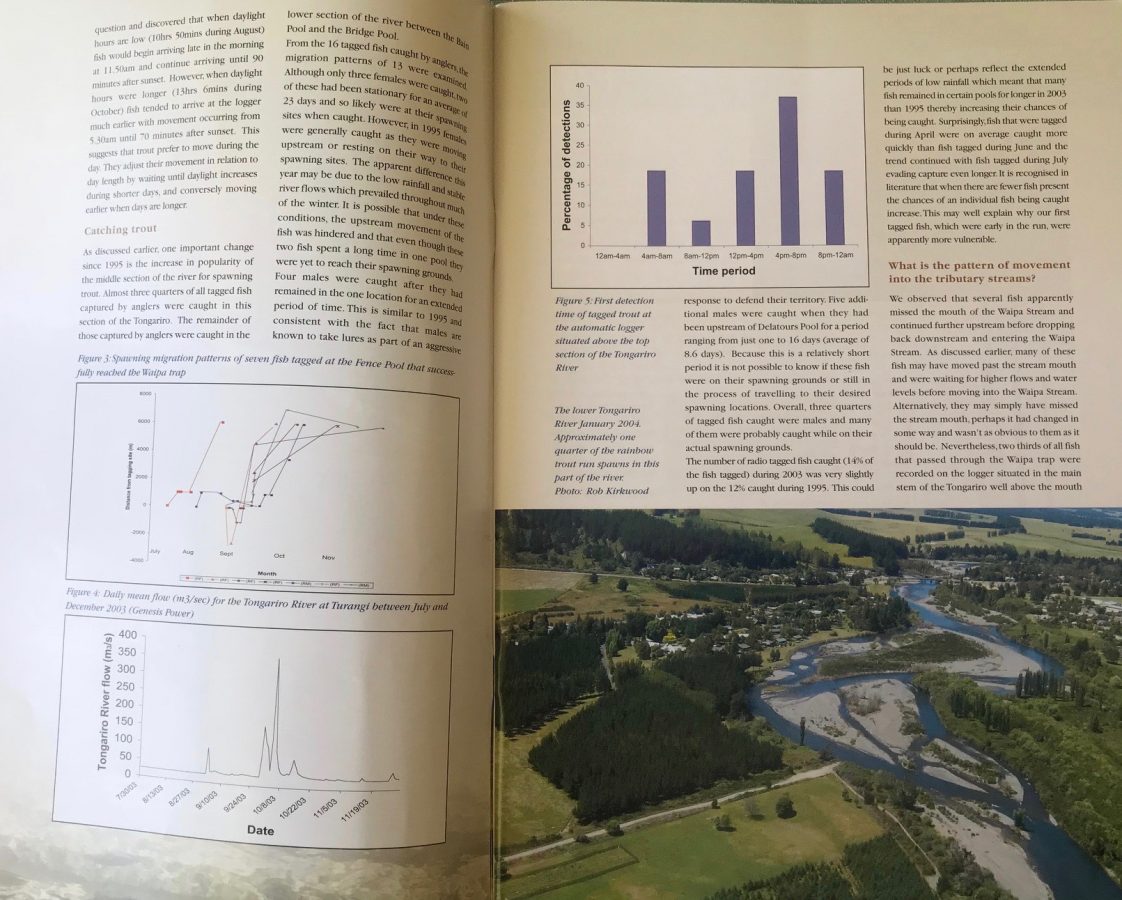
 Trout tagged at the Delta at the end of April were tracked in the river much sooner after release than fish tagged during June & July. This suggested that fish from the Delta move much quicker in the early part of the season than those running during the latter part of the season.
Only one trout tagged at the Delta made it to the Waipa trap taking 16 days for 24km (av. 1.5 km per day) but this was exceptionally fast.
The average time for a trout to travel from the Delta to the Fence Pool – 18 km upriver – was 67 days = 270 metres per day. This was a slower average speed than the 41 days calculated in 1995.
The average time for trout to travel approximately 6 km. from the winter limit Fence Pool to the Waipa trap was 41 days = 150 metres per day. However the daily movements were highly variable. Some fish might not move over a couple of days before moving a considerable distance in just one day.
(This is why TRM continually have to remind fishos that when DOC report of x fish passing through the Waipa trap, – as they did on 17 October when 45 went through overnight – those trout were most likely passing through Turangi pools up to 2 months before…)
Spawning behaviour
 The 1995 experiment confirmed that rainbow trout follow a hierarchical system. This pecking order was also observed in 2003 with dominant fish fighting off other males while mating.
The weather – i.e. rain fall producing variable flows – was the key criteria to stimulate movement. During 1995 it was found that every fresh induced an increase in daily movement rates and that tended to occur both as the river was rising and receding. This pattern was followed in 2003.
i.e. The behaviour of one jack was reported as an example. After being tagged it took 9 days to travel 10 km to the Braids where he remained for 2 weeks. Over the next 7 days he moved to the Breakaway Pool 9 km upriver where he remained for 42 days while he spawned. Then he rapidly headed down river to Reed Pool for another 47 days where he probably spawned again?. Then he headed back to the lake.
This type of behaviour was consistent with a dominant male as he was big enough – measured at 555 mm – to be capable of fighting off other males at two separate locations for a period of more than one month while mating.
When do fish move?
(This is particularly for those TRM inmates who have to be first into a pool at daybreak as they convinced me the trout only move in at night?)
 From data using a logger at the Waipa Steam to record the arrival times for 16 fish over 3 months, they reported no fish arrived between midnight and 4am with most of the morning movement between 4am and 8am. Overall 25% of trout arrived between midnight and midday. The remaining 75% arrived between midday and midnight with the majority (37.5%) arriving between 4pm and 8pm. So it appeared from their study that more move between midday and midnight with the majority between 4 pm and 8pm. (That may also explain why many TRM inmates realise they do not have to be the early bird – they wait until after the first ‘shift’ of anglers return to then catch the worm?)
Another pattern observed was for trout to pass a spawning stream and rest just upstream before dropping back to enter the stream after a few weeks. (i.e. Hydro Pool’s Mangamawhitiwhiti Stream or Poutu Pool or Whitikau Stream)
Catching trout
 Almost three quarters of all tagged fish were caught in the middle pools. The remainder were caught in the lower section between Bain Pool and the Bridge Pool – aka Braids.
Estimating the Tongariro River spawning runs
One of the main objectives of the study was to estimate the size of the run. They estimated that between April and November 2003 the total was 80,000 fish. This was higher than 1995 figure of 60,000.
Conclusions
 From comparison of the 1995 and 2003 surveys of the most popular pools, possibly due to flooding the favoured pools changed considerably. In 1995 they identified Reed, Swirl, Hydro, Red Hut and Blue Pools. Compare 2003 when they chose Delatours, Bridge, Cattle Rustlers, Poutu and Fence Pools, but flooding (and Waikato Regional Council “flood protection” (?) works using diggers and bulldozers) has since changed these pools. They commented on the need for anglers to keep an open mind and move around more if your favourite pool stops producing.
(Tongariro River as it was in 2003, showing the pools referred to in the article – P 12, Target Taupo March 2004 Issue 45)
