

We realise he should have been more respectfully referred to as “Sir”, but as he never earned it, as he bought it, he does not deserve it.
Bob Jones is arguably the most famous, or infamous (?), character amongst TRM’s list of ex-inmates. He was a regular guest back in the 60’s when Taupahi Road was the main North-South Road, so he always occupied the cheapest studio hidden as far away from the road as possible. Then he would sweep into TRM, driving his lime-green XJ6 Jaguar, pretending he would not be noticed. Other fishy guests from his era have nothing nice to say about him. His sheer arrogance was breathtaking. That may have made him so memorable to many, though we find his business history more revealing of the character behind the image.
He died about one year ago and the NZ Herald and other newspapers are still riding on his reputation. There is so much material about him, mainly composed by him, that it is difficult to choose any particular article by journalists. All they wanted was sensational headlines. For more selective TRM inmates, the best reviews about him have been posted by other investment advisors who describe his devious business history more honestly. They deserve to be published much more than the journalists’ tripe.
Below is TRM’s previous blog on him.

An Easter story – when Sir Bob Jones edited TONGARIRO Skulduggery?

In 2025 TRM’s Facebook page posted our version of an obituary about Sir Bob Jones and mentioned his involvement in “editing” our fictional “mockumentary” TONGARIRO Skulduggery. This sparked several requests from inquisitive readers. It always surprises us to see how readers scrutinise every word in our blogs, perhaps hoping to catch us out! You need to be warned, this blog involves sensitive racist issues.
Over the last 60+ years Jones imposed himself on the New Zealand consciousness like few other people. He appeared regularly in every broadcast media and public debates, ran radio talkback shows, wrote books, and wrote a column published in more than 20 newspapers. People either loved him or hated him. TRM were in the former camp. The reason we appealed to Sir Bob was that he was arguably TRM’s most famous fishing “old boy”. He had stayed in a studio out of public view for many years before building his own home further down Taupahi Road.
You might need to buy the book to understand the background to the storyline (Sold out by May 2026). The original plot featured him prominently as the “broker” appointed to negotiate a $ multi-million-dollar settlement to compromise a deal with Maori, negotiated with the Government representative, our Taupo MP. TRM outlined the plot and asked for his permission, which was granted. He was very considerate and initially enthusiastic about the satirical nature of the plot as indicated below, although we were warned and underestimated the possibility of any future changes from his encouraging reply:
“My apologies for the delay in reply to your letter but I’m up to my neck preparing for my imminent Maihi libel action. First, congratulations for having a crack at a humorous novel. I’ll certainly be happy to proffer advice when you’ve finished the draft.”…
Some months later, after he had read the final draft, we were surprised and disappointed when he changed his mind and declined. This required a complete rewrite of the story, which lost much of its “punch” in the watered-down revised version, so much so that I had almost given up and scrapped it. Then a kind neighbour, an established author of several published books, offered to review it. She replied enthusiastically, suggesting it deserves to be published. That is how it all happened.
The mockumentary, i.e. whether it was fact or fiction, has been discussed at length with many TRM inmates for the last five years. It was composed at a time when Covid dominated NZ and motels became redundant overnight as guests could not travel. So it gave me a new project. Readers, aka critics, who question my judgment on not taking Sir Bob’s advice, may be interested in the professional opinion from another author who was approached for a “manuscript assessment” at the same time. She replied,
“What a yarn! The melding of fact and fiction makes for a great read as the story lurches from one event to the next, building on local issues and the idea of compensation being given out to Maori. The finding of the skull turns everything on its head as Jim and the old man set about seeking compensation. The final irony, of course, occurs with the old man’s deathbed confession: (I had to delete her comment here as it gives away the plot!)
How interesting to read about the old parched human skeleton that had been revealed under an ancient dugout canoe that appeared to have been used to protect the skeleton like a primitive sarcophagus or vault. An amazing description of the son carefully putting the skull in his fishing bag. It’s also fascinating as the team find that the discovery has already been buried under pumice and it’s quite funny as each of the agencies involved have a different take on what might take place next.
A strength of the manuscript is the humour, and there are many hilarious moments. Another strength is the depiction of this local environment and its history. There is some excellent history about the river, including the Bob Jones punching incident on the river.“

So why did Sir Bob change his mind?
There were two main reasons.
First, perfectly timed for Mother’s Day, I had failed to mention the TRM Ladies Committee, or our MP, in my brief outline designed to gain his permission. (You can now appreciate why this has never been revealed previously.) When he discovered that much of the plot was schemed by women, he declined to be involved. On those grounds, we fully accepted his reluctance, but the other background reason may have been very influential.
Maori Gratitude Day
The timing coincided with the imminent Maihi libel action explained below, with Sir Bob being subject to publicity from a defamation case claiming racist slurs. It happened after Jones had previously written in his weekly column in the National Business Review that, among other things, he suggested there should be a “Māori Gratitude Day” when “Māori bring us breakfast in bed or weed our gardens, wash and polish our cars and so on, out of gratitude for existing”.
I have tried to briefly summarise it, but as we experienced when publishing the novel, any brief description can become super sensitive, and humour can easily be misinterpreted when it involves contentious racist issues. To avoid any misunderstanding and to ensure readers understand the background, below is a reprint of the article, published around the same time we were asking Sir Bob for his approval. His responses during questioning reflect his attitude toward obsolete historical conventions, such as the 180-year-old Treaty of Waitangi.
Jones went to court several times for defamation. During the 1984 election, he stood in the Ohariu seat against a National cabinet minister, Hugh Templeton, who distributed a pamphlet listing several groups that he said Jones despised, including women, bureaucrats, civil servants and professionals. Jones won the case, which set precedents in defamation law at the time.

Māori Gratitude Day
After she presented a petition to NZ Parliament calling for his knighthood to be revoked, Jones sued filmmaker Renae Maihi for defamation. In Jones’ weekly column in the NBR (National Business Review), Jones suggested that the country’s national holiday Waitangi Day, should be replaced by a Māori Gratitude Day, a suggestion he claimed was satirical. The defamation trial began in February 2020 and was due to last 2 weeks. Ultimately, Jones withdrew the case after five days.
Sir Bob Jones’ reputation in Turangi lives on, confirmed by the requests from curious TRM inmates, seeking more background information on why he firstly agreed to feature in TONGARIRO Skulduggery and then declined. I had to decide whether to eliminate all the women in the story and reduce the story to the size of a “novella” or stick with the original draft.
I should also confess my dilemma was that I knew instinctively it would sell many many more books if Sir Bob featured as the broker, than without. He pointed out that the original story was too convoluted, unnecessarily bringing in too many extra players and too much local history, which risked the coherence of the story. Naturally, I considered his advice very seriously as he had such a long, successful history as a celebrity author of many books, while this was my first attempt. However, I did not want to fail those other contributors, such as our Taupo MP, who had given us consent to be included in the original plot.
We understand that in the circumstances back in 2020, any involvement in TRM’s plot, which touched on many controversial racist issues such as the existence of pre-Maori tribes in Turangi, would not have been a wise move on his part. We received many complaints anyway after the book was published. To compensate for the removal of the main character, Sir Bob, a censored version was composed with several chapters added about fishy inmates’ experiences. From the threats and complaints received since the watered-down revised plot, we now realise it was not acceptable in 2020 to joke about such sensitive matters. We now appreciate that public attitudes to humour have changed in so many ways.
CONFESSION: We accept that many other TRM inmates also suffer from obsolete BOF (Boring-old-fart) attitudes “out of sync with some aspects of contemporary life”, as we concurred with Jones when he told the court, “You have to be sick not to see the item as a piss-take”. So there you are… although we accept some others had a different view…

What really happened in the Sir Bob Jones v Renae Maihi defamation case?
- By Joanne Black
- Feb 22, 2020
In the High Court at Wellington, Sir Robert Edward Jones v Renae Maihi felt as much about racism as about defamation, before the plaintiff halted proceedings.
For those who saw it, the image of commercial-property magnate Sir Robert Jones in the witness box at Wellington’s High Court with a set of earphones upside down on his head was comical.
But more than just a laugh at his expense, the image and some of the evidence Jones gave in court revealed a man who, despite his sharp mind, quick wit and voracious consumption of current affairs, is out of sync with some aspects of contemporary life. Whether that extends as far as holding views that could be considered by an ordinary person to be racist was left unanswered.
Jones, 80, who told the court he does not have a mobile phone, but has staff instead. When on the second day of the trial he turned up without his hearing aid, they scurried to find it. They failed; hence, earphones were made available in court for those with hearing impairments.
The case came about after Jones wrote a column in February 2018 in the National Business Review that, among other things, suggested there should be a Māori Gratitude Day when “Māori bring us breakfast in bed or weed our gardens, wash and polish our cars and so on, out of gratitude for existing”.
He said the gratitude day was intended to be the first in a series. The next was going to be a day of gratitude to motorcyclists whose deaths in accidents provided hearts for transplants. The Māori Gratitude Day column was removed from NBR’s website two days after it was first published. “You have to be sick not to see the item as a piss-take,” Jones told the court.
In evidence, Renae Maihi said it was incomprehensible to her that Jones’ column had been “written by a knight”. “His words were an act of violence,” she said. After reading it, she had started a petition to have Jones stripped of his knighthood. Her article accompanying the petition on the website was titled, “Strip racist ‘Sir’ Bob Jones of his Knighthood – Read his vile rant here.”
After threatening legal action against Maihi if she persisted in her actions, Jones sued for defamation.
Maihi told the court that she stood by the words she had used in the petition. She had been angered and upset “as a Māori woman and as the mother of a Māori son” by the column. A film-maker, she has a bachelor of Māori performing arts and lives in Toronto where she said the themes of her work were “around colonial oppression”.
In court, both Jones and Maihi presented as confident, intelligent, articulate and sincere witnesses. Both have Māori children. Jones’ late first wife was Māori and they had two children together. Maihi has an 18-year-old son whom she has co-parented with the boy’s father. At different times, both Jones and Maihi were moved to tears as they gave evidence. And in the end, five days into a case that had been set down for two weeks, both agreed to the matter being called off. The abrupt ending removed the court’s responsibility to rule on the defamation charge, but also its opportunity to provide guidance on what, in 2020, counts as racism.

Humorist, satirist, comic writer
Opening the trial before Justice Susan Thomas, Jones’ counsel, Fletcher Pilditch, said Jones felt he had been defamed by Maihi calling him a racist, and by her saying that he was the author of hate speech and unfit to hold the rank of Knight Bachelor. Jones was a noted humorist, satirist or comic writer, Pilditch said. His published works spanned more than 50 years.
“He is also a libertarian. He believes in freedom of choice and responsibility for those choices. His beliefs can perhaps be best described by the principle of live and let live. These themes run consistently through his published work.”
A key issue at trial would be whether the natural and ordinary meanings of the words used by the defendant “are that the plaintiff is a racist, or that the plaintiff’s article contains racist comments”.
Pilditch said the plain and ordinary reading of the words “Strip racist ‘Sir’ Bob Jones of his Knighthood” were a clear and unambiguous personal attack. “That is further borne out by the purpose of the petition, to strip the plaintiff of a knighthood bestowed on him more than 30 years ago.”
Pilditch said hate speech was topical but hate-speech laws were not intended to protect people from offence, or to suppress ideas. “The aim was to punish the incitement of hate in other individuals. The bar for classifying hate speech, both nationally and internationally, is very high, as is the bar for identifying someone as a racist. It is much higher than simply commenting on historical or current cultural issues.”
In court, Jones had no compunction in outlining how irate and upset he was by what he frequently called “a campaign” that Maihi had run against him after his column appeared in NBR. He was not a racist, he said. “I’ve put an enormous amount of effort into trying to help Māoridom and that’s why I’m very incensed to be sitting here now, over this,” he told Maihi’s counsel, Davey Salmon.
Although it had been twice rejected by Parliament, at the time of the trial the petition was still on change.org, . It was removed from the site as part of the agreement on the fifth day of the trial to end the proceedings. By then, four witnesses, Victoria University of Wellington emeritus professor of politics Dame Margaret Clark, gym owner and Jones’ regular tennis partner Ryan Wall, author Alan Duff and New Zealand First leader Winston Peters’ chief of staff, Jon Johansson, had given character evidence on Jones’ behalf. All said he was not a racist.
For her part, Maihi described how upset she was by Jones’ column. She recognised racism when she saw it, she told the court. She had grown up with it. Her mother’s Pākehā partner had created an abusive home life; she had been racially taunted at the local swimming pool in Auckland’s Manurewa as a child; her son had been the victim of racism and she saw her petition “as part of a mother’s duty of protection”. Racism was a dangerous and potentially damaging mindset. “To my mind, hate speech and racist speech are one and the same.”

Sir Bob Jones outside the High Court at Wellington on the first day of a defamation case. Photo: RNZ / Charlotte Cook
Jones on the stand
Because the trial ended before Maihi was cross-examined, or had called witnesses in her defence, it was dominated by the case for Jones. At one point, he started to break down when describing his first visit to a women’s refuge. He had been taken to one, before there was a national refuge movement, by a woman who had hoped he might financially support the refuge that she had helped establish in Wellington’s Hutt Valley. Most of the women at the house were Māori. A small boy, aged about three, had dived under a table on seeing Jones visit. The boy, it seemed, was terrified of men. “It was so upsetting,” Jones said, his voice breaking. He became a committed supporter of the refuge movement, donating to it, fundraising for it and serving on its boards for many years.
Jones was also at times an irascible witness, sparring constantly with Salmon in lengthy exchanges and unwavering in his assertions that colonialism and, in particular, breaches of the Treaty of Waitangi, were not a cause of socio-economic disadvantage among contemporary Māori. It was more likely welfarism was to blame, and characteristics particular to disadvantaged Māori. Everyone had choices about how they lived their lives, he said. It was a fact that there were no full-blooded Māori left.
He was asked about suggesting in his NBR column that he didn’t want his children, “wasting their education on a dying language now confined to hobbyists”.
“Are you aware of any extent to which a number of Māori might find that a hurtful or offensive comment?” Salmon said.
“Oh, God. I walk down the street – some people find it offensive,” Jones responded. “That’s an absurd proposition to put to me. Taking offence at everything is a modern-day phenomenon.”
Jones insisted te reo Māori was dying. “It’s not a [disputed] matter of fact. The Government announced last week that they’re making no progress. I’m pleased to hear it.”
Salmon said a number of Māori did not consider the language dying, nor did they think it should be allowed to die. “You’d agree with that?”
RJ: Yes.
DS: So you would agree that they might find that offensive to hear the suggestion …
RJ: Oh, God. I stated a fact. It is a dying language, admitted by Government proponents last week who are making no headway. Which shows there’s common sense out there. But I consistently said … that if people want to do it, that’s their choice. Don’t make it compulsory. And I’ve held that view since I first started secondary school at 13 when all New Zealand public state-school kids had to learn French. I refused to. I don’t want to learn French.
DS: You call it a waste of education.
RJ: Of course it is. The human brain has infinite capacity to absorb stuff. What kids don’t have is infinite time. They should be more selective of what they use their study time for.
DS: You then relate it to law students having to learn Latin, “a language with no connection to New Zealand”. Do you see that that might be provocative?
RJ: Oh, God. Provocative to whom? Dead Romans?
DS: I’m not asking whether you think people should feel provoked, I’m asking whether in your columns in which you appear to enjoy provoking, you realise that this would provoke.
RJ: Basically, you’re saying, if I wrote, “the cat sat on the mat”, would that be provocative? I tried it once, and it was.
Jones said he had never once said that people should not learn Māori, and his objection was only to compulsion. “I have always argued simply, as I started arguing when I was 13 and refused to learn French, ‘I don’t want to learn French’.”
Salmon put to Jones another column quote in which Jones had written, “If someone’s interested, by all means learn Māori. So, too, with an endless list of activities from stamp collecting to line dancing. Each to their own, but let’s not have compulsion based on an ill-considered romanticism.”
Salmon asked if Jones agreed that “describing learning te reo as, quote, ‘ill-considered romanticism’, will offend a number of people?”
RJ: Och, well, as I say, all sorts of things offend people. We live in an age of offence-taking as we read about all the time.
DS: We also live in an age, though, where there’s a fairly strong position in Government policy and in culture to reinforce and learn te reo and where it is not considered –
RJ: Which, by their own admission last week, has failed …
DS: And which is not considered an ill-considered romanticism by most Māori people. Do you agree?
RJ: No, I don’t think most Māori people don’t agree with that at all. I think they’d probably agree with me, I think. If you want to learn it, learn it – I make no judgment about that. I just say don’t compel us to. Or Latin, or French or anything else.
DS: So you see no implications in your description of learning te reo as ill-considered romanticism?
RJ: I think it is. I think it’s an accurate description.
DS: And your expectation is most Māori would also consider learning any te reo to be ill-considered romanticism?
RJ: In my view, yes. I think they would be very silly to waste good learning time, time being the keyword, not capacity. If they want to, they should do it.
DS: That’s what you think. Do you think they will agree with that?
RJ: I have no idea, but I imagine they probably would. It’s pretty logical, but do it if you wish to do it, don’t force it on people … There’s a qualification, that it is compulsory. You keep dodging that. I lambasted the Welsh for this stuff … a ridiculous language and the only thing it’s ever contributed is lovely Christian names for women: Bronwyn and the like.”
Jones refused to concede his columns were designed to provoke readers. If that was true, he said, Maihi’s petition to revoke his knighthood would have had five million signatures rather than the 65,000 she originally claimed.
“It went down to 59,000. It seemed to go backwards, notwithstanding the efforts of 200 women [assisting her].
DS: I’m not talking about …
RJ: Why aren’t there five million signatures? So, no, I don’t agree. The statistical evidence is you’re wrong.
DS: You don’t agree that you have been seen, by some people, as a controversial voice on issues Treaty and Māori?
RJ: Some people object to everything.
Jones rejected Salmon’s suggestion that he wrote columns “for a bit of a joust”. He wrote for his own pleasure, he said.
DS: In any event … you talk about introducing Māori Gratitude Day. Now, everybody understands, and you don’t need to say this again, that you weren’t genuinely suggesting that Parliament legislates a new holiday.
RJ: No, I can name one who kept insisting that I was. [Maihi said] she couldn’t sleep all night.
DS: Well, that’s your view of what she said.
RJ: I’m sorry, she did say that. She’s on record. Not only couldn’t she sleep all night …
DS: Let’s park that …
RJ: Well, you asked if I knew anybody [who took Māori Gratitude Day seriously]. Yes, I do. Your client. She couldn’t sleep at night and she spent two years saying I advocated servitude, to use her word.
DS: Do you want to hear my question, Sir Robert?
RJ: I thought you’d asked it.
DS: You then go on to say in place of a “much-disdained Waitangi Day”, and it’s those words I want to focus on. Would you agree that your sentiments, included implicitly here about Waitangi Day and about the Treaty of Waitangi, are somewhat controversial?
RJ: No.
DS: You don’t?
RJ: No.
DS: You consider that your view that the Treaty of Waitangi is irrelevant and has had no negative impact on Māori by its breach, you say that’s not a controversial view?
RJ: No, I don’t think its controversial. I’ve already pointed out that article recently in the Economist about the average life of treaties [being six years] … I don’t know what everybody agrees with, but I don’t think it’s controversial to say that a 180-year-old treaty is now redundant.
DS: You are not just saying it is redundant, you are clear in what you’ve written and what you’ve said to me today that the breach caused no harm to modern Māori … do you regard that as just a potentially controversial view?
RJ: A lot of these people we’re talking about – like with socio-economic [implications] – would never have heard of it. How do I know that? I had a home at Tūrangi when I was in my fishing obsession and I knew a couple of prison guards and they used to tell me about Māori youths coming into prison who had never seen or held a knife and fork and they had to teach them. I doubt very much if those kids knew about the Treaty of Waitangi.
DS: Sir Robert, I’m just asking if you know it to be a somewhat controversial view?
RJ: No, I don’t believe it’s controversial at all.
Treaty breaches
Jones said he accepted that there had been breaches of the treaty “and they can be dealt with, but now we see the extrapolation of the Treaty. These are the dangers. This is what irritates me. To cite one: airwaves. They weren’t even known about until 45 years later and so on and so on.”
DS: Can we stick on topic, Sir Robert. You said the breaches caused no social or economic harm to Māori.
RJ: Not 200 years later. You’re making excuses.
DS: I’m just asking whether you know enough of New Zealand, of the Government’s public policies, and of recent jurisprudence to know that your position there is a controversial one?
RJ: No, it’s not a controversial one. I know politicians better than you and I know what motivates them when it comes to this sort of thing – the critical Māori seats, which are the things that have been actively fought over once Labour lost them for the first time.
DS: All right. And where you’ve said that rather than make kids learn the language – to those Māori still alive, some of them here, who were strapped for speaking Māori at school, do you think that that would be a controversial thing to say? That there’s nothing in learning to speak Māori, because it’s dying?
RJ: You’re talking about the past – the strapping in schools. We’re talking about now.
DS: But now we have people with that living memory. As to why Māori is spoken –
RJ: I got strapped every day at school. Literally. I don’t carry it with me for the rest of my life. You get on with life.
DS: I’m not suggesting anything about that. I’m saying, do you regard the fact that children were prevented, for example, from speaking te reo at school …
RJ: I accept it’s true, but to say that generations later they’re still reeling from the impact and therefore going out committing crimes, etc …
DS: I’m not saying that, Sir Robert …
RJ: Well, I’m sorry, that is what you’re saying.
DS: Then you’re not listening to my questions.
Justice Thomas: No, that’s not what Mr Salmon said.
DS: I’m putting to you that those are examples of the types of people who would find what you say contentious, and possibly hurtful. Do you accept that, or not?
RJ: I don’t believe that. I’d be happy to argue with any intelligent Māori on the Treaty of Waitangi being redundant.
Free to call out racism
Opening the case for the defence, Salmon said that although the case concerned a private law claim in defamation, “it raises issues of significant public importance about freedom of speech and in particular the freedom of Māori and other racialised groups to name and respond to racism, prejudice, discrimination and antagonism, as those terms are properly understood today”.
There was no question, Salmon argued, that Jones was free to express his views about Māori in the NBR column. However, Jones’ argument was that Maihi was not free to respond to his views, and to express her opinion that those views were racist and a type of hate speech. Such an outcome, Salmon said, would not just deny the defendant’s freedom of expression, “it would also risk dangerously curtailing the ability of racialised groups, and the community as a whole, to discuss and address racism.
“The plaintiff and Pākehā would be free to attack Māori and other racialised groups, or use pejorative or discriminatory language about them, but those racialised groups would be hamstrung in their ability to respond.”
Salmon said Maihi did not accept that she had damaged Jones’ reputation, “because his reputation was generally bad in the aspect to which the proceedings relate, on account of his publicly expressed views on Māori and other ethnic groups”.
She relied on four affirmative defences to defamation: honest opinion, truth, responsible communication on a matter of public interest and qualified privilege.
Salmon said Maihi would call witnesses including Treaty lawyer Moana Jackson, psychologist Raymond Nairn, international human-rights expert Kris Gledhill, and media-studies expert Nicholas Holm.
A “sensible” end to proceedings
Before she had a chance to do that, Jones discontinued the proceedings.
“I filed these proceedings because I was deeply offended by Ms Maihi’s allegations,” Jones said in a statement issued after the case was abandoned.
“I am not a racist. I now accept, however, Ms Maihi’s offence taking was a sincerely held opinion. The parties may never align on what is acceptable humour, however, no malice was intended by either, thus it is sensible to put an end to proceedings.”
Maihi welcomed Jones’ move.
“This has always been about highlighting the harm and impact that racist language has, both now and historically,” she said in a statement. “It is important for us all to remember that language and articles of this nature, whether intentional or not, can and do cause hurt. It is important, too, that those on the receiving end of racism have an opportunity to express their feelings.
“While I and many others disagree strongly with the language Sir Robert has used about Māori, we can disagree with him without being rude about him as a person. I ask people to keep this in mind when posting on social media.”
An obituary
Wellington Alive · Follow
The Unapologetic Life of Sir Bob Jones: Battler, Brawler and Empire-Builder
Few figures in New Zealand public life stirred debate with the same energy, eloquence, and disdain for convention as Sir Robert “Bob” Jones. With his death, Wellington farewells a man who shaped much of the city’s skyline, unsettled its politics, and dominated its headlines for over half a century. He was, at various times, a property magnate, political disruptor, bestselling author, amateur boxer, staunch atheist, and unapologetic provocateur. His sharp mind, volcanic ego, and disregard for social norms ensured he was rarely ignored – and never forgotten.
Born in 1939, Jones grew up in Lower Hutt and attended Naenae College, a background he wore with both pride and irony. Though he could have lived anywhere, he never strayed far from the Hutt Valley, choosing to stay in close orbit to his working-class roots even as he amassed immense personal wealth. He relished the role of the self-made man, and though he often adopted the airs of a patrician, he never quite shook off the chip on his shoulder.
After studying at Victoria University (and later being awarded an honorary doctorate), Jones began investing in commercial real estate. His company, Robt Jones Holdings, became one of the most powerful property portfolios in the country, known for redeveloping tired buildings into corporate towers, festooned with art. He brought a trader’s aggression to the property world, and by the early 1980s, his net worth made him one of the richest men in New Zealand.
Then came the crash. The 1987 stock market collapse decimated Robt Jones Holdings, erasing hundreds of millions in shareholder value and casting a long shadow over his reputation. Jones emerged personally intact – his property assets and holdings insulated him better than most – but the collapse remains a sore point in New Zealand corporate history. Critics alleged he failed to act decisively as the business faltered; supporters claimed he’d merely been caught in a global storm. Jones himself, characteristically, offered little public contrition.
His foray into politics was brief but seismic. In 1983, dismayed by what he called the “economic lunacy” of Robert Muldoon’s National government, Jones founded the New Zealand Party. His aim wasn’t to win power, but to break Muldoon’s stranglehold by splitting the right-wing vote, and in 1984, he did just that. The party’s votes helped usher in David Lange’s Fourth Labour Government, which then implemented the exact free-market reforms Jones had long advocated. Afterward, he promptly disbanded the party and walked away, saying it had served its purpose. Not before punching a journalist in the face on the Tongariro river.
In person, Jones could be magnetic – razor-sharp, ruthlessly funny, and intellectually intimidating. But he was also volatile and offensive. His remarks about Māori were often condescending and hurtful; dismissed by some as provocation, but experienced by many as racism. He was banned from flights for refusing to obey crew instructions, including famously refusing to remove his headphones during a safety briefing. He smoked incessantly and with impunity, ignoring no-smoking signs and defying workplace bans. When punished for decking the aforementioned journalist while fly fishing, Jones paid the $1000 fine, and slyly asked the Judge if he could pay $2000 to punch the man again. It wasn’t the only pay-off he made, once paying his personal assistant $10,000 to change her name from Sharleen to Charlotte because he found the original name “cheap.” The name was changed, even if only temporarily, and the funds gladly received.
And yet, Sir Bob also had a quieter, less public-facing side. He donated millions across his lifetime, funding women’s refuges, scholarships for disadvantaged youth, and initiatives in the visual and performing arts. He rarely publicised these efforts, preferring to let his money speak where his mouth often didn’t. He abhorred commerce degrees, famously calling them “degrees in greed,” and believed passionately in the humanities. The arts, he said, taught people how to think, not just how to profit. He funded poetry competitions, supported classical music institutions, and championed intellectual freedom, though rarely with soft words.
A technological holdout to the end, Jones never used a computer and had no interest in the internet. He dictated his many books – novels, essays, travelogues – to a typist, insisting that a life offline was a life better lived. His columns, published in The National Business Review and Metro, were infamous for their sharp tongue and sharper elbows. He was suspended more than once, and sued more than twice.
Love him or loathe him, Sir Bob Jones was a force of nature. He brought ideas, money, and controversy in equal measure to every room he entered. He thought deeply, wrote prolifically, and offended regularly. And though he scoffed at sentimentality, Wellington has lost one of its most fascinating minds – one that was as infuriating as it was brilliant.
Rest in peace, Bob. You didn’t go quietly. You never did.
– Justin
Update 2026: TRM have been asked by many inmates and others to update the original story with a sequel. Instead, as it is now over 12 months since he died on 2 May 2025, a “prequel” is being considered, going back to the more spicy original version when Sir Bob Jones featured as TRM’s broker. Wouldn’t it be a ripper! Watch this space…
Sir Bob’s Tongariro tales
After noticing Sir Bob still featuring on TV1 prime time after all these years, most famous for bopping a TV journalist on the Tongariro rive rin 1985, TRM just have to repeat previous reports featuring him:
Recently TRM was trying to record all the most famous anglers on the Tongariro River. These included all manner of “celebrities” (?) from the Queen Mother to the Queen to her Son Charles to American President to Zane Grey to the original Bob Jones of Tokaanu Pub fame over 100 years ago. And you can guess who won – Sir Bob. He did more to promote trout fishing on the Tongariro River in about 1985 than all the others combined. How? By bopping the nosy, rude TV journalist. TRM’s version of the story is as follows:
Without doubt, the most well-known Tongariro trout angler in recent years is the successful property magnate, Bob Jones (Now Sir Robert Jones). Before he built his own home on Taupahi Road, he was a regular “inmate” at TRM. He earned his fame (or notoriety?) in a most unusual, yet memorable, manner.
In his successful attempt to unseat the existing Prime Minister in July 1985, Bob Jones formed his own party. Then, after splitting the vote in the election, he announced to the astonished nation that the third-most-popular party was taking an eighteen-month recess. Anxiously seeking comment, TVNZ chartered a helicopter to track down Jones who was seeking privacy and tranquility fishing in the remote parts of the lower Tongariro River. After searching his property from the air they followed the course of the river down towards the delta where he was identified wading in the river. After circling him they landed close to where he was casting and completely ruined the peace and quiet that Bob Jones was seeking.
This was a memorable moment in Turangi’s short history. Bob Jones established his popularity and notoriety amongst anglers forever with his reaction. Before the TV journalist could interview him he was filmed charging out of the bushes and after throwing his rod aside he attacked and punched the TV interviewer/journalist followed by the cameraman also being thumped for good measure. Great footage.
Naturally, it was the top of the news on the TV that night. The punch-up with a blood-spattered journalist suffering a broken nose trying to report back was repeated many times afterwards. Kiwis love a good stoush. Eventually, the matter ended up in Court where Bob Jones was fined $1,000 for assault. His fame among Tongariro anglers and the public grew when he asked the Magistrate: if he paid $2,000, could he punch him again?
Priceless!
From TRM library of reports:
NZ’s version of Donald Trump?…
Continuing the series of anglers own reports on the Tongariro River, but with a ‘twist’ to enhance your weekend reading enjoyment…

TRM has taken this opportunity to introduce Bob Jones (particularly for Australian readers who may be unaware of his contribution to Tongariro angling folk lore) as he is one of the enduring controversial characters who made more headlines for the Tongariro River than most other TRM inmates combined. As such he deserves his own special report, but as he has never stayed at TRM he was not asked…
Nevertheless TRM acknowledge his considerable contribution to the colourful history of the river keeping many anglers entertained and amused for the last 30 years – in particular from the following incident:

In July 1985 New Zealand Party leader Bob Jones and president Malcolm McDonald surprised many by announcing the nation’s then-third most popular party was taking an 18 month recess. TVNZ went searching for comment, and after chartering a helicopter, found Jones fishing on the Tongariro Delta, near Turangi.
Jones was not amused; he infamously punched reporter Rod Vaughan, arguing later he would fight any charges in court, since the journalists had subjected him to intolerable harassment.
When fined $1000, Jones asked the judge if he paid $2000, could he please do it again?
So how could SWMBO not include him in these stories on the Tongariro…?!!!
He still features regularly. In last week’s ‘Herald on Sunday’ – in the editorial & comment page 38 – their columnist Rodney Hide wrote:
“New Zealanders shouldn’t struggle to understand the phenomenon that is Donald Trump etc…. – think Bob Jones.” He goes on to say, “Jones is a successful and flamboyant businessman. He entered the 1984 election with his freshly hatched New Zealand Party to win 12 percent of the votes. He came from nowhere, won no seats, defeated National and propelled Labour into office, which proceeded to implement his New Zealand Party’s free market policies.”
And to keep TRM’s readers informed (?) is Jones’ opinion on the Government’s current water claim?…………
……….. For example, the Mighty River Power company’s principal assets are eight hydro electric generators on the Waikato River. In 1840, the river provided eels and transport for Maori villagers in the vicinity. But today, like everyone else, Maori buy their food from supermarkets and have substituted cars for canoes. To argue that the river was vested to them in 1840 and claim water usage money is simply opportunistic twisting of the original objective. If that proposition had validity, why is it only now being raised? Why have they not claimed against the power company hitherto?
The answer is blackmail, specifically that via the threat of delay through litigation of the Government’s sale plans, this action could secure taxpayer millions in yet another bogus settlement.
His solution to the constant blackmail?

The Waitangi Treaty is redundant. It need not be formally annulled but like many other outdated laws, be simply ignored as a historic relic. Claims such as illicit land seizures can be dealt with by the courts.
(Photo above of Bob Jones cautiously navigating across Veras Pool below Tongariro Lodge)
For TRM’s Australian fishos we add an appendix – an obituary from Metro Magazine – as the opening paragraph refers to trout fishing on the Tongariro…
First published in Metro, November 2013.
Illustration by Daron Parton.
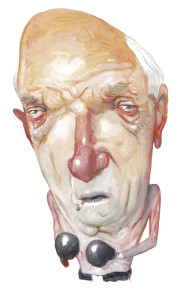
Sir Robert Jones, the world’s oldest man, is dead. He was 194.
A shy fellow, Jones was happiest alone in the Tongariro River tickling trout, emerging from time to time to present his cherished beliefs about sunglasses, grey shoes, cellphones and unattractive feminists.
For more than a century and a half he wrote a column for the FoxNZ Herald; a record bested only by the fictional “Shelley Bridgeman” character.
Born middle-aged, Jones was teased at school for wearing a smoking jacket and pipe, but the taunts fell away as his capacity for a left hook developed. By the age of 17 he had read every book ever written — twice — and owned 5700 investment properties.
Sunning himself in the warm glow of his success, he resolved to spend the remaining years of his life dabbling in property and sharing his wisdom with his fellow man. Women were also welcome to listen.
He became a talkback host, a columnist, an author, a commentator, a knight of the realm, a brawler with TV reporters.
Decades came, decades went. Politicians came, politicians went. New Zealand, once prosperous, grew poor. Foot and mouth disease liquidated the country’s 200 million dairy cows.
Through it all, one constant remained: Sir Bob Jones and his opinions on sunglasses, grey shoes, cellphones and unattractive feminists. His popularity never ebbed. For every old curmudgeon who breathed his last in a retirement home, another dudebro would pick up a newspaper for the first time and chuckle at Jones’ dyspeptic musings.
Nothing, it seemed, would ever change. But in Jones’ 12th decade it did, a little. He decided his true calling was the law.
The courtroom had long been his second home — a boxing ring of a softer kind — and he enjoyed the company of barristers. He admired their arrogance. He admired their bravado. He admired their talent for going about their business fortified by wine.

By the time he was 142 he was sitting in the Wellington High Court.
Although he had to be carried to and from the courthouse in a litter, and a factotum was required to lift his papers and hold his hand steady for signatures, his pronouncements from the bench were invariably those of a much older man, as they had ever been.
Legal scholars called his florid and discursive judgments the best sport since Lord Denning. “Ten days ago,” one judgment began, “the sky fell in Auckland, judging by the hysterical over-the-top reaction.”
Radio hosts stood by each morning to find out “who Bob’s going to stick it to today”.
“You’re not some kind of feminist girl are you?” he would ask witnesses, “because you sound like a very silly one.”
“Life is full of risks, which is why we buy insurance, wear seat belts, lock our doors, don’t holiday in Somalia or, as plainly needs to be said, walk alone through dark parks at night,” he would invariably remind assault victims.
His Friday afternoon sentencing sessions became a Wellington tradition. Spectators would eat popcorn as Sir Robert rasped: “You will now reside at our expense in prison for 70 years where hopefully some awful fate will befall you. Take his cellphone away, but let him keep his grey shoelaces.”
Sir Robert will be buried at his holiday home on Mars.
—————————————————————————————————————————————-
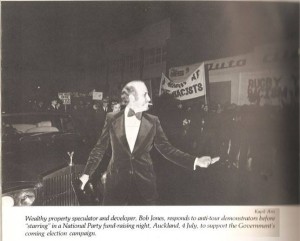
The news caption for photo on right reads “Wealthy property speculator and developer, Bob Jones, responds to an anti-tour demonstrator before starring in a National Party fund-raising night.
Last, nothing at all to do with fishing the Tongariro but just to amuse you, (?) a NZ Herald article.
As wage parity is in the news at the moment with SWMBO, Jones’ comments on women’s rights etc. are timely?
Bob Jones: Female directorships – careful what you wish for
Tuesday Apr 8, 2014
In the early 1960s, to widespread disbelief, a woman lawyer hung out her shingle in Lower Hutt. I recall with colleagues gazing awestruck at this madness. Who would possibly use her? we asked. “I will,” promptly asserted an industrial building investor mate, noted for his extreme eccentricity, and so he did, but no one else followed and she soon vanished.
Women have come a long way since in New Zealand, rated last month by the Economist in the top five nations in its glass ceiling index. Prime ministers, Cabinet ministers, the chief justice, judges, the Ombudsman, government departmental heads, bishops, boxers and bulldozer drivers, mayors, company CEOs and entrepreneurs, doctors, editors, farmers, commercial pilots, governors-general, soldiers, ambassadors, professors; there’s no field where they don’t play an equal part and no one notices gender any more.
Moreover, this is particularly praiseworthy given women’s innate irrationality handicap, such as driving in the right-hand lane or pushing golf carts before them, despite their being designed for pulling.
And as for law, women now outnumber male graduates and are also progressing splendidly in equality terms with law’s flipside, namely crime.
Despite some recent strong performances they still lag behind men on the murdering front but make them mere pikers in the theft as a servant stakes. Scarcely a week passes without another mid-40s divorcee company manager or accountant before the courts, having nicked a few million from her employer.
All of this has been achieved in a relatively short time. Half a century ago, women were married at about 20, thereafter fulfilling their prescribed role as mothers and home-makers. Two decades later, with the children gone, they often devolved into dullard appendages to their husbands.
Here’s an example. Back then my girlfriend and I (she was the only female I ever saw fishing) would walk to the Tongariro River’s large Major Jones pool parking lot, cross the swing bridge and head upriver seeking pools to ourselves. In the parking lot would be up to a dozen cars containing middle-aged and older wives of the anglers working the Major Jones pool out of sight down the river.
There they sat, immobile, not reading, not talking, instead just staring blankly ahead, awaiting their husbands’ return, often as much as eight hours later. We called them the clumps. Such non-participating lethargy is inconceivable today.
My initial puzzlement about women’s lib after it arose in the 1960s, abruptly ended when I read Frank Sargeson’s 1969 novel The Joy of the Worm, which awoke me to women’s plight, epitomised by those Tongariro clumps.
Now feminists in Britain, Australia and New Zealand are again on the warpath, agitating to overcome what they describe as the last male bastion, namely public company directorships. They should think again, for it’s a most ignoble and parasitical ambition.
The importance of public companies is grossly exaggerated, as they comprise only a small part of the economy. Remove the top five and the remainder are insignificant in the overall scheme of things.
Public company boards of directors are required by law, but for all their prescribed roles of policy-setting and watchdog shareholder protection, history repeatedly shows they’re utterly ineffectual. So, too, with the many dozens of government boards, which merely provide sinecures for political mates. Having been on both public and government boards I know what a total waste of time they are and now won’t have a bar of them.
The reality is that executives run companies and make policy decisions and the directors are simply Christmas tree decorations. “A Lord on the Board”, sneered the British entrepreneur Tiny Rowlands decades back, mocking the image value of public company boards, but nothing has changed since.
In his 1980s heyday, Ron Brierley controlled dozens of public company boards here and abroad. He refused to pay non-executive outside directors, first because they contributed absolutely nothing and second, because there was always a queue of useless public figure sad-sacks, the male equivalents of yesteryear’s Tongariro clumps, incapable of ever starting a business themselves, who viewed directorships as prestigious – God only knows why.
In recent years some honest men of good repute who accepted finance company directorship baubles found themselves facing criminal trials because of an ill-considered law, namely strict liability.
Nevertheless, in prostituting themselves through accepting these free-ride pretend roles, they in part deserved their fate.
During one of those trials, at day’s end, the prosecuting QC, a lessee in my building, turned up and flopped into an armchair muttering his disbelief. The following exchange had occurred. “You accepted the chairmanship of a company engaged in property development finance?”
“Yes.”
“Do you know anything about property development?”
“No.”
Women should think again about directorships, for far from trailing men, it’s greatly to their credit that so few are debasing themselves in this way.
And another report from another local angler who fished with Bob Jones nack then:…
“The Tongariro is part of my soul and I am a lucky man.”
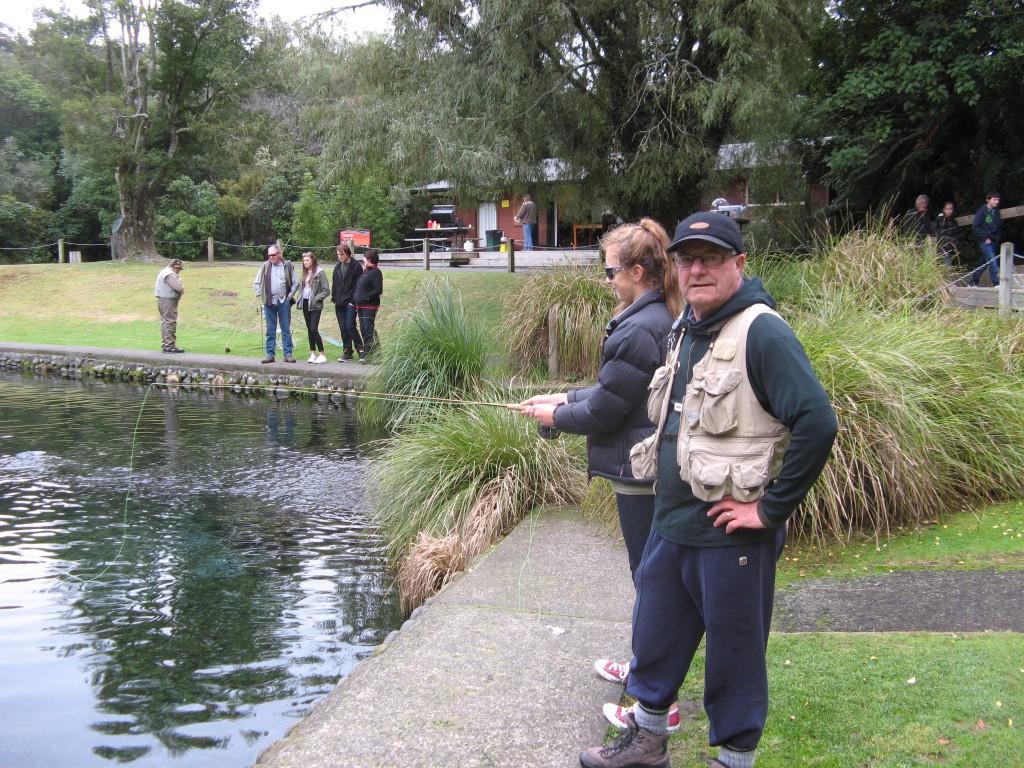
(Photos above and below right of Graham coaching young ladies at the Trout Centre)
“My name is Graeme Duff, a resident of Wellington and a keen trout fisherman, who has owned a holiday home in Herekiekie Street at Turangi for nearly 35 years.
I was introduced to trout fishing by my father in the 1950’s on the rivers near New Plymouth where I was born and raised.
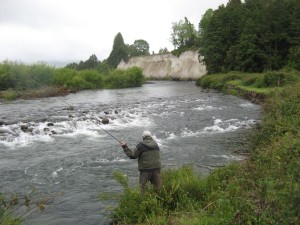
(Photo on right of Wanganui River below the confluence with Whakapapa River and below is the old railway line access from Kakahi to the Whakapapa River))

My interest in trout fishing was heightened when my Dad and three of his mates bought a small fishing hut on the Whakapapa River at Kakahi – a little cabin which we visited two or three times a year.
That cabin named Whaka Lodge by the owners still stands today, some sixty years on, on the banks of the Whakapapa.
This interest as a young lad waned as the attraction and appeal of other sports developed in my teenage years, but in the mid 1970’s, when I was a resident in Hamilton, I was invited on a number of weekends to visit Turangi and once again explore the magic of the trout and the fly rod.
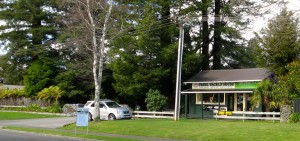
In those days two families came down, the children were certainly pre schoolers, we stayed at the Creel Lodge (T.R.M. was always fully booked!!!), and from memory paid about $15 a night for family accommodation.
Our visits from Hamilton to Turangi became more regular and in the late 1970’s I started a wonderful annual tradition of 10 days in Turangi in the middle of winter fishing with my mates.
We rented baches from acquaintances and as a result of renting the Herekiekie Street bach of Ashley Heydon from Taranaki, we purchased the next door bach from a Palmerston North family in 1982. The boy’s annual fishing trips continued for some 20+ years but were generously supplemented by numerous family holidays both summer and winter.
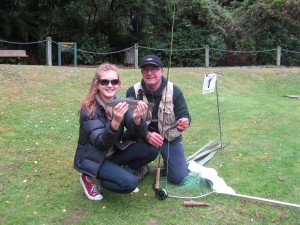
I have now fished the Tongariro River for close on 40 years and every one of those 40 years has contained indelible memories of fish caught, fish lost, great camaraderie, outstanding fishery, declining fishery, recovering fishery. The beauty of the river and its wild life inhabitants, the changing seasons, some enormous floods (February 1999 and February 2004 come to mind), and the joys of relearning the river after it had been rearranged by these floods.
In my early days the standout pools for us were the Boulder, the Breakaway (or Harry’s Rock as it was often known), the Never Fail, the Megan’s and the Reed. Being so much younger and more competitive in those days 90% of our fishing was with the nymph, a technique shown to me by Garry Kemsley one morning at the Never Fail Pool in about 1978. It became my pool of choice because from my experience it lived up to its name 52 weeks of the year.
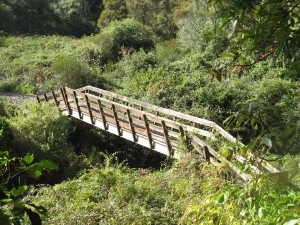
On right is the original anglers access footbridge across the Poutu before SH1 was realigned.)
The Boulder was another pool that held wonderful memories. We went there for years, the best of those years which were before the road around the prison was opened in 1982. We would park the car on State Highway 1 by the Poutu Stream, walk into the Boulder with a pack on our back,always corned beef sandwiches, a thermos of hot tomato soup a good slab of chocolate and a beer or two for lunchtime.
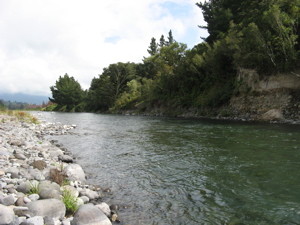
We would be there at 6 a.m. and arrive back at the car 12 hours later more often than not carrying at least six fish. It was a wonderful pool, forever producing fish and on many occasions held up to 9 rods.
On other occasions, particularly during mid week you and your mates had the pool to yourselves and a wonderful day of sport was had by all.
(Photo of Blue Pool above on right, Bob Jones crossing Vera’s Pool below right))
“An interesting and amusing memory was a very productive mid week day back in 1982 with Bob (now Sir Bob) and Anne Jones.
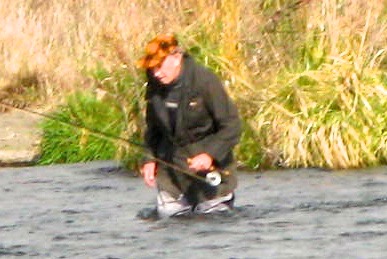
I had met Bob through business and we were both going to Hamilton to watch Wellington lift the Ranfurly Shield from Waikato.
The next day the three of us ventured to the Boulder Pool. These were the days before the road was opened and we parked on State Highway 1.
On the walk in I noticed that the Breakaway Pool (or Harry’s Rock) was unoccupied so I said to the Jones that I would have a fish there before joining them at the Boulder. I did so and some hour or so later as I pushed through the undergrowth I heard – “How many have you got???!!!”
My response to Bob was that I had landed three fish which I had killed and buried to be collected on the walk out later in the day. My response was immediately met with a joyous – “I am two ahead of you”, which indicated to me that an active and competitive day lay ahead!!!
We had a most enjoyable and productive day with Bob wet lining (which was the only way he fished in those days) and me nymphing. I took my time and spent plenty of time on the bank but the introduced competition required me to respond every time Bob landed a fish, which he did on numerous occasions.
The Boulder Pool was fishing on that particular day like it could 30 odd years ago and a long cast with a nymph to land behind the huge boulder, that the pool got its name from, guaranteed a fish every time.
In the end Bob had to concede defeat which he did with the amusing comment – “Anne I have been fishing for 30 bloody years and I have been facing the wrong way (!!!).”
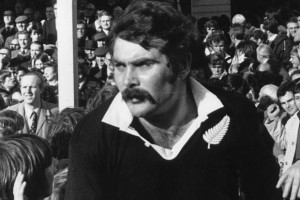
Now to the Murdoch story –
“As mentioned earlier the 10 day mid winter fishing trips were legendary and most of these were spent in the company of my good friend from New Plymouth, Bruce Hutchings.
In about 1978 we were in the midst of one of these annual trips when the persistent rain for several hours even tested the keenest of young fisherman.

In mid afternoon we decided to call it a day but thought that before we returned to our accommodation in Kuratau we would drop in for a thirst quencher at the local Turangi hotel.
The way that we were dressed, and the fact that we were drenched, necessitated the public bar where we were made most welcome to a table with some locals.
Another local joined us an hour or so later and was simply introduced as Keith.
As keen sports followers we knew exactly who it was and some hours later when the effects of our thirst quenchers had well and truly taken effort my mate said to Keith – “I remember when Alistair Scown whacked you in a Taranaki/Otago match.
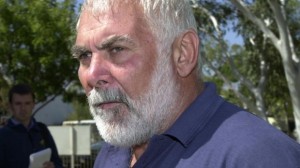
Keith Murdoch with a smile on his face, and the modesty of a great rugby player and All Black simply replied – “I don’t recall that but I think it unlikely”(!!!).
As I said this is the late 1970’s when the media of NZ was still searching for Keith Murdoch who had never been found after he left the All Black tour of Great Britain in 1972.”
———————————————————————————————————
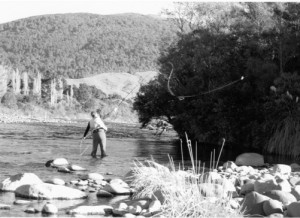
I continued to nymph fish as my predominant form for many years but I have returned to wet lining in the last 10 years – as my family say I am showing my age, but nymphing has never offered the exhilarating experience of the fisherman nearly having the rod pulled from his hand by the aggressive take of a fit strong 6lb rainbow hitting a wet fly.
I have owned the holiday home in Herekiekie Street now since its purchase in 1982 but we pulled down the original black bach in 1997 and built a new more comfortable family holiday place which still stands today.
I say still stands because on the night of 29th February 2004 there was some real doubt – the property was inundated when the river burst its banks around the area of the Tongariro Lodge, but 9 months later it was rebuilt, reoccupied and the wonderful memories continued (almost) uninterrupted.
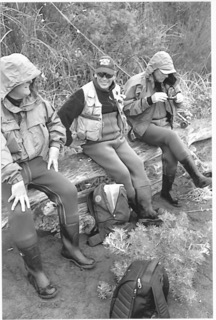
(The photo below on right is the boys in the rain at the Cattle Rustlers, circa 2005. Me on the left, Bruce Hutchings in the middle and John Paul from Auckland on the right. Of interest but not in the story is the fact that we were all mates at New Plymouth Boys High School in the early and mid 1960’s so it goes to show the camaraderie of fishing!!!)
My years on the Tongariro and particularly in Herekiekie Street has given me the opportunity to meet, socialize with, and fish with many characters. They included Reg Crane and Ray Legg who both owned No.1 Herekiekie Street at different times, street guardian Les Wilson, and well known Wellington businessmen Max Downes and Donald Budge. My fishing mates include Chris Young from Taupo, John Paul from Auckland both who are now Herekiekie Street holiday home owners, and Bruce Hutchings from New Plymouth.
I could go on and on about the 40 years but I think the fact that I still go back, still fish, still catch the odd one, and am now enthusiastically joined by the third generation of our family spells volumes for the area and the river. It is part of my soul and I am a lucky man.”
Regards
Graeme Duff