

For the most popular pool on the Tongariro River, on the new map – the Tongariro Bucket List, “Fifty Pools to Fish Before you Die’, TRM has adopted the original name, now over one hundred years old. Many anglers scoffed at the new pool and thought SWMBO had just invented a new flowery name for the map. But the historic connections are almost 100 years old.
There is so much interesting fishy history surrounding the names of the pools on the Tongariro River. With the increased growth in tourism, mainly from bikers, now increased by a new generation of ebikers, the history of these more famous Tongariro River pools deserves attractive tourist panels to explain their history. As indicated with the Daisy Pool, some of these are over one hundred years old and lack any information notices.
Who was the Admiral of Admirals Pool? Who was the Judge of Judges Pool? Who was the Duchess of Duchess Pool? Who was Major Jones? Why was it called “The Sly Grog Pool”? etc…..
A couple of years ago we asked DOC for permission to provide tourist panels but sadly they declined and advised they considered there is adequate signage on the Tongariro River Trail. DOC – Department of Conservation manage the Taupo fishery and the Tongariro River Trail. We suggested that when the Tongariro directional signage is compared to other more successful tracks like the Timber Trail, it lacks signage information, particularly on the historic names of pools. Distance markers are normal on other tracks as well. Anglers were hoping DOC must have many signs in storage to describe the fauna and flora and native birds seen along the trail. We were hoping the local fishing club TALTAC (Tongariro and Lake Taupo Anglers Club) or the Advocates for the Tongariro River might have followed up TRM’s original request. But they need DOC’s support as well. The only way anglers and bikers and trampers and tourists can improve their historic knowledge of the Tongariro River pools is from these motel blogs.

The Daisy Pool
TRM’s top vote for the most successful productive pool this winter season continues to be the DAISY POOL. It has completely replaced the old Bridge Pool as a wonderful holding pool for the trout on their spawning run to rest up and wait for their leader to decide which fork they will take on their spawning run upriver. Despite being thrashed every day, one Taranaki angler reported his best result in twenty years of fishing the Tongariro River when he landed over twenty in one day last week – and that was after everyone else had given it a hiding. OK?
As indicated in the photos below, the most populated fishy spot on the TRB was what we call the ‘Daisy Pool’ just above the road bridge, about 50 m above the original Bridge Pool and below the confluence of the main flow from Judges Pool and the side channel around under the cliff from the old Lonely Pool. Most important to TRM inmates, it is less than 5 minutes level walk (in waders).
The Daisy Pool can be fished off the bank – casting without wading – on the TRB or by wading out from the TLB – more popular for lefties. Beware of BIG snags below where the anglers are casting – they can be spotted from the road bridge.

Meantime anglers continue to ask ‘who was Daisy?’ Where did the “Daisy Pool” name come from? To explain, the following has been hacked from a previous TRM report.
This spot has been known by several other names in the past. Many pools and parts of the river were dramatically changed or moved during the Tongariro Power Development in the 1970’s.
It is so close to the Bridge Pool that some have referred to it as the ‘Upper” Bridge Pool. TRM’s usual main reference for pool names history is the booklet by Allan & Barbara Cooper, “Pools of the Tongariro”, which refers to it as the “Groin”. Prior to their 1975 publication, it was referred to as the “Weir Pool” described by R L Begg in the NZ Fishing and Shooting Gazette in June 1936. But on Whitney’s map of 1932 and on the earlier 1928 map it is called the ‘Daisy’ Pool. OK? So TRM has adopted the original name, now over one hundred years old.

Where did the “Daisy” name come from?
The name must be very old as SWMBO knows all the words to the song.
It is said to have been inspired by Daisy Greville, Countess of Warwick, one of the many mistresses of King Edward VII. It was one of the earliest songs sung in music halls in 1892, by which time the bicycle had become an everyday sight in Victorian life. Henry Dacre composed the song that became immensely popular, both in the London music halls, and also in America.
Later when the rest of the world had forgotten the tune, it was kept alive daily in NZ for 27 years (1936-1963) by a famous radio host who called herself Aunt Daisy. She was an icon as NZ’s most popular radio host for the 9 am to midday state-owned ZB channel. She was early radio’s most famous name, along with the afternoon programme by Uncle Scrim. Her popular show was always introduced with the “Daisy, Daisy” (see all the words below) song from the show above.
SWMBO listened religiously to her every day when She was supposed to be doing correspondence lessons on their remote farm. She insists you need to know the full story below.
TRM inmates are such curious inquisitive fishos with an insatiable appetite for all these little hardly known historic local details. So now you know!

The story goes that when Dacre, an English popular composer, first came to the United States, he brought with him a bicycle, for which he was charged import duty. His friend William Jerome, another songwriter, remarked lightly: “It’s lucky you didn’t bring a bicycle built for two, otherwise you’d have to pay double duty.” Dacre was so taken with the phrase “bicycle built for two” that he soon used it in a song. That song, Daisy Bell, first became successful in a London music hall, in a performance by Katie Lawrence.
The song was originally recorded and released by Dan W. Quinn in 1893.

Daisy Bell by Harry Dacre
Daisy, Daisy, give me your answer do
I’m half crazy all for the love of you
It won’t be a stylish marriage
I can’t afford a carriage
But you’ll look sweet upon the seat
Of a bicycle built for two
Aunt Daisy – New Zealand’s first celebrity foodie
Maud Basham, better known as ‘Aunt Daisy’ was a radio broadcaster and personality who broadcast for 27 years (1936-1963) every weekday morning to New Zealanders.
She greeted listeners with her boisterous catch call: ‘Good morning, everybody’, then regaled listeners with recipes (mostly supplied by her followers), home hints and sponsors’ products. In addition to her role as a pioneer female celebrity broadcaster, Aunt Daisy was also New Zealand’s first celebrity foodie.
She became famous and loved: before sailing to the United States on a goodwill trip in 1938 trip, she had a farewell in Wellington’s Town Hall which overflowed with fans, and the train stations en route to Auckland’s port were crowded by well-wishers singing her programme’s theme song ‘Daisy, Daisy, Give Me Your Answer Do’. Hard to imagine in 2023!
Early career
Daisy was born in London in 1879. Her widowed mother emigrated to New Zealand in 1891, settling in Taranaki where Daisy later became a pupil-teacher with a keen interest in acting, singing and debating. She married civil engineer Frederick Basham and the couple moved to Wellington in 1922.
She started her radio career singing for an experimental radio station and began broadcasting seriously in 1928 when, in the lead up to the Great Depression, her husband was put on half-pay.
Building a following
She became known as ‘Aunt Daisy’ when she presented her first children’s programme. She went on to work for a number of radio stations before joining 1ZB (Newstalk ZB’s ancestor) in 1933 to present a 30 minute programme for women. She built up a huge following, limited only by the restricted transmission range of the station.
State-owed IZB in Wellington was the first radio station to take advantage when the 1936 Broadcasting Act 1936 introduced commercial radio (although 1ZB was still state-operated) and Aunt Daisy officially began promoting products. As the ZB network expanded throughout New Zealand, she became a national celebrity.
An expert talker
Aunt Daisy would talk; read an uplifting ‘thought for the day’; share recipes, home hints, and advice – and chat about products she’d agreed to promote. Aunt Daisy was a famously fast talker, managing between 175 and 202 words per minute (wpm); (about the same as SWMBO!) all clearly articulated and precisely spoken. By comparison, the usual conversational speed is 120-150 wpm; radio hosts usually manage 150-160wpm.
Products she promoted were often sold out within hours; her listeners trusted her implicitly because they knew she would only advertise products she had tried herself.
World famous in New Zealand
She went on a world tour in 1938 and paid wartime and post-war goodwill visits to the United States where her irrepressible manner and unquenchable optimism earned her the label of ‘The Dynamo from Down Under’.
In New Zealand she was regarded as ‘the first lady of radio’ and was recognised in the broadcasting industry as one of the country’s most potent advertising forces. Her influence was enormous. She was made an MBE in 1956 and continued broadcasting her daily programme with rarely a break until a few days before her death in Wellington on 14 July 1963 at age 84.
New Zealand’s first foodie
Her first cookbook was published in 1934; it was the first of ten. The Aunt Daisy Cookbook has remained in print since it was first published in 1968, and it’s been reprinted 21 times. It was a heritage collection of her recipes, compiled by her daughter, the late Barbara Basham. All proceeds go to a charitable trust that funds medical research in New Zealand.
The cookbooks provide a fascinating insight into how much our world has changed. There are ingredients such as beef dripping, lard, and suet which are rarely used today and they include suggestions such as substituting crayfish for meat, making ‘Faggot Loaves’ from liver and bacon; ‘Sea Pie’ from beef; and the ‘Good Pastry for Housewives’.
Its baking section has stood the test of time, however, with Kiwi classics such as ‘Brandy Snaps’, ‘Anzac Biscuits’, and ‘Bumble Bees’ although it would be a brave person who served ‘Māori Kisses (Eggless)’ these days!
Having been admonished as a child for talking too much, Aunt Daisy built what some might have considered an unfortunate characteristic into a professional, enduring and lucrative career – one that has known no equal in New Zealand.
And no, she did not fish that or any other pool.
Below is a previous TRM blog with tourist information from other trails to indicate the type of signage that is still needed on the Tongariro River Trail.

Tourist Information Signage
Where is the Tourism information signage on the Tongariro River Trail?
A little while ago an interesting facebook post involved some character who calls himself “Didymo Dave” had a little rave about the need for local trout fishing guides to include more in their repertoire than just fishing stuff. He particularly mentioned the need for knowledge of the native species in their fishy environment. This was in response to a Facebook comment about the lack of any Maori fishing guides who could give the tourist anglers more than just a fishing experience but to include more information from the Maori perspective as well.
TRM are amazed there is not someone providing this already on the Tongariro, or if there is they have not promoted it. The timing is unfortunate just now with covid recently restricting the numbers of anglers from abroad during the last two years. At the time of composing this TRM have eight fishos from overseas (two men from Melbourne, three from New Caledonia, a couple from Canada and one from the South Island – all booked for two weeks stay) in residence.

Maori guides were a feature of the tourist fishing experience at one time – see the photo above of the legendary Zane Grey with his local guide Hoka Downs. Since then in the 1920’s there have been many more situated on the Waitahanui River but more recently they appear to have disappeared. From TRM’s experience in helping tourists select a guide, we know there is a gap in the market and they would be popular.
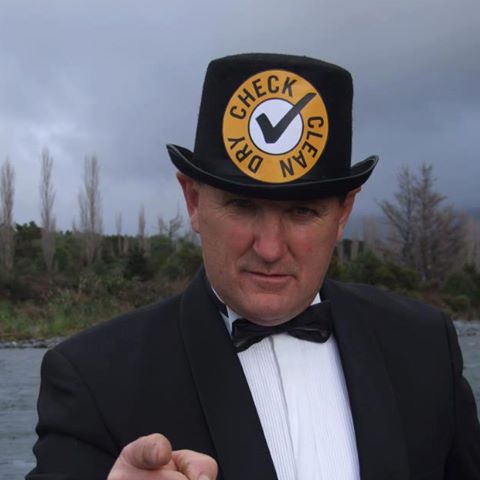
But what this post is supposed to be about is a better way to educate many more tourists than just the fishing species, on the fauna and environmental issues (like CHECK CLEAN DRY!), by erecting a series of information boards along the Tongariro River Trail. We have been on about this for some time without any success but are sure it will eventually happen.

Why? Every other bike trail uses attractive tourism information boards to provide an informative commentary along their trails to make them more than just a bike ride, but an informative experience in local history and to enlighten tourists about the environmental issues.

For some more mature bikers, the information boards are always a good excuse to stop for a “breather’. Even if they only describe the native trees on the track with vital information on whether they might be poisonous or any historic medicinal qualities or remedies from their leaves, etc. is fascinating fodder for tourists. The photos of tourist notice boards with tree descriptions and local history are from the Coast to Coast trail up in Kaikohe.

Another very important “gap” not catered for is to provide some local history for tourists. On the Tongariro River Trail the history of some of the “pools” is fascinating. These fishing pools were named about one hundred years ago and most anglers of this generation are not aware of the characters or the reason they were named.

Just the names alone are sufficient to stir up questions. i.e. The Duchess Pool – named after the Duchess of York in 1920’s – see photo below.

TRM previously offered funding the signs from book sales (TONGARIRO Skulduggery) to kick it off and DGLT (Destination Great Lake Council are Taupo Council’s tourist promotions team) were keen to contribute to make it happen as well. In the meantime the project is waiting for approval from the Government Department that manages the river trail – DOC. They replied to our request that the present signage is considered adequate! But there is none..!

An example is the Admirals Pool (which so many believe is named after the Rear Admiral Hickling who wrote a book on fishing the Tongariro River – Freshwater Admiral?) which is named after Admiral of the Fleet, Lord Jellicoe, second Governor-General of NZ, 1920-1924. But his personal history of why he was sent to NZ is even more remarkable. (Ditto, Rear Admiral Hickling!) These stories need to be told.

Then there is the Cattle Rustlers Pool, Sly Grog Pool, Hydro Pool, Gun Club Reach, which beg the question to explain the reason behind the names. Who was Major Jones? Who was Vera?

With flooding on everyone’s mind recently, the history of Tongariro floods destroying the swingbridges is of interest, how the anglers’ access swing bridge was replaced by a flying fox at Red Hut. Or the Bridge Pool flood history deserves some recognition.

Just as important is some of the Maori history of the region. There are many other pioneers who deserve recognition or businesses who need to tell their version of events or inform of their significance in local affairs.


One of the most memorable and largest signs on the Coast to Coast trail was the local Maori tribe explaining how the land was originally “stolen” from them under the Public Works Act, taken for a railway line, but was never returned after the railway closed and was converted into a bike trail. Tourists love that stuff.

I am sure a similar fascinating history could be about how the modern Turangi township was created on the western side of SH1 by abusing the terms of the Public Works Act.
Or they could use the notice boards to elaborate on why they oppose any bike trail between Toe-paw and Turangi? Tourists love any such controversy.

Another popular bike trail locally is the Timber Trail between the Pureora Forest and Ongarue. The information panels designed for tourist bikers adds so much to the experience.


In addition, distance poles are essential to indicate how far to the end… The Tongariro River Trail has been completed for ten years now and tourists are still waiting for similar interesting informative tourist signage boards.
