
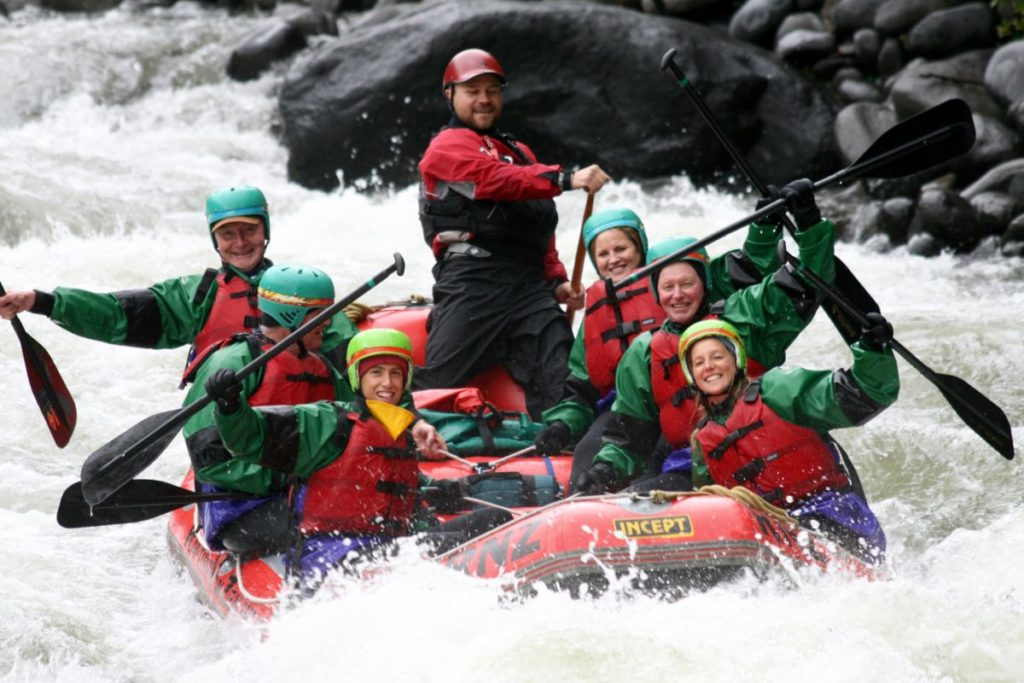
(Image above was taken August 2007 with Taupo MP Louise Upston in the back right and TRM Laundry Assistant back left on a special trip sponsored and organised by RNZ to show her what this region has to offer and where the Tongariro River bike trail was going to extend to. Now, 11 years later, Turangi is still waiting on Taupo Council…)
Raft the Tongariro River for Easter?
Now you know who to choose!. RNZ
If you are looking for something special for Easter or a family outing or an iconic back country river trip or just to see what some Kiwis are providing to boost tourism in this region, you cannot do better. It takes about 4 hours base to base to float down 14 km with over 50 rapids. Anglers trips are a speciality – the only way to access the upper Tongariro River is by raft – but only with RNZ (Rafting New Zealand – Phone 0800 865 226) OK?
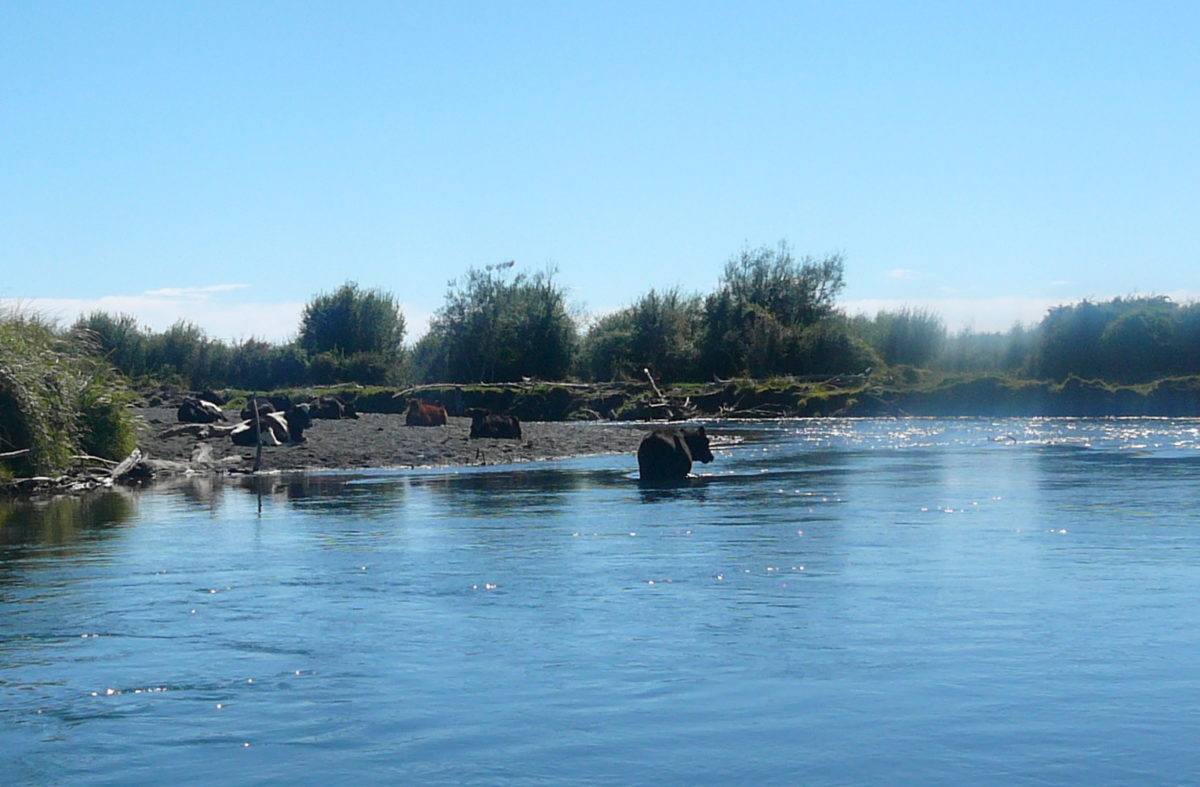
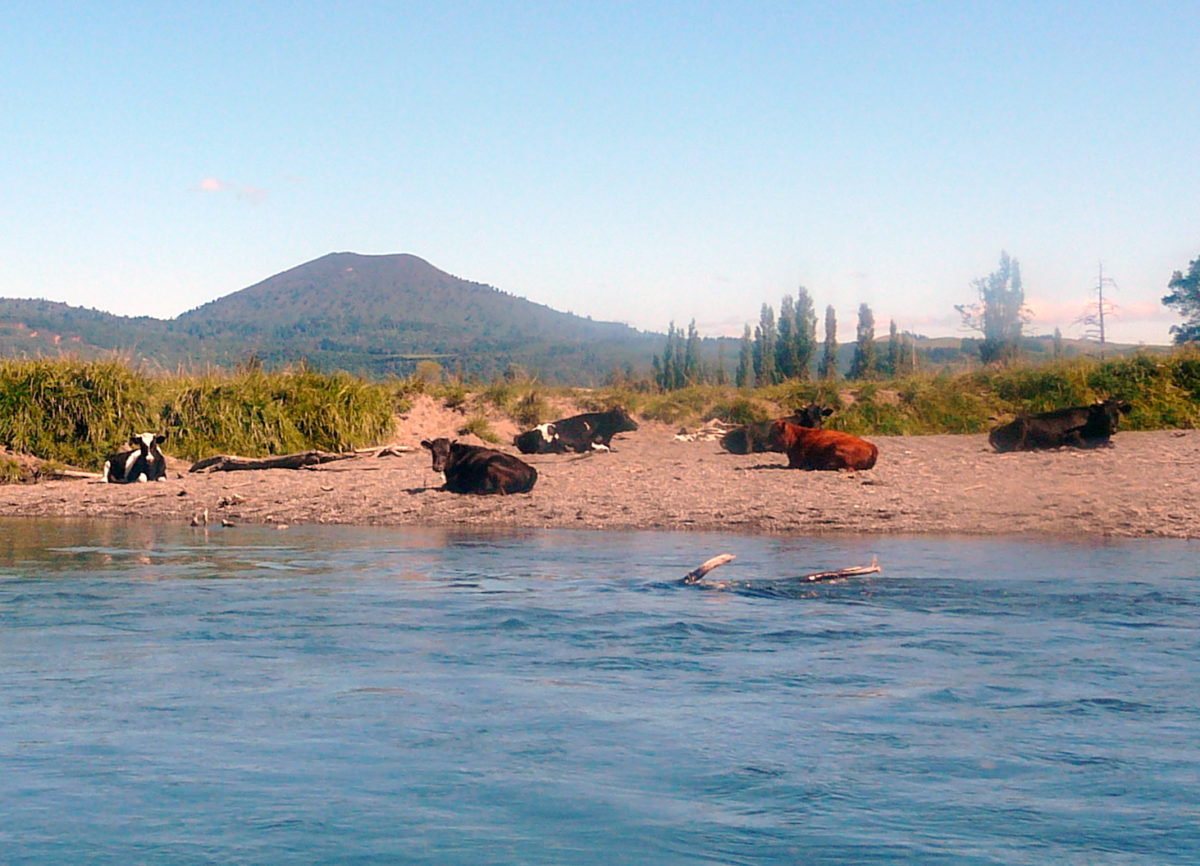
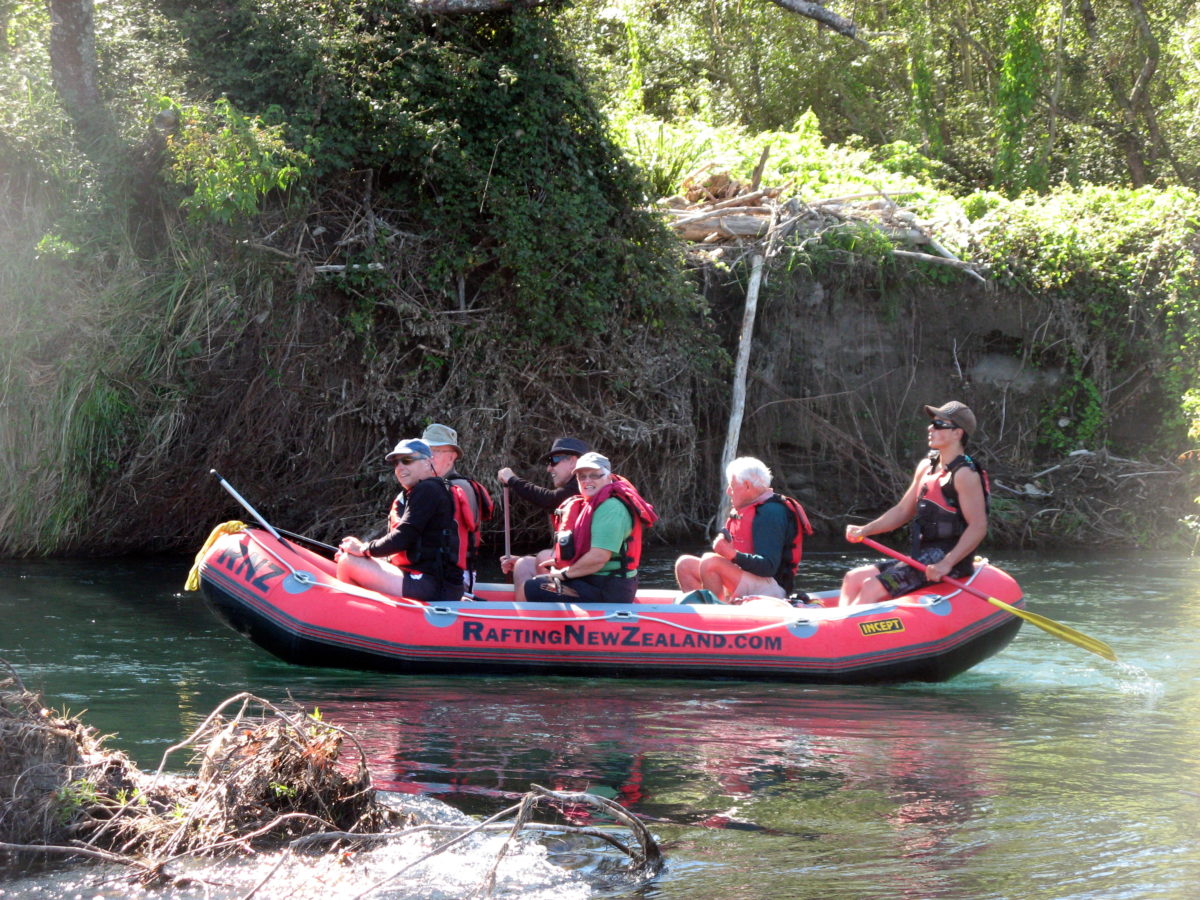 (Other images on right of another raft trip down the lower Tongariro River in March 2011 sponsored by RNZ was the committee from The Tongariro Advocates inspecting erosion and flood damage. The images below of cattle grazing and crapping in the river was taken from the raft – that is what Councils should be concerned about!)
Now we hear you asking – why is TRM Daily (Fishing?) Report suddenly morphed into an advertorial for this wonderful RNZ company? Consider the following – received at 5 pm yesterday from Taupo Council:
Quality signs will nip down tomorrow and cover the directional signage – I am in Auckland tomorrow but will be taking to NZTA Thursday re signage.
John Ridd
Head of Economic Development and Business Transformation
Taupo District Council
 So that could be the end of the signs saga. The bullies from Taupo Council compliance department are going to force their way to prove they really are bloody minded twits. This is not my opinion, but the clear unambiguous message from every email and many phone messages and face-book comments received during the last week.
Thank you to everyone. They all support RNZ in what they have tried to do to help the Turangi community. The messages vary in intensity and bitterness but the common theme is that the Compliance Department bullying tactics over RNZ’s sign are an absolute disgrace to local Government. This should not be allowed to happen anywhere in NZ. Their weak defence hiding behind the NZTA guidelines for signs is pure BS. They are just persecuting TRM and RNZ on a vindictive personal crusade. It is an abuse of their responsibilities and they should be fired. They are absolute pricks.
Unfortunately I cannot give my own opinion as the censors would ban it.
 So this report today is a promo for all TRM readers and Turangi visitors to make sure you support only RNZ (Rafting New Zealand in the red rafts) for any river rafting trips planned in the future on the Tongariro or elsewhere. They deserve so much credit and support for trying to welcome tourists and all they get back is aggro from a very bitter and twisted Taupo Council Compliance Department who appear to have a different objective, determined to stop any such initiatives and restrict any tourist promotion in Turangi. Since this signs dispute was aired on Radio NZ and made headlines in local papers we have heard from so many others who have suffered similar unacceptable unreasonable difficulties trying to deal with the Kremlin – the Taupo Council Compliance Department nazis. They are a disgrace to this beautiful region.
There – now I feel better.
9am Update:
Spot the difference:
Before:

After:
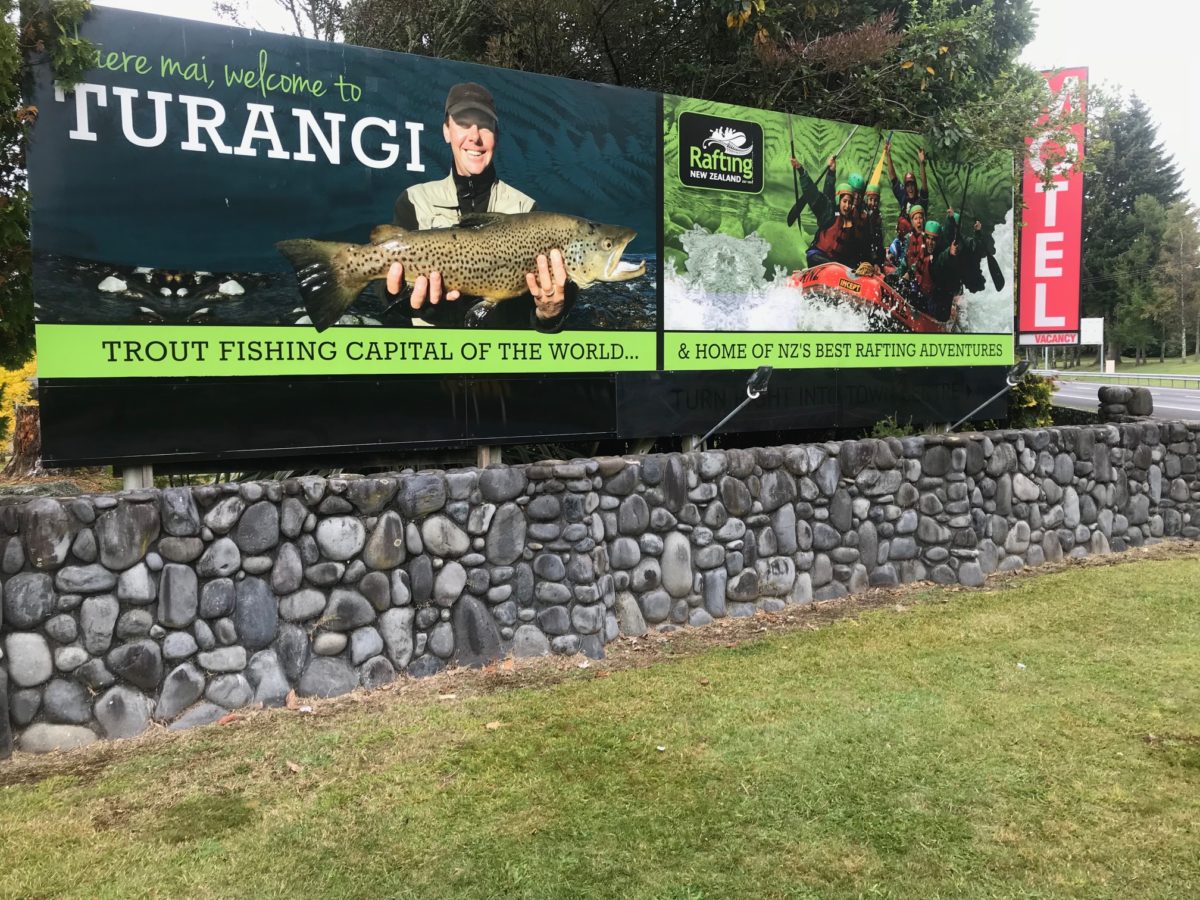
Now TRM are seeking inspiration from readers – what to replace the “TURN LEFT” & “TURN RIGHT” tourist promotion signage with? All contributions will be carefully considered.
Back to fishing… Thank you to Herb for following report. (Images on right from TRM library)
Night Fishing For River Browns
Herb Spannagl
 During the debate about restoring the early rainbow runs in the Tongariro brown trout have been identified as major competitors at spawning sites and as a potent predators of juvenile rainbows on their downstream journey towards the lake.
In the Target Taupo magazine a DOC scientist postulates that the 350 browns passing through the department’s Waipa Trap could eat as many as 4200- 12600 juvenile rainbows per day. This is a staggering loss only made worse when the impact of the brown trout that spawn in the non-monitored main stem, the Whitikau Rv. and the Mangamawhiti Stm. is factored into such a calculation.
 No one really knows if browns are increasing in the Tongariro but judging from what I have seen over the last 42 years of fishing this river I am convinced this species has always been grossly under harvested. There are obvious reasons for this low catch rate: As a species browns are more wary than rainbows and upstream nymphing is not as successful on browns as downstream lure fishing. However, the most overlooked reason is that large browns are voracious night hunters. In stark contrast to their daylight caution, in the dark they bounce on anything that moves, quite often getting hooked in water that is only ankle deep.
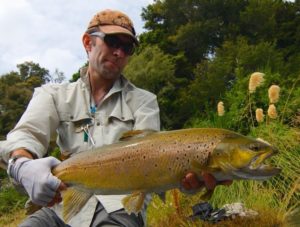 Despite the popularity of river mouth fishing, night fishing on the Tongariro is practically nonexistent, especially so during the winter. Yet I recall some great river fishing after sunset for both browns and rainbows. In the seventies my American friend Rudy Ferris, his mate and I frequently wet lined the TRB of the Hydro pool below the mouth of the Mangamawhitiwhiti Stm., which is an important spawning stream for browns. Standing on the bank that has since been eroded we had to take turns as there was only one small gap in the bank side vegetation for a back cast. While one of us fished the other two sipped from a flagon of Sherry, ostensibly to keep the freezing cold at bay.
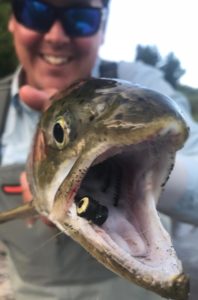 Over the winter months we hooked many big browns on large Hairy Dog flies and 20lbs leaders. From memory the biggest clocked in at 18lbs. At that time I was in charge of the then Pihanga Scenic Reserve and often fished the Red Hutt Pool after dark before returning to our home near the Chateau. I would usually arrive at the car park as the daytime regulars came off the river and clearly recall the well meant advice from some japara parka clad old timers: “Sony, you are a bit late going fishing”. I just carried on across the swing bridge and down to this great pool. It took about an hour to settle the water before I had the first tentative bite on the dark wet fly. Then fish came out steadily while my legs and fingers slowly turned into icicles. On numerous occasions I stumbled back to my Landrover barely able to hold onto 5 good rainbows in each hand. Rudy and I also night fished the lower river pools for brown and rainbows after the water was returned to the previously dug out riverbed.

One of the most memorable waters I caught huge browns in at night was the tiny Waimarino Stm. that flowed through the prison property at Erua. Apart from having to log in and out at the guard house a much bigger hassle was fighting my way through a dense flax swamp to reach the meanders of this slow moving stream. One night I broke 6inches off the tip of my beloved Hardy Itchen split cane rod when I hit a dried seed stalk with a back cast. It nearly broke my heart but my loss was eased when I hooked a14 pounder on the shortened rod that same night. In those days one or two prison officers only fished the easy water by the bridge, leaving large stretches virtually untouched that gave up a several monsters to my slowly swinging subsurface fly.
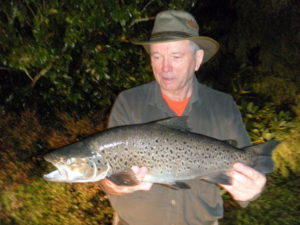 Even before I transferred as a ranger to Nelson Lakes National Park I had often fished the lakes and rivers of that region. One of my favourite activities was ambushing the cruising brown with tiny weighted nymphs on the mud flats at the head of Lake Rotoiti. After one such successful week staying at Coldwater hut I decided to return to Nelson via the Motueka Valley. I had been working with Norm Marsh junior who had asked me to say hallo to his father who lived on the Motueka River. The old man took a bit of tracking down but when I finally introduced myself he told me that he would have liked to come out for the evening rise but had to look after some guest from England. He suggested I fish “His Pool” just below the house I could get to through a kiwi fruit orchard. I drove as far as I could on the farm track and after a bit of a scramble through willows I broke out at a beautiful pool of slowly moving water. Its entire surface was dimpled with countless rise forms. This was indeed a sight for sore eyes and buoyed by my Rotoiti success I was confident of making a killing. Frustratingly quite the opposite ensured.
 For a start these fish were taking emergers and the only flies I had were small weighted nymphs, which they totally ignored. As darkness fell the rise and with it my confidence slowly petered out. I was just about to slink back to my car with my tail between my legs when I remembered that I had a small box of lures in the glove box. I hurried back to fetch them and by the time I returned to the river the rise had stopped and all was quiet on the glassy surface. By torchlight I tied on my smallest dark lure and sent the floating line out across the river. Slowly the current took out any slack and got me in touch with the swinging fly. Halfway through the backwater the line tightened and my rod throbbed under the load of a good brownie. More followed as the night wore on. By two in the morning I had pulled out 13 browns from this great pool.
 I felt a bit guilty doing that to Old Man Marsh but as self-control isn’t one of my strong character traits I just could not bring myself to stop fishing. On the way out the farmer, who had seen my headlights and thought I was a burglar, confronted me at the gate. Just before Norm Mash’s death I was lucky to be able to spend a couple hours with the great man. Amid canvassing the joys of fly-fishing I relieved myself of my sins from all those years ago. Norm assured me that he had not noticed any shortage of fish after my visit, which is not surprising as at that time the Mot had the highest concentration of trout of any of our rivers.
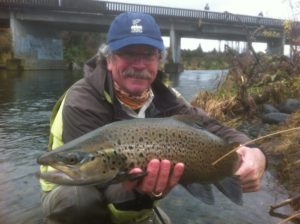 I could go on with my nocturnal tales but since the purpose of this article is to increase the brown trout harvest on the Tongariro I want to focus the rest of this discourse on a night fishing method that I am sure will catch more of these elusive fish. The first thing to be aware of is that under the cover of darkness browns have little hesitation to search for food in shallow water, including dead end backwaters. The second fact is that even on the darkest night a dark fly moving just under the surface is silhouetted against the night sky and is better visible than one on the bottom. And thirdly with the lower Tongariro pools full of snags a floating line collects far fewer than a sinker.
 Based on my experience this is how I would approach night fishing this river. In daylight I would scout out suitable pools and mark the best beats. I would choose a large dark fly with a lot of movements but not one that tail wraps easily. My preferred fishing method would be to swing the fly just under the surface all the way into the shallows. As this type of fishing is all about stealth I would avoid wading, flashing torchlight indiscriminately or thrashing the water. Above all I would fish alone and do so slowly and methodically.
 During the day one occasionally sees the big browns lying safely under the overhanging willows that fringe the lower pools. But that is not where they catch the 12-36 juvenile rainbows they are allegedly eating every twenty-four hours. They nail them in the slower water where the little fellows shelter at night. So if you hanker after a wall hanger brown and don’t mind being alone in the dark my advice is to stalk them down river with a big black wet fly after the sun has slipped beyond the horizon.