
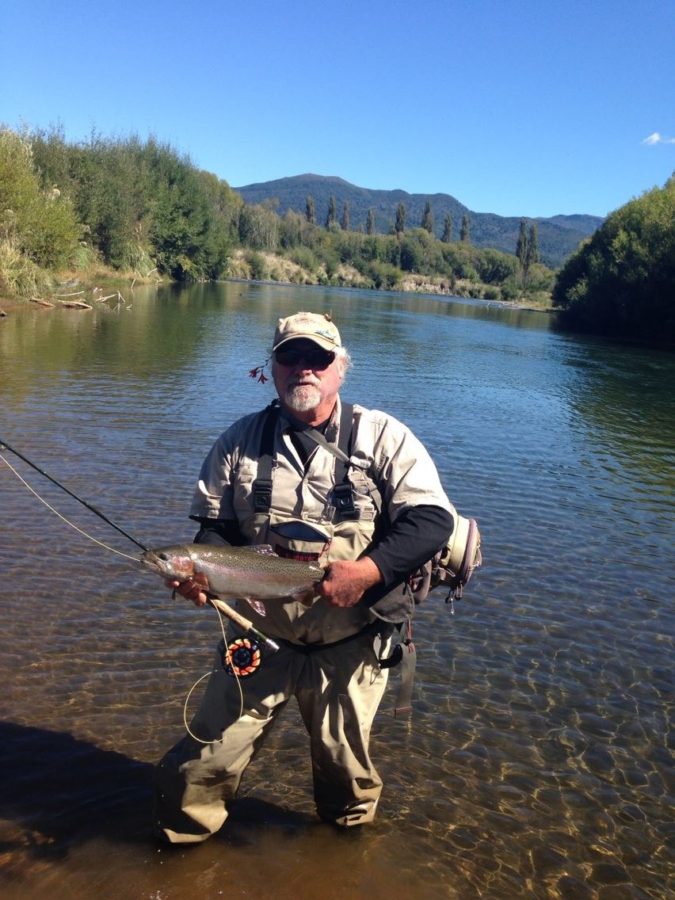
By Louiethefish DeNolfo:
 In my area of Lake Taupo, where I have been a trout guide and angler since 1980, I have seen a disturbing decline in the whole aquatic and terrestrial ecosystem that I can only attribute to the long term effects of 1080. I know for a fact that DOC and the government lie on many levels when faced with questions regarding 1080, and in many recent cases refuse to front up to concerned citizens groups.
Way back years ago, forestry workers I knew told me that they witnessed firsthand DOC employees, whose task was to count dead possums after a 1080 drop, and finding only a few dead animals, intentionally enter a figure into their records far greater than the actual count, a lie intending to make 1080 use more attractive.
 This was a regular occurence over decades to help the government justify increased 1080 usage, all based on Lies!
In the 90s we would invite DOC staff to speak at our Turangi Trout Unlimited club. When asked many times if 1080 killed birds, the answer was always no, a blatant lie !
The Taupo area when I arrived had huge hatches of green and brown beetles, cicadas and many other aquatic and terrestrial insects, which have declined to almost extinction now. The Delta area was swarming with baby native NZ frogs at times,now disappeared!
 Recent evidence by many anglers and long time lake users report a decline in many native species of galacsids, bullies and smelt! In fact after an “accidental ” drop of an entire helicopter load of 1080 pellets directly into Lake Taupo about 7 to 8 years ago, our area suffered a 5 year decline in trout size, which drew anglers and visitors away from Taupo, costing our area many millions in revenue, which in my opinion was a cost for which the government should have been accountable! Recent claims by many long time anglers and lake users report a decline in both the native Koura and mussels, which I view as indicator species warning us all of a big problem in our area!
We have been lied to from the get-go, and no one knows the long term effects of this poison not only only on our animal life but on human life as well. This is a travesty occurring in NZ on a daily basis and if the average Kiwi doesn’t wake up to this fact and protest, loudly , these bastards will pursue this agenda forever , because it provides the funding to pay for many DOC and government employees, most too afraid of losing their jobs to speak out.
 There are many cleaner and safer ways to control pests that could be used effectively , but as long as this cash cow is in the hands of our government, they will persist and deny and lie for decades to come!
Rise up and revolt!
Stop 1080
Louie’s rant was also posted on TRM facebook to encourage comment and received the following response from David:

David Mole-man Some of these anti-1080 comments are bordering on ridiculous Ross! I’m not here to argue the pros and cons of 1080. I’ll leave that for people who know more about it than myself and Louie the Fish (e.g. people who write peer reviewed papers in respected scientific publications).
I know you are fighting the good fight, and I usually enjoy reading your daily report. But please at least post articles that are unbiased, informative and have decent credible information, not an incredibly biased, unsubstantiated rant from a local with an agenda. (Apologies to Louie, I’m sure he’s a nice guy, and if he wants I’ll buy him a beer in the Turangi Tavern next time I’m up and debate all of this)
Regarding the first comment. First of all, I know a lot of DoC biodiversity, trapping, and pest control surveys are carried out by volunteers (e.g. locals who care about the environment) under the guidance of a local DoC ranger. So what he is saying that some random forestry workers started following around DoC staff (or volunteers) on a pest control survey and followed them around so closely that they could “firsthand” witness them enter incorrect results – really?? My guess is that the average forestry worked has very little understanding of survey methodologies, transects and data collection to be able to understand what the significance of any data collected by field staff anyway.
Or alternatively they may have heard field staff yelling out “no possums here mate, let’s just make up some numbers!” – very unlikely. And most obviously, this is a complete contradiction to the whole anti-1080 argument, that 1080 kills absolutely everything it comes in contact with, including “the disturbing decline of the whole aquatic and terrestrial ecosystem”. So it can destroy the whole aquatic ecosystem but not possums?
No more green and brown beetles, and no cicadas!!?? Where were he this summer?! Sorry don’t know much about frogs, but I’m sure my comments below will apply.
The third comment says that an accidental drop of 1080 in the lake 7 to 8 years ago is responsible for the decline of galaxids, bullies and smelt. Apologies, I don’t know the history of the accidental drop in the lake so correct me if what I write is wrong.
Firstly, DoC usually contracts out aerial 1080 drops to local helicopter contractors. So it is very unlikely this was a DoC mistake, but actually a mistake by “Bazza the helicopter pilot from down the road”. Ironically, this is probably the same “Bazza” who takes hunters and anglers up into the local hills.
Secondly, I’m not denying declining numbers of freshwater fauna, and reduction of trout size. I’m sure there is some research out there confirming this. The loss of freshwater fauna is probably attributed to a lot of things, and is probably extremely complex. Taupo is an extremely large lake, and I really doubt a single heli drop of 1080 would have such an adverse effect. I’d take a guess that climate change is a large driver in the declining numbers. The warmer winters are likely to prevent thermal mixing of the lake, meaning the lake stays more stratified during winter and prevents upwelling of zoo and phytoplankton into the shallows, which is what smelt and bullies need in order to eat.
As for reduction of trout size, I’d imagine this would be the result of a number of things too, including:
– Volcanic activity (ash clogging waterways)
– Hydro / energy production reducing river flows; silt aggredation causing poor conditions for freshwater invertebrates (e.g trout food)
– “Flood protection works” (your favourite topic) destroying large sections and spawning areas on the Tongariro River
– Excessive killing of mature and large trout (an argument for another day) reducing quality of the gene pool
– Limited food supply
Last I heard the trout size and condition was on the increase (even with all the recent 1080 drops and increased 1080 usage??), and from what I’ve read average trout size has fluctuated in the past, well before 1080 was introduced.
I’m not even going to bother on the last comments as they are complete hearsay.
Rise up and revolt!
Ban unsubstantiated and biased information!
Cheers
David (a proud owner of a lucky green TRM hat)
http://www.pce.parliament.nz/media/1294/evaluating-the-use-of-1080.pdf